Anti-Hindu hatred on display: Indian politician vilifies Hindu scripture, falsely portrays it as misogynistic
 Pune, Maharashtra, India
  21 August, 2026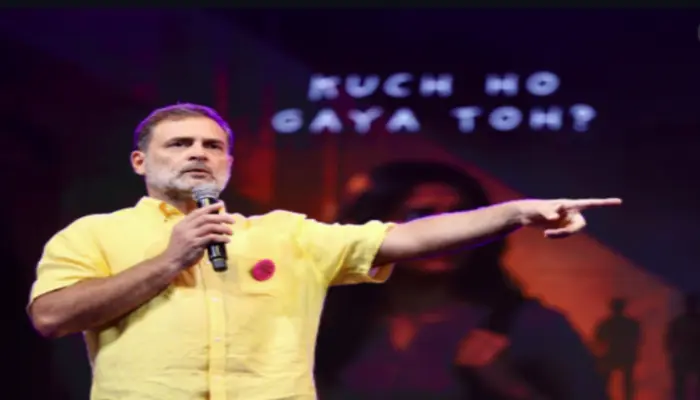
Case Summary
Congress leader Rahul Gandhi falsely vilified the Hindu scripture Manusmriti and attempted to portray it as misogynistic. The remarks were made during a students’ programme in Pune, Maharashtra, on 22 August 2026. Gandhi addressed young women and students at the ‘Chhatron Ki Goonj’ programme, organised as part of the Congress’s youth outreach initiative. The programme was centred on the theme ‘Break the Cage’, which encouraged young people, particularly women, to break free from social, cultural and traditional restrictions and assert their independence and individual identity. Gandhi said he had come to the programme not to lecture or discuss politics, but to allow young people to express their views and discuss their ideas. The programme was held on the grounds of a local college, where young women were present in large numbers. During his address, Gandhi deliberately misquoted a passage from the Manusmriti stating that a woman should be subject to her father during childhood, her husband during youth and her sons after her husband’s death, followed by the assertion that a woman must never be independent. He termed these words “a shame” and criticised the Manusmriti’s prescription that women should remain under the authority of male relatives at different stages of their lives. Gandhi asserted that women belonged to themselves and not to their fathers, husbands or sons. He said that women could have relationships with their fathers, brothers, husbands and sons, but did not belong to them. He urged women to stand for themselves, believe in themselves and “break the cage”. He also called on the girl students to “smash patriarchy”. Gandhi described women as India’s biggest asset and said that women were often confined to the identities of daughter, wife and mother despite their contributions as professionals, sportspersons and participants in various fields. He said these relationships should not define a woman’s entire identity and described women as more sensitive, compassionate and forward-looking than men. The derogatory remarks against Manusmriti drew criticism from Hindu organisations and political leaders. The Vishwa Hindu Parishad (VHP) national spokesperson Vinod Bansal said that Gandhi had selectively quoted a single shloka from the Manusmriti without understanding its context and accused him of placing Hindu society in the dock on the basis of a distorted interpretation. Bansal also stated that Gandhi was attempting to “poison” the minds of the country’s youth with what he described as an “impure mindset”. Bansal questioned whether Gandhi would show the same courage to publicly quote passages concerning women from the Quran, the Bible and other Abrahamic scriptures. He urged Gandhi to first read the entire Manusmriti and consult Hindu saints and commentators before passing judgment on Hindu society. He said that selective quotations and distorted meanings could lead to “tainted politics” and asserted that Gandhi’s attempt to turn the issue into a “Manusmriti versus Constitution” battle for political speeches was an injustice to both history and culture. Bansal further said that feminine power had always been an integral part of India’s civilisational identity. Uttar Pradesh Chief Minister Yogi Adityanath and Assam Chief Minister Himanta Biswa Sarma also condemned Gandhi’s remarks concerning the Manusmriti and Hindu traditions. Notably, this was not the first instance of Rahul Gandhi making anti-Hindu remarks. Hinduphobia Tracker has documented multiple instances in which Gandhi made contentious remarks concerning Hinduism and the Hindu community. For example, on 1 July 2024, while speaking in the Lok Sabha, Gandhi made remarks targeting Hindus, stating that those who call themselves Hindu “only talk about violence, hatred, untruth”. He essentially portrayed the Hindu community as hateful and violent. In another instance in Lima, Peru, Rahul Gandhi attempted to deliberately fracture Hindu unity and create divisions and intra-caste conflicts within the Hindu community by making contentious remarks about India’s education system and claiming that it was designed to benefit only upper-caste Hindus.
Why it is Hate Crime ?
This case has been added to the tracker under the primary category: Hate speech against Hindus. The subcategory selected is: Subversion of scriptures. Subverting the religious scriptures of Hindus has particularly devastating consequences. Subversion of the scriptures of Hindus is often done to justify or promote hatred, discrimination, or violence against specific individuals or groups of Hindus. Religious scriptures are often nuanced and those who harbour religious animosity towards Hindus often misquote or misrepresent the scripture to legitimise their animosity and hate towards the faith and its adherents. Any such misquoting of scriptures or subversion to justify hate, violence and discrimination against Hindus owing to religious animosity is hate speech and is categorised as such. The other sub-category selected is: Anti-Hindu subversion and prejudice. Hate speech is defined as any speech, gesture, conduct, writing, or display that is prejudicial against a specific individual and/or group of people, which is leading to or may lead to violence, prejudicial action or hate against that individual and/or group. Media plays a specific and overarching reach in perpetuating prejudicial attitudes towards a community owing to unfair, untrue coverage and/or misrepresentation/misinterpretation, selective coverage and/or omission of facts of/pertaining to issues affecting a specific religious group. This type of bias can dehumanise the victim group, making it easier for others to justify harmful actions against them, which aligns with the objectives of hate speech laws aimed at preventing such harm. It is often observed that the media takes a prejudicial stand against the Hindu community driven by their need to shield the aggressor community which happens to be a numeric minority, however, is the one perpetrating violence against Hindus. For example, the media is often quick to contextualise religiously motivated crimes against Hindus, omit or misrepresent facts that point towards religiously motivated hate crimes, justify and/or downplay religiously motivated hate crimes or simply present fake news to stereotype Hindus. Such media bias leads to the denial of persecution and is often used to dehumanise Hindus, leading to justification for violence against them. For example, the media covered several fake allegations of Hindus targeting Muslims and forcing them to chant Jai Shree Ram. Most of these cases were proved false and fabricated after police investigation. These fake news reports were subsequently never retracted or clarified. Such fake news led to the justification of violence and dehumanisation of Hindus based on the argument that since Hindus targeted Muslims and forced them to chant Jai Shree Ram, the dehumanisation of Hindus and violence against them was par for the course and merely a retaliation. Such media bias leads to prejudicial portrayal of Hindus and offers a justification for violence against them and therefore, is considered hate speech under this category. This case was a clear example of religiously driven hostility because Rahul Gandhi targeted a Hindu scripture, Manusmriti, and portrayed it as inherently misogynistic and anti-woman. His remarks sought to associate Hindu religious tradition and Hindu society with the subjugation of women, thereby creating a negative and distorted portrayal of Hinduism. Rahul Gandhi specifically targeted Manusmriti, a Hindu Dharmashastra, by referring to verse 5.148, which speaks of women being protected and cared for by the male members of their household at different stages of life. The verse refers to the protection provided by the father, husband and son, but Rahul Gandhi deliberately misrepresented its meaning by portraying it as a command that women should remain permanently subservient to men and live under the authority of their father, husband or son as inferior beings. By deliberately interpreting the verse in this manner, he attempted to portray Manusmriti as a misogynistic text and Hindu society as inherently patriarchal and anti-woman. Such a deliberate and malicious subversion of a Hindu text demonstrates hostility towards Hindu religious tradition and reinforces negative stereotypes about Hindus and their faith. By presenting a Hindu scripture in a distorted manner to falsely associate Hinduism with the oppression and degradation of women, Rahul Gandhi sought to malign the Hindu community and its religious beliefs, thereby showcasing anti-Hindu prejudice towards the faith and its sacred texts. The remarks further reflected anti-Hindu prejudice by presenting Hindu religious tradition through an exclusively negative lens and suggesting that Hindu society is fundamentally oppressive towards women. When such a portrayal is advanced by a prominent political leader before a large public audience, it reinforces existing prejudices and encourages people to view Hindus and their religious traditions as misogynistic, backward and anti-woman. Selectively highlighting one prescription while presenting it as the defining character of an entire religious tradition amounts to a distorted representation of Hinduism and contributes to the vilification of its followers. In this context, Gandhi’s remarks demonstrated hostility towards Hindu religious beliefs by portraying a Hindu scripture and, by extension, Hindu society in an inherently negative light. His malicious intent is further demonstrated by his selective invocation of Manusmriti, as he chose to highlight a verse that he portrayed as misogynistic while ignoring passages within the same text that explicitly honour women. For instance, Manusmriti 3.56 states, “Where women are honoured, there the gods rejoice; where they are not honoured, all rites are fruitless.”** The verse explicitly places the honouring of women among the conditions for divine presence and the fulfilment of religious rites. By selectively highlighting one passage while disregarding such verses that affirm the honour and dignity of women, Gandhi presented an incomplete and distorted picture of Manusmriti and Hindu tradition. This selective portrayal further demonstrates his deliberate attempt to depict Hinduism as inherently misogynistic and patriarchal, rather than engaging with the text in its broader context, and thereby reinforces the anti-Hindu prejudice conveyed through his remarks. His anti-Hindu prejudice is further displayed in his call to “smash patriarchy”, particularly because he selectively associates patriarchy and misogyny with Hindu religious tradition and Hindu scriptures while failing to apply the same scrutiny to the religious texts and traditions of other faiths. Patriarchy and misogyny are issues that exist across societies and communities, including among Hindus, Christians, Sikhs and followers of other faiths, and cannot reasonably be presented as an inherent characteristic of Hinduism alone. The fact that Gandhi specifically targeted Manusmriti and used it to portray Hindu society as patriarchal and anti-woman, while not subjecting the Quran, Bible or other scriptures of other faiths to similar scrutiny, demonstrates a selective and discriminatory approach towards Hinduism. Such selective targeting reinforces negative stereotypes about Hindus and their faith and reflects deep-seated religious hostility towards Hinduism, particularly when a prominent political leader uses his public platform to portray Hindu religious traditions as uniquely oppressive while overlooking comparable issues in other religious traditions. This act of targeting Manusmriti is not limited to Rahul Gandhi alone. Anti-Hindu elements like Islamo-leftists often weaponise the Manusmriti to portray Hinduism as regressive, casteist, or anti-women, but this argument collapses under even basic scrutiny. Hinduism is not a religion centred around one book, prophet, or fixed law. The Manusmriti is not the Hindu equivalent of the Bible or Quran; it is one among many Dharmashastras written for specific times and circumstances. Texts like the Yajnavalkya Smriti, Narada Smriti, and Parashara Smriti often contradict Manusmriti, showing that Hindu thought was never rigid or dogmatic but pluralistic and adaptable. To hold Hindus accountable for verses in Manusmriti is deeply unfair and reflects a bias against Hinduism itself. No other faith is judged by selectively quoting its ancient or contextual texts, yet Hinduism alone is targeted in this way. Expecting modern Hindus to answer for verses written thousands of years ago, in an entirely different era, is utterly irrational. Will Muslims be comfortable if they are held responsible for obscure hadiths, or Christians if they are blamed for verses in the Old Testament? Furthermore, no modern Hindu derives their moral or spiritual life from Manusmriti. Hindu rituals, festivals, and everyday ethics are guided by the Bhagavad Gita, Upanishads, Ramayana, and the living tradition, texts that emphasise duty, equality, and the divinity of all beings. In essence, the Manusmriti is a historical and religious text, but it does not define or govern Hindu life today. To use it as a weapon to vilify Hindus is intellectually dishonest and driven by prejudice rather than scholarship. It is a distortion that ignores both the pluralism of Hindu thought and the fact that Hindu society long ago moved beyond any literal reading of such ancient codes. Overall, this analysis demonstrates that Rahul Gandhi’s remarks were rooted in anti-Hindu hostility and prejudice. Therefore, the incident is being added to the Hinduphobia Tracker’s hate crime database.


Case Status
Unknown


Perpetrators Details
Perpetrators
Others
Perpetrators Range
One Person
Perpetrators Gender
male
 Sources




