Hindus targeted for forced Christian conversion under guise of 'healing' meetings in Prayagraj, Uttar Pradesh
 Prayagraj (Allahabad), Uttar Pradesh, India
  22 August, 2026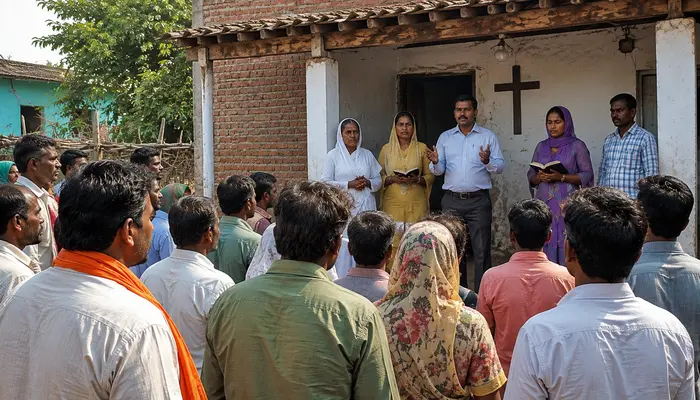
Case Summary
In the Bhawanipur hamlet of Kathouli village in Meja, Prayagraj, Uttar Pradesh, Hindus were targeted for forced Christian conversion under the guise of a ‘healing meeting’, also known as 'Changai Sabha'. According to media reports, the information about the religious conversion activity was received at around 12 noon on 23 August 2026, following which members and office-bearers of the Vishva Hindu Parishad (VHP), Bajrang Dal and Durga Vahini reached Bhawanipur. Hundreds of workers and office-bearers from these organisations subsequently gathered at the location. According to a complaint submitted by the VHP and Bajrang Dal at the police outpost, the ‘healing meeting’ was being organised at the house of Subedar, son of the late Agam Lal, with the purpose of converting Hindus to Christianity. When members of the Hindu organisations reached the house, preparations for the meeting were underway. The complaint named Rekha Devi, wife of the late Agam Lal; Sadhana, daughter of the late Agam Lal; Subedar, son of the late Agam Lal; Chanda Devi, wife of Alagu Maurya; and Ranno Devi, wife of Harishchandra Maurya, as being present at the location. Chanda Devi and Ranno Devi were residents of Rajapur Bharatganj, which fell under the jurisdiction of Manda Police Station. According to the VHP and Bajrang Dal, a large number of people had gathered for the meeting. However, they left the location after learning that members of the Hindu organisations had arrived. Shoes and slippers were found at the spot after the gathering dispersed. The organisations further stated that similar activities aimed at religious conversion had been taking place at the location for several years. They sought a thorough investigation into the matter and demanded strict action against the perpetrators. Meanwhile, Hariom Singh, the in-charge of the Meja Road police outpost, reached the location with a police team after receiving information about the incident. The police took the five individuals present at the location, Rekha Devi, Sadhana, Subedar, Chanda Devi and Ranno Devi, to the police outpost for questioning and brought the situation under control. Following the incident, a tense atmosphere prevailed in the village. The VHP and Bajrang Dal submitted a complaint seeking a detailed investigation into the matter and strict legal action against the perpetrators. The complaint was submitted by VHP district president Nityanand Upadhyay, district vice-president Shiv Dutt Mishra, Ramakant Pandey, Ravi Tiwari, Manoj Singh, Shubham Dubey, Adarsh Dubey, Ram Singh and Adarsh Vishwakarma alias Chhotu, along with hundreds of other office-bearers and workers of the organisations. The police subsequently began investigating the matter. Notably, the Hinduphobia Tracker contacted the police regarding the incident and was informed that the five individuals present at the location were involved in efforts to convert Hindus to Christianity. The police further stated that all five individuals had themselves converted to Christianity and that the matter involved efforts to facilitate forced religious conversion.
Why it is Hate Crime ?
The primary category selected in this case is: Predatory Proselytisation. Under this, the subcategory selected is: Conversion/attempts to convert through inducements. Predatory Proselytisation is not just limited to threat, harassment, force and violence, but it also has contours of stealth. In several cases, the Hindu victim is exploited to convert, with non-Hindus taking advantage of their poverty. In such cases, the Hindu victim who is suffering financially is offered monetary benefits, including lucrative offers for jobs, health treatment, education, etc, to induce the victim into changing his/her religion. In such cases, the religious identity of the victim and the aim to disenfranchise him from his faith form the heart of the crime. Also, taking advantage of and exploiting an individual’s economic vulnerabilities is widely acknowledged as exploitation, forms of which are often penalised by law. Such cases therefore are considered religiously motivated hate crimes since the victim’s religious identity forms the very heart of the crime itself. The other subcategory selected is: Proselytisation by grooming, brainwashing, manipulation or subtle indoctrination. The tertiary category selected is: Pattern of targeting Hindus. Religious brainwashing essentially means the often subtle and forcible indoctrination to induce someone to give up their religious beliefs to accept contrasting regimented ideas. Religious grooming or brainwashing also involves propaganda and manipulation. It involves the systematic effort, driven by religious malice and indoctrination, to persuade “non-believers’ to accept allegiance, command, or doctrine to and of a contrasting faith. Cases of such grooming or brainwashing are far more nuanced than direct threats, coercion, inducement and violence. In such cases, it is often seen that there is repeated, subtle and continual manipulation of the victim to induce disaffection towards their own faith and acceptance of the contrasting faith of the perpetrator. While subtle indoctrination is widely acknowledged as predatory, an element which is often understated in such conversions or the attempts of such conversion is the role of loyalty and trust which might develop between the perpetrator and the victim. Fiduciary relationships are often abused to affect such religious conversion. For example, an educator transmitting religious doctrine of a competing faith to a Hindu student. The Hindu student is likely to accept what the teacher is transmitting owing to existence of the fiduciary relationship. The exploitation of the fiduciary relationship to religiously indoctrinate victims would also be included in this category. Since the underlying animosity towards the victim’s faith forms the basis of predatory proselytization, such cases are considered religiously motivated hate crimes. This case is a clear example of a religiously motivated hate crime because Hindus were targeted for conversion to Christianity under the guise of ‘healing meetings’ in Prayagraj. The most significant religious marker in this case is the manner in which Hindus were lured towards conversion to Christianity under the pretext of attending supposed ‘healing meetings’ or Changai Sabhas. Such meetings portray Christian prayer, beliefs and religious practices as possessing the ability to cure physical ailments, resolve personal and family problems, and provide spiritual, mental and physical healing. In this case, these promises were used to attract Hindu individuals towards Christian religious gatherings and expose them to conversion activities. The promise of healing therefore acted as an inducement, as the victims were presented with the prospect of relief from their suffering and problems in exchange for engaging with Christian religious practices and ultimately converting to Christianity. At the same time, the promise also functioned as a tool of manipulation because the vulnerabilities and difficulties faced by Hindu individuals were used to influence their religious choices. Thus, the so-called healing meetings were not merely religious gatherings but served as a mechanism through which vulnerable Hindus were drawn into conversion activities and pressured towards abandoning their Hindu faith. The conversions in this case were forced because they were not based on the free and independent religious conviction of the Hindu victims but were driven by inducement, persuasion and manipulation. The perpetrators presented Christianity, conversion and participation in Christian prayer meetings as a means of curing ailments and overcoming personal difficulties, thereby creating an expectation that the victims could obtain relief from their problems through adopting Christian beliefs and practices. This exploited the circumstances of Hindus who were facing physical, emotional, financial or other personal difficulties and made their vulnerabilities a means of influencing them to change their religion. By using promises of healing to persuade vulnerable individuals to abandon Hinduism, the perpetrators manipulated the victims' circumstances for the purpose of religious conversion. This clearly showcases religious hostility towards the Hindu victims because their Hindu identity was specifically targeted, and efforts were made to induce them to relinquish that identity and adopt Christianity. Furthermore, the fact that similar conversion activities had been taking place at the same location for several years demonstrates that this was not an isolated incident but part of a sustained and organised pattern of targeting Hindus for conversion to Christianity. The prolonged nature of these activities indicates an effort to reach and influence a larger number of Hindus over time through the systematic use of so-called healing meetings. By repeatedly using such gatherings to draw Hindus into conversion activities, the perpetrators sought to change their religious identity and convert them to Christianity. This sustained pattern of targeting Hindus over several years clearly showcases religious hostility towards the Hindu community and an organised effort to convert larger numbers of Hindus, potentially altering the religious demographics of the area. Such instances of forced proselytisation are manifestations of doctrinal hostility embedded within Abrahamic religions like Christianity that regard non-adherents as inferior and encourage their conversion. This leads to the dehumanisation of those who do not share the faith and creates an environment in which coercive conversions take place. Therefore, this case is being added to the hate crime database of the Hinduphobia Tracker.


Case Status
Complaint filed


Perpetrators Details
Perpetrators
Christian Extremists
Perpetrators Range
From 5 to 10
Perpetrators Gender
both
 Sources




