Anti-Hindu hate on display; Muslim man invokes Quran to justify beheading of Hindus
 Delhi, India
  21 August, 2026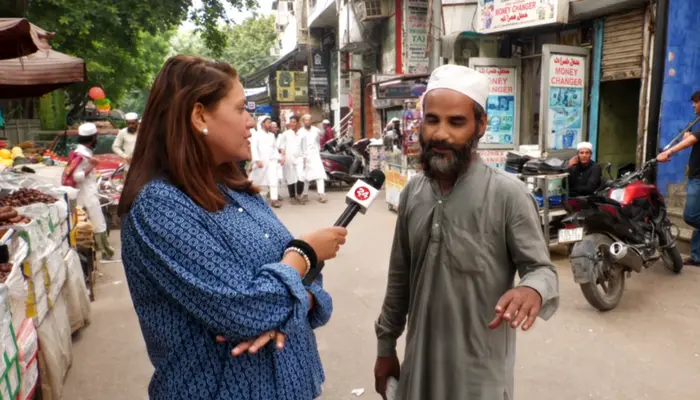
Case Summary
In Nizamuddin, New Delhi, an anti-Hindu provocative statement was made by a Muslim man, who justified the beheading of Hindus by invoking the Quran. The incident came to light after a video went viral on social media of the Muslim man making inflammatory remarks against the Hindu community. A tweet regarding this was posted on X (formerly Twitter) by Sakal Hindu Samaj, a Maharashtra-based Hindu organisation on 22 August 2026. In the video, the Muslim man was seen making objectionable statements during an interaction with a local female reporter. He then continued, “dusra naam le to gardan kaat do” (“If someone takes another name, cut their neck”), making the remark in the context of his rejection of the worship or invocation of more than one deity. He further stated that the Quran said “dono mana hai” (“both are forbidden/not allowed”), explaining that there was only one God and that invoking or worshipping another deity was therefore not permitted. He linked this religious argument to his earlier statement about cutting the necks of Hindus, thereby presenting violence against Hindus as a consequence of what he described as the prohibition against believing in or invoking more than one God. He then continued, “dusra naam le to gardan kaat do” (“If someone takes another name, cut their neck”), before invoking the Quran to justify his position. He further stated that the Quran said “dono mana hai” (“both are forbidden/not allowed”), explaining that there was only one God, and linked this belief to his earlier statement about cutting the necks of Hindus.
Why it is Hate Crime ?
This case has been added to the tracker under the primary category of - Hate speech against Hindus. Within it. the sub-category selected is - Violent threats. Violent threats, explicit, implicit or implied, is the most dangerous form of hate speech since it goes beyond discriminatory and prejudicial language to express the intent of causing harm to an individual or a group of people based on their religious identity and faith. There could be several different kinds of threats that are issued to Hindus based on religious animosity. An explicit threat would mean the direct threat of violence towards an individual Hindu, a group of Hindus or Hindus at large. Physical violence, death threats, threats of destruction of property belonging to Hindus and threats of genocide would mean explicit threats against Hindus for their religious identity. Implicit threats may not be a direct threat but implied through the use of symbols of actions – for example – in the Nupur Sharma case, other than explicit threats, there were also implicit threats when Islamists took to the streets to burn and beat her effigies. It implies that they want to do the same to Nupur Sharma – thereby is considered an implicit threat. Violent threats can be delivered in person, through letters, phone calls, graffiti, or increasingly through social media and other online platforms. It would be important to understand that a threat – explicit or implicit, online or offline – to an individual who happens to be a Hindu does not qualify as a religiously motivated threat. Such a threat, while vile and dangerous, could be owing to non-religious reasons and/or personal animosity. To qualify as a religiously motivated threat, it would need to exhibit an indication that the individual is being targeted for religious reasons and/or owing to his/her religious identity as a Hindu. This incident qualified as a religiously motivated hate crime because the statement was explicitly directed at Hindus on the basis of their religious identity and presented violence against them as justified by Islamic religious teachings. The Muslim man did not make a generic or indiscriminate threat of violence. He specifically referred to Hindus and stated that Islam taught that the “necks of Hindus” should be cut, making Hindu religious identity the defining basis of the violent statement. The reference to Hindus was therefore not incidental to his remarks but central to the hostility he expressed. The religious motive was further established by the manner in which he sought to substantiate and justify the violent statement. The remarks specifically targeted a core feature of Hindu religious belief: the worship or veneration of multiple deities. His explanation that there could be only one God, as per the Quran, was used to distinguish Islamic monotheism from the religious practices and theological traditions he attributed to Hindus. By invoking the Quran and attributing the teaching to Allah, he placed the justification for violence within an explicitly religious framework. This demonstrated that the hostility was directed towards Hindus because of their religious beliefs and practices, rather than towards individuals for an unrelated personal or social reason. The statement consequently cast a fundamental aspect of Hindu religious identity as something that could warrant violent treatment. Thus, by framing violence against Hindus as a consequence of a religious injunction, he transformed the remarks from a general expression of hostility into an explicitly religion-based justification for violence. The remarks also specifically targeted a core element of Hindu religious identity: the Hindu understanding of the divine. The man connected his justification for violence to the rejection of belief in more than one god, thereby treating a fundamental theological distinction between Islam and Hinduism as a basis for hostility. Hinduism encompasses diverse traditions and forms of worship, including devotion to multiple deities, manifestations of the divine and different theological understandings of God. The remarks also specifically targeted a core element of Hindu religious identity: the Hindu understanding of the divine. The man connected his justification for violence to the rejection of belief in more than one god, thereby treating a fundamental theological distinction between Islam and Hinduism as a basis for hostility. Hinduism encompasses diverse traditions and forms of worship, including devotion to multiple deities, manifestations of the divine and different theological understandings of God. Consequently, the statement did not merely criticise or reject a religious belief; it associated that religious difference with violent treatment of the people who held the Hindu faith. A further significant aspect of the remarks was the nature of the violent language used. Although the Muslim man did not use the specific phrase “Sar Tan Se Juda”, his repeated reference to cutting the “gardan” (neck) of Hindus conveyed a strikingly similar form of beheading rhetoric and carried the same essential message of lethal religious intimidation. The expression “Sar Tan Se Juda”, commonly translated as “beheading” or “severing the head from the body”, has become associated in public discourse with threats and calls for violent punishment in the context of alleged blasphemy against Islamic religious figures. The man's statement similarly invoked the cutting of a person's neck as a form of violent punishment, but, significantly, directed it specifically at Hindus on account of the religious distinction he was discussing. The absence of the precise “Sar Tan Se Juda” slogan therefore did not remove the significance of the beheading threat. What mattered was the substance and context of the language: Hindus were explicitly identified for their faith followed by a call for lethal violence involving the cutting of the necks, and the violence was presented as justified through religious doctrine. The remarks consequently reflected the same underlying intimidation associated with beheading rhetoric, namely the use of religiously charged threats of lethal violence to assert dominance over members of another faith and to signal the consequences of religious non-conformity. This aspect was particularly significant because the threat was not made in response to any alleged act of blasphemy or insult against Islam. The Hindu community was not accused of committing a specific offence against the speaker or against an Islamic religious figure. Instead, the Muslim man connected the proposed violence to the very fact of Hindu religious belief and to the perceived distinction between belief in one God and the invocation or worship of another deity. The reference to cutting the neck therefore functioned as a form of religious intimidation directed at Hindus because of their faith, rather than as a response to any specific conduct by an individual. The use of the slogan “Sar Tan Se Juda” or similar beheading threats in particular constitutes an explicit and religiously motivated threat directed at the Hindu victim. “Gustakh-e-Rasool ki ek hi saza, sar tan se juda, sar tan se juda”, which translates to “There is only one punishment for disrespecting the Prophet Muhammad, beheading”, is an Islamist clarion call, that has become a staple feature of violent protests that have so far claimed the lives of at least 6 Hindus, including Kanhaiya Lal in Udaipur and Umesh Kolhe in Amravati, after Muslim fundamentalists, egged on by the dog-whistling of Alt News co-founder Mohammed Zubair against former BJP spokesperson Nupur Sharma, resorted to violence for what they perceived as ‘blasphemy’ against Prophet Muhammad. From Kanpur in India’s northern plains to the southern metropolis of Bengaluru, from Kolkata in the east to Hyderabad in the south, protests in the name of blasphemy have erupted in almost every corner of the country as Islamists took to the streets running amok and shouting “Sar Tan Se Juda” chants over the perceived belief of blasphemy against their Prophet. Though a radical Muslim outfit in Pakistan coined this slogan, it has gained popularity among Islamists in regions beyond its geographical origins. Over the years, we have seen large crowds of Islamists chanting the “Sar Tan Se Juda” slogan, which is nothing but a direct incitement to violence against Hindus, leading to murders committed in the name of blasphemy. The radicalised outcry is not merely a statement of disapproval; it is a call for the execution of an individual through beheading, based on their religious identity. When this slogan is raised, it sends a clear and terrifying message not just to the individual targeted but also to anyone else who might share similar views or dare to express them. This tactic of intimidation aims to silence dissent and suppress freedom of expression, particularly in religious discourse. It aims to instil fear in the broader community. Islamists use this tactic to settle personal scores with non-Muslims, particularly Hindus, by levelling fabricated charges of blasphemy against them, which causes outrage and paints a target on them. The underlying hatred and animosity toward non-Muslims, especially Hindus, drive these false blasphemy accusations as a means to subjugate and victimise them. The fact that the slogan was still used in this context indicates that such rhetoric is not necessarily limited to situations of alleged religious offence, but is also deployed as a broader instrument of intimidation and coercion targeting Hindus. Its use in this case demonstrates that the underlying purpose of the slogan, in such instances, extends beyond its stated justification and functions as a means of exerting fear and asserting dominance over Hindu community members. This pattern, as reflected in the present case, points towards its use as a tool to target individuals based on their faith identity, thereby reinforcing religious hostility rather than responding to any actual religious transgression. Such statements are made by Muslim individuals due to indoctrination by Islamic theology, which advocates that all non-Muslims (referred to as kafirs) are inferior and subject to subjugation unless they convert to Islam or live under Islamic rule (dhimmitude). These ideas are not mere abstractions; they manifest in actions where non-Muslims, especially Hindus in India, are seen as targets for religious domination, coercion, or humiliation. This theological framework fosters an "us versus them" mindset, in which any assertion of Hindu identity or religious freedom is seen not only as undesirable but as a threat to Islamic supremacy. As a result, individuals who are shaped by such teachings feel justified, even morally obligated, to harass, suppress, or violently attack Hindus. Thus, in this case, the Muslim man's statements were rooted in broader ideological hostility towards Hindus as non-believers. The incident was therefore hate-based because it combined three distinct elements: a clearly identified religious target, an explicit reference to violence against that religious group, and religious justification for that violence. The statement identified Hindus as the people whose “necks” should be cut, linked this violence to their religious belief in multiple deities, and invoked the Quran and Allah to legitimise the position. These elements established that the hostility was directed at Hindus as Hindus and that their religious identity was central to the expression of violence, making the incident a clear instance of anti-Hindu religious hate speech and incitement to violence.


Case Status
Unknown


Perpetrators Details
Perpetrators
Muslim Extremists
Perpetrators Range
One Person
Perpetrators Gender
male
 Sources




