Hindu religious gathering disrupted; Muharram procession participants brandish weapons, hurl abuses and obstruct temple prayers in Berhampore, West Bengal
 Berhampore, West Bengal, India
  3 August, 2026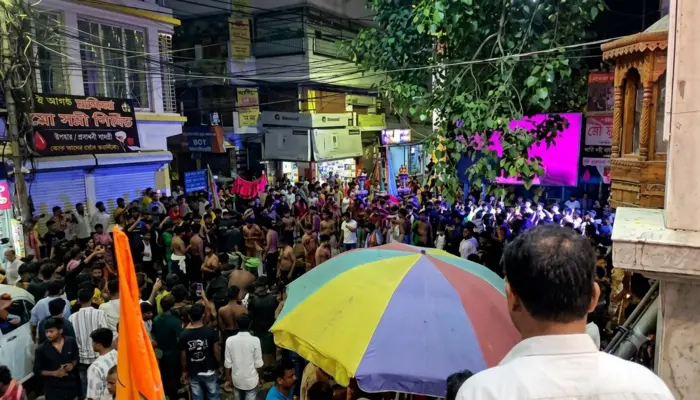
Case Summary
In Berhampore, near Mohan Mall in Murshidabad, West Bengal, a Hindu religious gathering at a Hanuman Temple was disrupted by Muslim participants in a Muharram procession. The disruption occurred while devotees were conducting Hanuman Aarti and reciting the Hanuman Chalisa, creating a tense atmosphere around the Hindu place of worship. The incident took place on 4 August 2026, when a Muharram procession, part of the 40th-day Muharram observance, was passing near the Hanuman Temple while Hindu devotees were conducting the Hanuman Aarti. During the procession, Muslim participants disrupted the Hanuman Aarti and Hanuman Chalisa recital by brandishing weapons in a threatening manner near the temple. They also used abusive and provocative language, deliberately played loud music and engaged in self-flagellation near the temple premises. Local Hindus described their conduct as an attempt to incite communal tension and disrupt the Hindu religious activities taking place at the temple. The Muslim participants attempted to interfere with the ongoing Hanuman Aarti, the recitation of the Hanuman Chalisa and the distribution of prasad. Their actions created a communally charged atmosphere around the temple and raised concerns about the situation escalating into wider communal violence. Smt. Piku Lahiri Chatterjee, a woman office-bearer of Bharat Raksha Manch, objected to the disruption. Following the incident, she and other members of Bharat Raksha Manch approached the local police station and lodged a formal complaint. Timely police intervention prevented the situation from escalating into a communal riot and helped avert the attempt to trigger large-scale communal violence in the area. According to available reports, 28 Muslim individuals connected with the incident were detained by the police. The report did not provide the individual names of the 28 detained persons. At the time of writing this report, the police investigation into the incident was ongoing.
Why it is Hate Crime ?
The primary category selected in this case is: Attack on Hindu religious representation. Within this, the subcategory selected is: Defiling religious customs. Sanatan Dharma is not a religion of one book, which is to say that while it has religious scriptures that form the central tenets of the faith, there are several traditions followed through thousands of years, mostly passed from generation to generation orally. There are several such customs and traditions that are followed by various Hindus and Hindu sects. Defiling of these traditions and customs is a breach of an individual or group’s religious practices. Such practices can range from dietary restrictions like not eating non-vegetarian food for a certain period of the year, not eating non-vegetarian food at all, not eating beef since the cow is considered holy in Hinduism, the sanctity of religious customs followed in the house (like many ISCKON devotees), etc. Any malicious action leading to the breach of such traditions or defilement of these traditions owing to animosity towards the faith or for the sake of activism stems not only from the lack of faith in the religion itself but also from disregard for the faith of the devotees who follow the customs/traditions and implicit bias against the faith, the tradition itself. Since these specific traditions are central to the faith of the devotees of that specific sect of Hindus, any non-compliance with these traditional rules would be considered a religiously motivated hate crime. This incident was a clear example of a religiously motivated hate crime, as Muslim participants in a Muharram procession deliberately attempted to disrupt the Hanuman Chalisa recital and Hanuman Aarti at a temple in West Bengal. During the Hindu religious observance, the Muslim participants violently brandished weapons in a threatening manner near the temple, hurled abusive and provocative remarks, deliberately played loud music and engaged in conduct that interfered with the ongoing Hindu worship. The fact that these actions were directed at Hindu devotees and took place during a revered Hindu religious observance demonstrated a deep-seated religious motivation and an act of religious domination intended to intimidate Hindus and disrupt the exercise of their faith. For Hindus, a temple is far more than a physical structure; it is regarded as the sacred abode of the presiding deity and as a spiritually charged space where devotees worship, offer prayers, perform puja, participate in aarti and seek divine blessings. Hindu temples are consecrated spaces whose sanctity is maintained through established religious rituals, customs and traditions. The devotees therefore expect to be able to perform their religious practices within a temple without intimidation, obstruction or deliberate interference. Any conduct that intentionally disrupts worship or threatens devotees within such a space strikes directly at the sanctity of the temple and the religious sentiments of the Hindu community. The Hanuman Chalisa is a deeply revered Hindu devotional prayer dedicated to Lord Hanuman and is traditionally recited as an expression of devotion, faith and spiritual surrender. Its recitation forms an important part of Hindu devotional practice and is commonly performed at Hanuman temples, either individually or collectively by devotees. Hanuman Aarti is likewise an important Hindu worship ritual in which devotees offer reverence to Lord Hanuman through prayer, devotional singing and the waving of a lit lamp before the deity. These practices are not merely ordinary activities taking place in a public space; they form an integral part of Hindu religious worship and devotion. The deliberate interference with the Hanuman Chalisa recital and Hanuman Aarti therefore constituted a direct disruption of an ongoing Hindu religious observance. The significance of the perpetrators' conduct lay in the fact that it interfered with Hindus in the exercise of their religion, rather than merely causing a general public disturbance. A Muslim religious procession passing near a Hindu place of worship, by itself, did not constitute a hate crime. The religious dimension arose from the conduct directed specifically towards Hindu devotees and the circumstances in which it occurred. The devotees were engaged in recognisable Hindu acts of worship when they were subjected to abuse, intimidation and deliberate disruption. The conduct therefore targeted Hindus not simply as members of the public, but as worshippers engaged in the practice of their faith, demonstrating religious animosity towards their religious identity and practices. This distinction was central to the classification of the incident. The interference occurred because Hindus were engaged in a Hindu religious activity, rather than as the result of an unrelated dispute in a public space. The threatening behaviour and brandishing of weapons created an atmosphere of fear and intimidation around the temple, placing pressure on Hindu devotees while they exercised their faith. Such conduct did not merely inconvenience or disturb those present; it sought to undermine their ability to carry out their religious observance peacefully. In this context, the intimidation also reflected an attempt to impose religious dominance over Hindus by disrupting and intimidating them during worship at their own place of worship. The circumstances also clearly distinguished religious hostility from an ordinary disagreement between individuals or competing groups. There was no necessity for participants in a Muharram procession passing near the temple to verbally abuse Hindu devotees, behave provocatively, brandish weapons in a threatening manner or interfere with their worship. Even if the procession followed a pre-existing route that brought it near the temple, mere proximity could not explain conduct specifically directed towards Hindu worshippers. The relevant issue was therefore not why the procession was present near the temple, but why Hindu devotees were subjected to intimidation, abuse and disruption while carrying out their sacred religious observance. The absence of any apparent necessity for such conduct, combined with its occurrence specifically in the presence of Hindu worshippers engaged in Hindu rituals, demonstrated that the religious character of the gathering was a significant factor behind the hostility. The incident therefore could not be reduced to ordinary friction arising from the presence of two religious gatherings in the same locality. It demonstrated religious intolerance and animosity towards Hindus and sought, through intimidation, threatening behaviour and deliberate disruption, to interfere with their ability to worship peacefully. The threatening display of weapons near a Hindu temple further reinforced the element of religious domination, as it created an atmosphere in which Hindu devotees were made to feel vulnerable while practising their faith at their own sacred place of worship. This deliberate and religiously targeted interference elevated the incident beyond a routine law-and-order disturbance and established it as a clear case of a religiously motivated hate crime. Given that this case meets the parameters of a religiously driven crime, it is being added to the Hate Crime database of the Hinduphobia Tracker.


Case Status
Arrested


Perpetrators Details
Perpetrators
Muslim Extremists
Perpetrators Range
From 10 to 100
Perpetrators Gender
unknown
 Sources




