Hindu girl blackmailed and pressured to convert to Islam and undergo nikah by Muslim man; accused targeted multiple Hindu girls using fake Hindu identity
 Aligarh, Uttar Pradesh, India
  21 August, 2025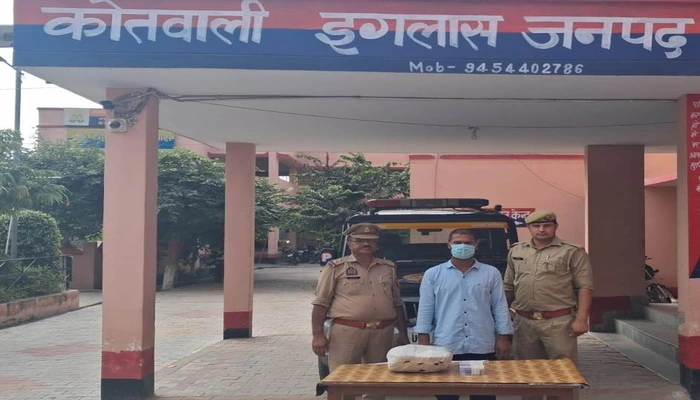
Case Summary
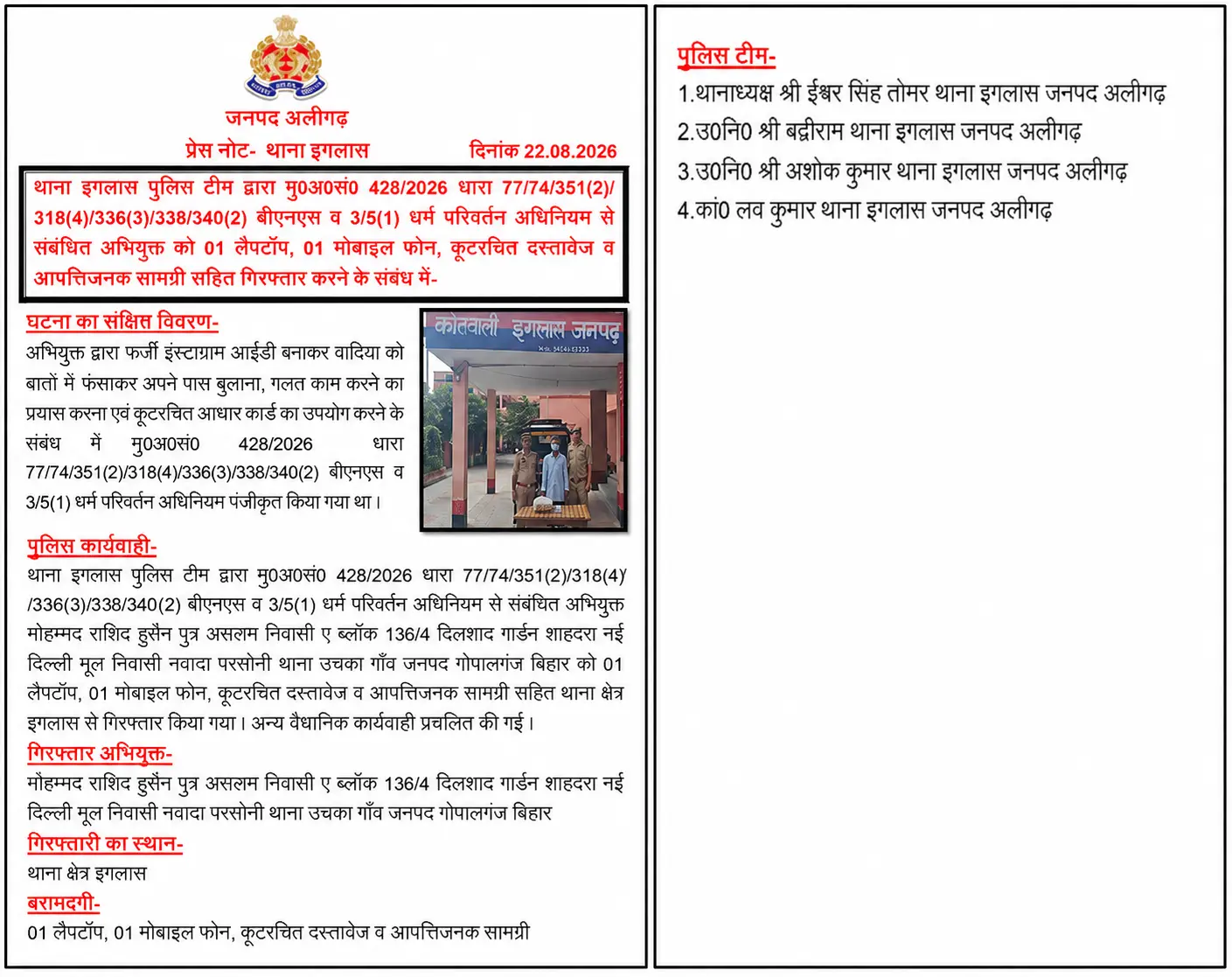
In the Iglas area of Aligarh, Uttar Pradesh, a 19-year-old Hindu girl was lured into a relationship, blackmailed and pressured to convert to Islam and undergo nikah by a Muslim man named Mohammad Rashid Hussain. The accused posed as a Hindu man named “Sonu Chaudhary” on Instagram to befriend the girl and two other Hindu girls. According to police, Mohammad Rashid Hussain, a resident of Nawada Parsoni in Gopalganj district, Bihar, had created the fake Instagram profile around August 2025. Using the fake Hindu identity, he befriended the girl, who originally belonged to a village in Mathura district and was staying at her maternal grandparents’ house in the Iglas area while pursuing her studies. He remained in contact with her for approximately one year and also regularly communicated with two other Hindu girls through the same account. During his interactions with the girl, he gave her gifts, including a mobile phone and a watch, and obtained some of her photographs and identity documents. In June 2026, Rashid met the girl in person in Aligarh and took photographs with her. She subsequently discovered that the person she had known as “Sonu Chaudhary” was actually Mohammad Rashid Hussain. After learning his true identity, she attempted to distance herself from him and end their contact. Following this, Rashid pressured the girl to convert to Islam and undergo nikah with him. When she refused, he threatened to publish their photographs on social media. He also used details from her genuine identity document to create a forged Aadhaar card in the name of “Sana Khan”, using her original Aadhaar number. The use of her photographs and identity details was subsequently examined as part of the police investigation. The girl informed her family about the matter, following which a complaint was submitted to the police. An FIR was registered at Iglas Police Station on August 21, 2026, under Case Serial No. 428/2026, invoking Sections 77, 74, 351(2), 318(4), 336(3), 338 and 340(2) of the Bharatiya Nyaya Sanhita (BNS), along with Sections 3/5(1) of the Uttar Pradesh Prohibition of Unlawful Conversion of Religion Act. On August 22, 2026, police conducted an operation to apprehend Rashid. The girl contacted him and arranged a meeting as part of the operation. When he arrived near Tochigarh Bridge in the Iglas police station area, a police team arrested him. During the arrest and subsequent investigation, police recovered a laptop, mobile phone, forged identity document and other materials. Following these recoveries, additional legal sections were added to the case. Rashid was subsequently produced before the court for judicial proceedings. During the investigation, police also identified an unnamed associate connected to the case and initiated efforts to apprehend him. Police were also examining Rashid’s mobile phone, social-media accounts and contacts to determine whether other women had been approached using the same fake identity.
Case Images
Why it is Hate Crime ?
The incident has been added to the tracker under the primary category: Crimes against women in relationships and other sexual crimes. Within this, the first subcategory selected is: Man pretends to be Hindu, and the tertiary category is: Name changed and pattern of targeting Hindu women. When a non-Hindu man pretends to be a Hindu to deceive a Hindu woman into a relationship, the act is seen as triggered by malafide intentions. In some cases, the woman eventually accepts the man’s original religious identity and converts after the man’s identity is revealed. These cases could be argued as cases of religious brainwashing and a result of the pressure a woman feels after getting into a relationship with a man. The woman, it can be argued, also changed her religious identity because of the stigma she believes she might face if she chooses to walk out of a deceptive relationship. However, for the purpose of documenting hate crimes, the cases in this subcategory are limited to those where there is explicit violence aimed at religious conversion against the wishes of the victim (force-feeding beef, blackmailing with intimate videos, rape on refusal to convert, etc), or if the woman herself complains of the man’s religious deception. In such cases, it is established that the deception of the non-Hindu man had a specific aim of religious conversion or targeting of the victim due to her Hindu religious identity, therefore making it a religiously motivated hate crime. The second subcategory selected is: Forced conversion before marriage. The tertiary category selected is: Forced to do Nikah In such cases, a non-Hindu man is in a relationship with a Hindu woman when the pressure to convert her religion begins to manifest. In such cases, typically, two patterns emerge. First, when the relationship is consensual and the religious identity of the perpetrator is known to the Hindu woman in the relationship, at some point during the relationship, the non-Hindu man starts to force the victim to convert her religion and give up her Hindu religious identity. The second is when the woman gets into a marriage with the man pretending to share her faith. Later, when the truth is revealed, the man starts pressuring the woman to convert her religion and give up her religious identity. In both situations, the methods used to force the victim to convert her religion often revolve around force-feeding beef, forcing her to wear hijab, forcing her to read the Kalma or even pressuring the victim to do ‘Nikah’, which is marriage under Islamic law, with a prerequisite being conversion to Islam. Cases where a Hindu woman consensually converts to Islam in a relationship will be left out of the hate crime database, even though it could be argued in several cases that the conversion was a result of religious brainwashing. The third subcategory selected is: Blackmailed to convert. When Hindu women are in a relationship with non-Hindu men, there are cases where the woman is blackmailed to convert her religion, owing to her religious identity of being a Hindu. Such relationships may be consensual, with the religious identity of the non-Hindu man known to the victim; however, there could be cases where the relationship is not consensual, and the non-Hindu man starts blackmailing a Hindu woman to convert her religion. In these cases, it is often seen that the Hindu woman is blackmailed with intimate photos and/or videos, threats of harm to her or her family, threats of violence, etc. Such cases are driven by specific religious motivations and against the religious identity of the victim and are therefore qualified as hate crimes. When Hindu women are in a relationship with non-Hindu men, there are cases where the woman is blackmailed to convert her religion, owing to her religious identity of being a Hindu. Such relationships may be consensual, with the religious identity of the non-Hindu man known to the victim; however, there could be cases where the relationship is not consensual, and the non-Hindu man starts blackmailing a Hindu woman to convert her religion. In these cases, it is often seen that the Hindu woman is blackmailed with intimate photos and/or videos, threats of harm to her or her family, threats of violence, etc. Such cases are driven by specific religious motivations and against the religious identity of the victim and are therefore qualified as hate crimes. The fourth subcategory selected is: Assault or threat upon refusal to convert. When Hindu women are in a relationship with non-Hindu men, there are cases where the woman faces threats or assault after she refuses to convert and change her religious identity owing to pressure/force by the non-Hindu man. Such relationships may be consensual, with the religious identity of the non-Hindu man known to the victim. Somewhere along the relationship, the non-Hindu man starts pressuring the Hindu woman to convert to Islam and, upon her refusal, assaults or threatens the victim. Such cases are driven by specific religious motivations and against the religious identity of the victim and are therefore qualified as hate crimes. Cases where the Hindu woman converts to Islam and does not file a complaint about the force or threat are not considered part of the hate tracker, even though it may be argued that the woman was brainwashed or threatened to convert to Islam. The religious motive of the crime is evident from the fact that the accused initially concealed his true identity and befriended the Hindu victim under a false name on social media. This act of deception was not incidental but a deliberate attempt to gain her trust by presenting himself in a manner that would not raise suspicion. By hiding his real identity, the accused was able to establish a relationship under false pretences, which indicates a calculated effort to manipulate the victim while bypassing the natural social and religious boundaries that may have otherwise existed. Further, the manner in which the victim was drawn into the relationship through a fake Instagram identity and concealment of the accused’s true identity, followed by pressure for religious conversion and marriage, reflected a pattern of deception, emotional manipulation and coercion. The accused used the pseudonymous identity “Sonu Chaudhary” to establish contact with the victim, gained her trust through prolonged communication and gifts, and later used her photographs and personal identification details to exert pressure over her. This became significant as it indicated that, after the victim discovered his actual identity and attempted to sever contact, the use of blackmail, threats to publish her photographs, pressure to convert and marry, and the creation of a forged identity document were used to influence and control her decisions and circumstances. Another important marker was the condition imposed for marriage, wherein the victim was pressured to undergo religious conversion before marrying the accused. The demand was accompanied by threats to publish her photographs on social media if she refused. This indicated that continuation of the proposed relationship and marriage were made contingent upon the abandonment of her existing faith. The pressure for conversion, coupled with blackmail and threats, therefore became a significant aspect of the case, indicating that conversion was not merely incidental to the relationship but was presented as a condition for marriage. The continued conduct after the victim attempted to sever contact further demonstrated an escalating pattern of control, particularly through the misuse of her personal identification details to create a forged document in the name of “Sana Khan.” The preparation and use of such a document, following the earlier interactions, indicated that the accused’s conduct extended beyond the relationship itself and involved the manipulation of the victim’s identity and personal records. This subsequent act, along with the recovery of the forged document and electronic devices during the police operation, became significant to the investigation and suggested that the wrongdoing had continued even after the victim sought to distance herself. At the same time, the accused was also communicating with two other Hindu girls through the same “Sonu Chaudhary” profile. The use of the same false Hindu identity to establish contact with multiple Hindu girls indicated a broader pattern of targeting Hindu women through the concealment of his actual identity. This pattern was significant because it showed that the deceptive Hindu persona was not limited to his interaction with the victim, but was also used to approach and gain the trust of other Hindu women. Taken together, the accused’s use of a false Hindu identity to approach the victim, followed by pressure to convert to Islam and marry him, blackmail when she resisted, and the subsequent manipulation of her identity documents, demonstrated a sustained pattern of religiously targeted deception and coercion. The sequence of conduct showed that the victim’s Hindu identity was central to the circumstances of the offence, making the case a clear instance of religiously motivated targeting of a Hindu woman. Disclaimer: The incident was reported by the media on 22nd August 2026. The Hinduphobia Tracker, however, records incident dates based on when the victim’s ordeal began, rather than when it was reported. In this case, the available information indicates that the sequence of events began in August 2025, when the accused created a fake Instagram account using a pseudonymous identity and first contacted the victim. However, as no specific day is mentioned in the reports, the date has been standardised to the day on which the case was reported, i.e., the 22nd, while the month and year have been kept as August 2025 to maintain consistency in documentation while accurately reflecting the timeline of the incident.
Victim Details
Total Victim
3
Deceased
0
Gender
- Male 0
- Female 3
- Third Gender 0
- Unknown 0
Caste
- SC/ST 0
- OBC 0
- General 0
- Unknown 3
Age Group
- Minor 1
- Adult 0
- Senior Citizen 0
- Unknown 2


Case Status
Arrested


Perpetrators Details
Perpetrators
Muslim Extremists
Perpetrators Range
One Person
Perpetrators Gender
male
 Sources




