Hindu businessman shot dead inside his shop in Balochistan, Pakistan amid persistent persecution of Hindus
 Balochistan, Pakistan
  20 August, 2026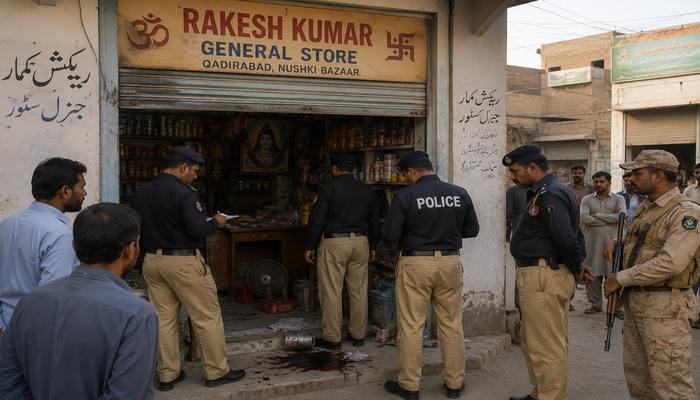
Case Summary
In the Qadirabad area of Nushki Bazaar in Balochistan, Pakistan, a young Hindu businessman, Rakesh Kumar, was shot dead inside his shop by unidentified gunmen. According to police reports, on 21 August 2026, armed men entered his shop and opened fire after Kumar confronted them over an issue. He sustained gunshot wounds and died at the scene. The attackers fled following the shooting, while police later arrived and shifted his body to the district hospital. A case was registered against unidentified assailants, but the motive for the murder remained unclear, and no group had taken responsibility for the killing. The killing drew condemnation from Gurpal Singh, a member of the Khyber Pakhtunkhwa Provincial Assembly, who described it as a cowardly act and highlighted Kumar's identity as a member of Balochistan's Hindu community. Singh stated that the Hindu community had been an integral part of Balochistan for centuries and urged the provincial government and security agencies to identify and prosecute those responsible. The murder occurred amid heightened armed violence in Balochistan, where Baloch insurgent groups had carried out attacks against security forces, police posts, military convoys and infrastructure. However, the available reports did not establish that Kumar was targeted because of his Hindu identity, and the motive behind his killing remained undetermined. This case highlights the persecution faced by the Hindu minorities in Pakistan, marked by systemic discrimination, violence, and forced conversions. Hindu women, particularly young girls, are often abducted, forcibly converted to Islam, and married off to Muslim men with little to no legal recourse. Temples are frequently vandalised or destroyed, and Hindu communities are subjected to social and economic marginalisation. Blasphemy laws are disproportionately used against Hindus, leading to false accusations and severe punishments. Many Hindu families are forced to flee their homes due to religious intolerance, living in constant fear of attacks. This sustained persecution highlights the dire conditions for Hindus in Pakistan, where their religious identity makes them targets of oppression.
Why it is Hate Crime ?
This case has been added to the tracker under the primary category- Attack resulting in Death. The subcategory selected is- Attacked for Hindu identity. In several cases, Hindus are attacked merely for their Hindu identity without any perceived provocation. A classic example of this category of religiously motivated hate crime is a murder in 2016. 7 ISIS terrorists were convicted for shooting a school principal in Kanpur because they got ‘triggered’ seeing the Kalava on his wrist and tilak that he had put. In this, the Hindu victim had offered no provocation except for his Hindu religious identity. The motivation for the murder was purely religious, driven by religious supremacy. Such cases where Hindus are targeted merely for their religious identity would be documented as a hate crime. Under this category, cases where the attack led to the death of the Hindu victim/s would be documented. This case was assessed as a religiously motivated hate crime against a Hindu minority victim, as Rakesh Kumar, a young Hindu businessman, was shot dead inside his shop in Nushki, Balochistan, Pakistan, by armed assailants. The attack occurred in a country where Hindus constitute a vulnerable religious minority and have faced recurring violence, intimidation, forced conversions, abductions and attacks on their religious and economic presence. Kumar's killing therefore carried significance beyond an ordinary act of violence, particularly because he was a Hindu businessman operating openly within a Muslim-majority environment. The religious dimension of the case was reflected first in the identity of the victim and the manner in which his killing was carried out. Armed men entered Kumar's shop in the Qadirabad area of Nushki Bazaar and opened fire after he confronted them. He sustained multiple gunshot wounds and died at the scene, while the attackers fled without being identified. The attack took place at Kumar's place of business, where he was carrying out his livelihood as a Hindu member of the local commercial community. The use of armed violence inside his shop demonstrated that his public presence as a Hindu businessman did not provide protection from lethal targeting. While some may argue that the case details do not explicitly state a religious motive, the broader context of anti‑Hindu persecution in Pakistan remains relevant for classification. During periods of sustained violence against Hindus based on religious identity, the Hinduphobia Tracker applies a contextual presumption that attacks on Hindu victims are likely faith‑targeted, even when the immediate report does not record a specific religious marker. In such periods, the normalisation of religious hostility and the dehumanisation of minorities can contribute to crimes against them without perpetrators openly stating a motive. The killing also had a wider communal significance because of the vulnerability of Hindus in Balochistan. Hindu communities have historically maintained a longstanding presence in the province, while remaining a small minority within Pakistan's overwhelmingly Muslim population. This vulnerability makes attacks against Hindu civilians and traders particularly significant, as the killing of a member of the community can create fear extending beyond the immediate victim. The fact that Kumar was killed at his business premises, rather than in an isolated private setting, further heightened the potential intimidatory impact on other Hindu traders and members of the community. The broader pattern of targeted killings of Hindu minority businessmen and professionals in Muslim-majority regions is the third and most significant religious marker of this case. The killing of Rakesh Kumar in Balochistan did not occur in isolation. It is part of a documented and recurring pattern of targeted attacks on Hindu minority individuals who have chosen to remain and build their lives in Muslim-majority environments rather than flee. The most direct parallel is the killing of Makhan Lal Bindroo, a 68-year-old Kashmiri Pandit pharmacist who was shot dead at his pharmacy in Iqbal Park, Srinagar, Kashmir, in October 2021 by suspected Islamist terrorists. Bindroo was one of the few Kashmiri Pandits who had refused to leave the Kashmir Valley during the ethnic cleansing of Hindus in the 1990s, when Islamic terrorists had driven the overwhelming majority of the Hindu Pandit community out of the valley through systematic violence and terror. He had stayed, built his business across three generations, earned the trust of the entire community as a pharmacist of impeccable integrity, and was shot dead at his counter for precisely this reason. His daughter's response, that his spirit could not be killed even if his body was, captured the defiance of a Hindu minority community that has refused to be entirely erased from its homeland. This pattern is not confined to isolated incidents but reflects a wider precedent across Muslim-majority countries such as Pakistan and Bangladesh, where Hindu minorities have repeatedly faced targeted violence. In Sindh, cases of abduction and forced conversion of Hindu girls have been widely documented. In Bangladesh, recurring attacks on Hindu homes, temples, and businesses during periods of communal tension have followed a similar logic of targeting visibility and identity. These incidents, like the killing of Rakesh Kumar, are marked by selective victim identification, public execution or intimidation, and the intent to instil fear within the broader Hindu community. The consistency of this pattern across regions shows that such acts are not random but rooted in a larger framework of exclusion and hostility towards Hindu presence in Muslim-majority environments. The case therefore demonstrated how violence against a member of a vulnerable religious minority can have consequences extending beyond the individual victim. Rakesh Kumar was not merely a civilian caught in indiscriminate violence; he was a Hindu businessman whose killing occurred within his place of work and whose death prompted specific concern about the targeting of Hindu traders and civilians. The attack consequently contributed to an atmosphere of insecurity for the Hindu community in Balochistan, where members of the minority community were exposed to the threat of severe violence while maintaining their livelihoods and public presence. Since the case met the parameters adopted by the Hinduphobia Tracker for documenting religiously motivated violence against Hindus, the killing of Rakesh Kumar was added to the hate crime database. The classification was based on the religious identity of the victim, the circumstances of the attack, his status as a Hindu businessman, the wider vulnerability of the Hindu minority in Pakistan, and the communal significance attached to the killing by a minority representative. At the same time, the available reports did not establish the precise religious motive of the unidentified attackers, and no specific organisation had taken responsibility for the murder.
Victim Details
Total Victim
1
Deceased
1
Gender
- Male 1
- Female 0
- Third Gender 0
- Unknown 0
Caste
- SC/ST 0
- OBC 0
- General 0
- Unknown 1
Age Group
- Minor 0
- Adult 1
- Senior Citizen 0
- Unknown 0


Case Status
Complaint filed


Perpetrators Details
Perpetrators
Unknown
Perpetrators Range
Unknown
Perpetrators Gender
unknown
 Sources




