Tribal Hindu communities targeted for religious conversion by Christian missionary; ED action over foreign-funded proselytisation
 Jaipur, Rajasthan, India
  21 August, 2026
Case Summary
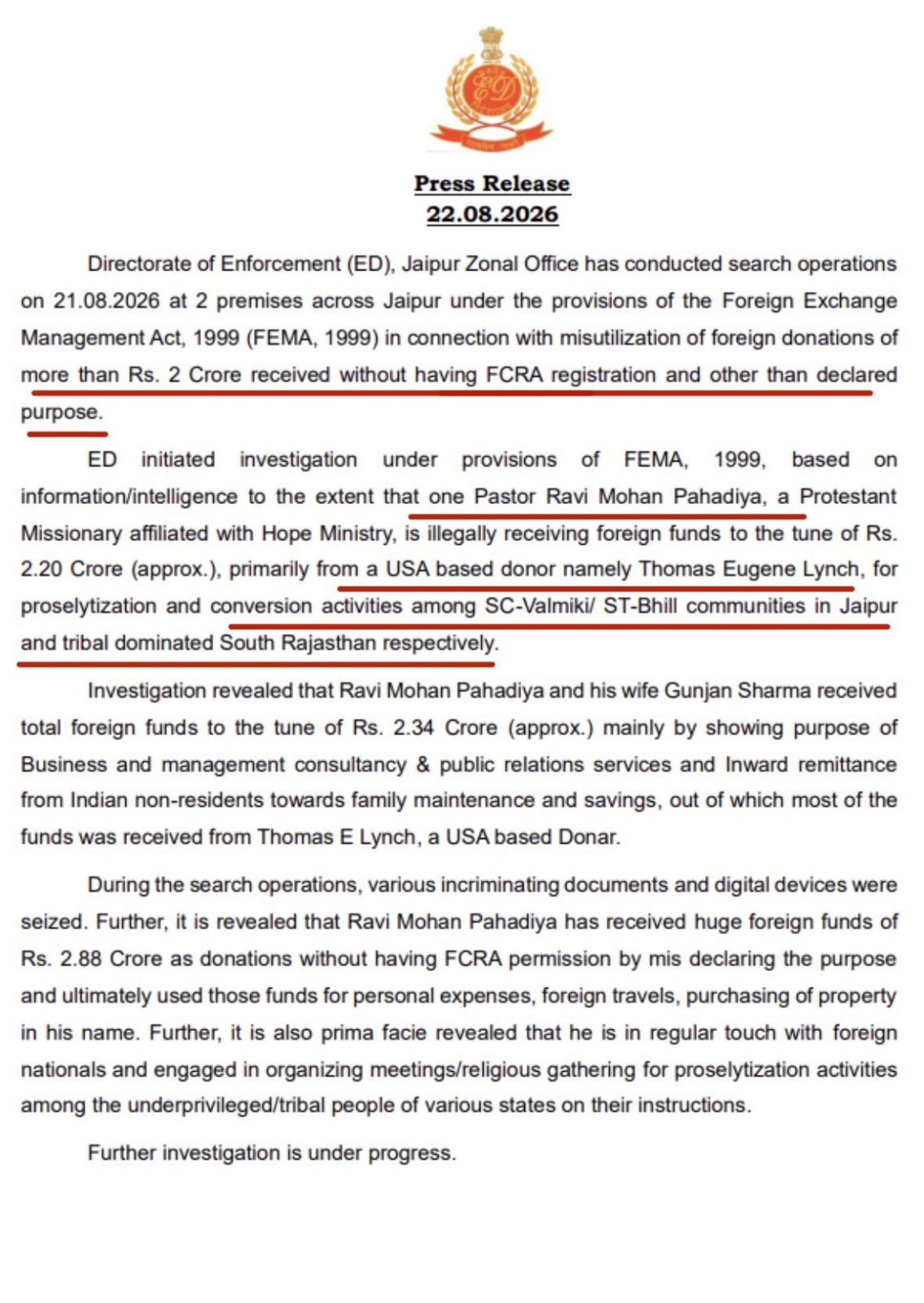
Tribal Hindu communities in Rajasthan were targeted for religious conversion by Christian missionary, Ravi Mohan Pahadiay, who was associated with a Christian missionary organisation. The incident came to light on 21 August 2026, when the Enforcement Directorate (ED) conducted searches at two premises in Jaipur belonging to Rajasthan-based Protestant missionary Ravi Mohan Pahadiya. The accused was associated with Hope Ministry, a Christian missionary organisation, in connection with a Foreign Exchange Management Act (FEMA) investigation into the receipt and use of foreign funds. The investigation found that Pahadiya and his wife, Gunjan Sharma, had received foreign funds worth approximately ₹2.34 crore, while the total foreign donations received by Pahadiya were estimated at around ₹2.88 crore without the required Foreign Contribution Regulation Act (FCRA) registration. According to the ED's investigation, Pahadiya had received more than ₹2 crore in foreign funds, primarily from US-based donor Thomas Eugene Lynch, for proselytisation and religious conversion activities. These proselytisation activities primarily targeted SC-Valmiki Hindu communities in Jaipur and ST-Bhil Hindu communities in tribal-dominated areas of southern Rajasthan. The funds received by Pahadiya and his wife had been declared under purposes including business and management consultancy, public relations services, and inward remittances from Indian non-residents for family maintenance and savings. The ED found that Pahadiya was in regular contact with foreign nationals and had been involved in organising meetings and religious gatherings for proselytisation among underprivileged and tribal communities in various states on their instructions. The investigation further found that the foreign funds had been used for personal expenses, foreign travel and the purchase of property. During the searches, ED officials seized documents and digital devices from the premises and examined financial records relating to the foreign remittances and their utilisation. The investigation remained focused on the source and use of the foreign funds, the religious conversion activities carried out through them, and the involvement of other individuals in the network.
Case Images
Why it is Hate Crime ?
The primary category selected for this case is: Predatory proselytisation. The first subcategory selected for this case is: Proselytisation by grooming, brainwashing, manipulation or subtle indoctrination. The tertiary category selected is: Pattern of targeting Hindus. Religious brainwashing essentially means the often subtle and forcible indoctrination to induce someone to give up their religious beliefs to accept contrasting regimented ideas. Religious grooming or brainwashing also involves propaganda and manipulation. It involves the systematic effort, driven by religious malice and indoctrination, to persuade “non-believers’ to accept allegiance, command, or doctrine to and of a contrasting faith. Cases of such grooming or brainwashing are far more nuanced than direct threats, coercion, inducement and violence. In such cases, it is often seen that there is repeated, subtle and continual manipulation of the victim to induce disaffection towards their own faith and acceptance of the contrasting faith of the perpetrator. While subtle indoctrination is widely acknowledged as predatory, an element which is often understated in such conversions or in the attempts at such conversion is the role of loyalty and trust which might develop between the perpetrator and the victim. Fiduciary relationships are often abused to affect such religious conversion. For example, an educator transmitting religious doctrine of a competing faith to a Hindu student. The Hindu student is likely to accept what the teacher is transmitting owing to the existence of the fiduciary relationship. The exploitation of the fiduciary relationship to religiously indoctrinate victims would also be included in this category. Since the underlying animosity towards the victim’s faith forms the basis of predatory proselytisation, such cases are considered religiously motivated hate crimes. This incident constituted a religiously motivated targeting of tribal Hindu communities because the central activity under investigation was not merely the receipt or misuse of foreign funds, but the use of those funds for proselytisation and religious conversion directed towards Hindu communities. The Enforcement Directorate's investigation specifically identified SC-Valmiki communities in Jaipur and ST-Bhil communities in tribal-dominated areas of southern Rajasthan as the communities targeted for proselytisation and conversion activities. The conduct therefore affected the victims not merely as members of a socio-economic or tribal group, but as members of a Hindu religious community whose existing faith was the intended subject of change. The targeting of Hindu tribal communities was particularly significant because the communities were specifically selected for proselytisation on account of their vulnerable and underprivileged socio-economic circumstances. The focus on ST-Bhil Hindus in tribal-dominated areas of southern Rajasthan indicated that their vulnerability was a factor in their selection as targets for religious conversion. The organised meetings and religious gatherings directed towards underprivileged and tribal populations therefore reflected a deliberate effort to reach sections of the Hindu community considered particularly susceptible to conversion, rather than an incidental encounter between individuals of different faiths. The religious dimension was further demonstrated by the manner in which the foreign funds were channelled and used. The funds had been declared under purposes such as business and management consultancy, public relations services and family maintenance, while the ED's investigation connected the underlying funding to religious activities. This demonstrated that the financial arrangements were not incidental to the religious activity but formed part of the mechanism through which the proselytisation effort was conducted. The nature of the conversion efforts and the wider impact on the Hindu community all indicate a targeted action against Hindus as a collectivity. When individuals or groups focus their efforts on converting members of a particular religion, in this case, Hindus, then it demonstrates a fundamental disregard for the Hindu faith. Conversion, especially when not based on personal conviction but rather on external persuasion or pressure, is not simply about sharing a different belief system. It is an attempt to undermine the values, traditions, and identity of the Hindu community. In this context, the Christian perpetrators specifically targeted Hindus, which demonstrates a lack of respect for Hinduism and its followers. Such actions are carried out to strip Hindu victims of their faith, making it a religiously motivated crime. The broader pattern documented by the Hinduphobia Tracker also provided context for the present case. According to the Tracker's documentation between 1 January and 23 August 2026, 1,799 cases of predatory proselytisation were recorded across India, involving 24,078 documented victims. Of these, 768 cases involved the use of some form of inducement to facilitate or encourage religious conversion. This documented pattern demonstrated that organised efforts to persuade Hindus to abandon their faith, including through inducements, had occurred repeatedly across the country rather than being confined to isolated incidents. Viewed against this documented pattern, the present case reflected a broader phenomenon of targeted proselytisation in which Hindu communities were subjected to organised efforts aimed at changing their religious affiliation. The significance of the present incident was heightened by the fact that the ED identified SC-Valmiki Hindu communities in Jaipur and ST-Bhil Hindu communities in tribal-dominated areas of southern Rajasthan as targets of proselytisation and conversion activities. The targeting of tribal and underprivileged Hindu communities, combined with the use of foreign funding and organised religious gatherings, demonstrated that vulnerable sections of the Hindu population were specifically being reached for religious conversion. The case therefore formed part of a wider documented pattern of predatory proselytisation against Hindus in India, rather than representing an isolated instance of routine religious preaching. The Christian faith, by its very theological foundations, places a strong emphasis on proselytisation. In pursuit of conversion objectives, Christian evangelists often employ unethical means, ranging from psychological pressure and misinformation to inducements such as money or jobs. In such cases, Christian missionary groups often target and brainwash socially and economically vulnerable Hindus to further their agenda of religious conversions. This form of coercion strips Hindus of their agency and dignity and enforces forced conversions. Such acts are deeply rooted in religious animosity towards Hindu victims, and thus, this case was added to the tracker.


Case Status
Complaint registered


Perpetrators Details
Perpetrators
Christian Extremists
Perpetrators Range
One Person
Perpetrators Gender
male
 Sources




