Hindu man offered inducements, his faith denigrated for forced Christian conversion in Raipur, Chhatisgarh
 Raipur, Chhattisgarh, India
  20 August, 2026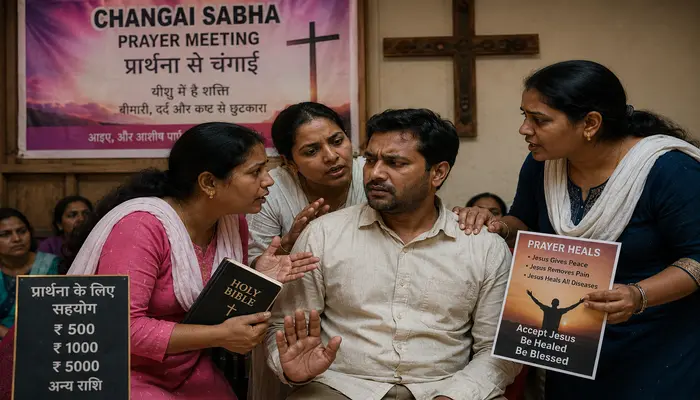
Case Summary
In the Bhanpuri area of Raipur, Chhattisgarh, a Hindu man, Tarendra Kumar Verma, was offered inducements and manipulated for religious conversion by three Christian women under the guise of a prayer/healing meeting (Changai Sabha). During the prayer meeting participants were offered monetary inducements, told that prayers could cure illnesses and diseases, and Hindu gods and goddesses were subjected to objectionable remarks. The gathering was attended by a large number of Hindu women along with women from the Jain and Christian communities. During the gathering, Sushma Kaushik, Laxmi Nishad and Surekha Rangare attempted to persuade those present to adopt Christianity and exerted psychological pressure by portraying the powers of Christianity as capable of eliminating illness, pain and suffering. The incident came to light after a complaint was filed by a 32-year-old Hindu man named Tarendra Kumar Verma, a mobile shopkeeper residing at New Anand Nagar, Gandhi Chowk, Bhanpuri, He stated that Sushma Kaushik, Lakshmi Nishad and Surekha Rangare, who were known to him and regularly visited his mobile shop, had spoken to him about Christianity. Around four or five days before the incident, Sushma invited Tarendra to a prayer meeting at her residence. On 21 August 2026, at around 2:30 pm, he visited the house, where approximately 20–25 people, including women, were present and engaged in prayer. Tarendra stated that Sushma, Lakshmi and Surekha encouraged him and others to accept Christianity and explained the purported power of prayer to cure illnesses. They also told him that prayer and religious conversion could provide relief from pain and illness. They also made derogatory remarks about Hinduism and encouraged him to pray to Jesus. He refused to convert and subsequently left the gathering. Following the incident, Tarendra informed his friends and approached the police. Members of the Bajrang Dal also submitted a complaint regarding the prayer meeting. On 22 August 2026, Khamtarai police registered an FIR against Sushma Kaushik, Lakshmi Nishad and Surekha in connection with the prayer meeting, making derogatory remarks against Hindu deities and inducement for religious conversion. Assistant Police Commissioner Purnima Lama stated that the matter was under investigation and that further action would be taken based on the facts established during the investigation.
Why it is Hate Crime ?
The primary category selected for this case is: Predatory proselytisation. The first subcategory selected for this case is: Conversion/attempts to convert by inducement. Predatory Proselytisation is not limited to threat, harassment, force and violence, but it also has contours of stealth. In several cases, the Hindu victim is exploited to convert, with non-Hindus taking advantage of their poverty. In such cases, the Hindu victim who is suffering financially is offered monetary benefits, including lucrative offers for jobs, health treatment, education, etc, to induce the victim to change his/her religion. In such cases, the religious identity of the victim and the aim to disenfranchise him from his faith form the heart of the crime. Also, taking advantage of and exploiting an individual’s economic vulnerabilities is widely acknowledged as exploitation, forms of which are often penalised by law. Such cases therefore are considered religiously motivated hate crimes since the victim’s religious identity forms the very heart of the crime itself. The next subcategory for this case is: Attempting to convert/ converting by denigrating Hinduism. In several cases, Hindus are converted, or an attempt is made to convert Hindus by denigrating their faith, Hinduism. In such cases, the Hindus associate with the non-Hindu perpetrators, often by choice and then the attempt to convert them by insulting their faith, putting the faith down, etc begins. An example of this would be a non-Hindu gathering where the Hindus are attending the gathering of their own free will. However, once they attend the gathering, there is an explicit attempt to convert them by abusing their faith and hailing the faith of the perpetrator. The denigration of the Hindu faith is often based on misrepresentation of the Hindu faith, its doctrine and scriptures and insults to espoused traditions, if not blatant lies about Hindu beliefs and ways. Such conversions or attempts at conversion are driven by animosity towards the Hindu faith and are therefore documented as religiously motivated hate crimes. The last subcategory selected is: Proselytisation by grooming, brainwashing, manipulation or subtle indoctrination. Religious brainwashing essentially means the often subtle and forcible indoctrination to induce someone to give up their religious beliefs to accept contrasting regimented ideas. Religious grooming or brainwashing also involves propaganda and manipulation. It involves the systematic effort, driven by religious malice and indoctrination, to persuade “non-believers’ to accept allegiance, command, or doctrine to and of a contrasting faith. Cases of such grooming or brainwashing are far more nuanced than direct threats, coercion, inducement and violence. In such cases, it is often seen that there is repeated, subtle and continual manipulation of the victim to induce disaffection towards their own faith and acceptance of the contrasting faith of the perpetrator. While subtle indoctrination is widely acknowledged as predatory, an element which is often understated in such conversions or in the attempts at such conversion is the role of loyalty and trust which might develop between the perpetrator and the victim. Fiduciary relationships are often abused to affect such religious conversion. For example, an educator transmitting religious doctrine of a competing faith to a Hindu student. The Hindu student is likely to accept what the teacher is transmitting owing to the existence of the fiduciary relationship. The exploitation of the fiduciary relationship to religiously indoctrinate victims would also be included in this category. Since the underlying animosity towards the victim’s faith forms the basis of predatory proselytisation, such cases are considered religiously motivated hate crimes. This case was included in the Hinduphobia Tracker because the conversion efforts were directed at a Hindu man to persuade him to abandon his existing faith and accept Christianity. The nature of the conduct went beyond the ordinary propagation of a religious belief because the Hindu victim was subjected to inducements, manipulation and denigration of his faith in the course of the conversion attempts. Targeting an individual based on his Hindu religious identity and seeking to detach him from that identity reflected animosity towards Hinduism and disregard for the religious beliefs of its followers. The use of monetary or material inducements added a predatory dimension to the conversion efforts. Offering benefits to encourage a Hindu to abandon his faith exploits the circumstances of the individual and places an external incentive behind the decision to change religion. When such inducements are tied specifically to an effort to convert a Hindu to another faith, the religious identity of the victim becomes central to the conduct. Such exploitation therefore reflected religious hostility and enmity towards the Hindu faith, rather than merely the expression of an alternative religious belief. The conversion efforts were further accompanied by denigration of Hinduism and Hindu religious beliefs. Attempting to persuade a Hindu to accept Christianity while making objectionable remarks about his own faith undermined the dignity of Hinduism and sought to create disaffection towards the religion of the individual being targeted. Such conduct was not simply an attempt to present Christianity in a favourable light; it involved putting down the victim's existing faith while promoting the contrasting faith. The deliberate disparagement of Hinduism in the course of conversion efforts demonstrated contempt and hatred towards Hindu religious beliefs and constituted a clear religiously motivated element. The manner in which the conversion attempts were conducted also reflected manipulation and psychological pressure. Presenting Christian prayer as a means of eliminating illness, pain and suffering created an association between accepting Christianity and obtaining relief from personal difficulties. Such methods can operate through psychological influence rather than overt force, gradually weakening attachment to the victim's existing faith while encouraging acceptance of the competing religion. The use of such manipulation against a Hindu therefore fell within the category of predatory proselytisation through grooming, brainwashing, manipulation or subtle indoctrination. Taken together, the inducements, denigration of Hinduism and psychological manipulation demonstrated a coordinated attempt to undermine the religious identity of the Hindu victim and persuade him to abandon his faith. The conduct therefore reflected animosity, enmity and hostility towards Hinduism, making the incident a religiously motivated hate crime under the selected categories of conversion by inducement, conversion by denigrating Hinduism, and proselytisation through grooming, brainwashing, manipulation or subtle indoctrination. Disclaimer: The victim count has been marked as one, as the published media reports specifically identified Hindu man Tarendra Kumar Verma as the complainant and target of the reported conversion efforts. The reports also stated that Hindu, Jain and Christian women were present at the prayer meeting. While the Hinduphobia Tracker acknowledges that there may have been other Hindu victims or individuals subjected to the conversion efforts, the exact number of Hindu victims was not specified in the available media reports. Therefore, the victim count has been conservatively recorded as one.
Victim Details
Total Victim
1
Deceased
0
Gender
- Male 1
- Female 0
- Third Gender 0
- Unknown 0
Caste
- SC/ST 0
- OBC 0
- General 0
- Unknown 1
Age Group
- Minor 0
- Adult 1
- Senior Citizen 0
- Unknown 0


Case Status
Complaint filed


Perpetrators Details
Perpetrators
Christian Extremists
Perpetrators Range
From 2 To 5
Perpetrators Gender
female
 Sources




