Hindu women targeted for forced conversion to Christianity through inducements and promises of curing illnesses in Fatehpur, Uttar Pradesh
 Fatehpur, Uttar Pradesh, India
  20 August, 2026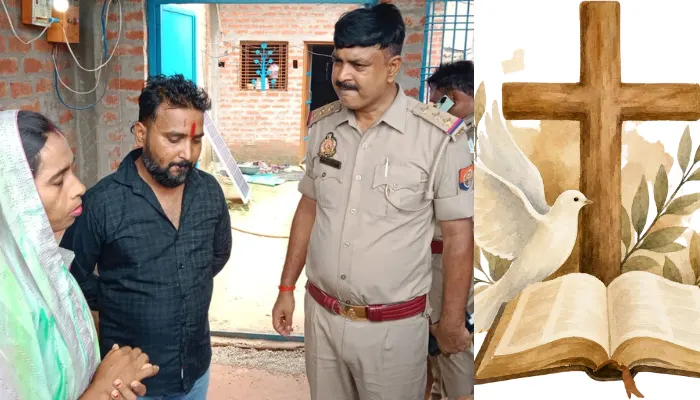
Case Summary
In Azad Nagar, Husainganj, Fatehpur, Uttar Pradesh, Hindu women were targeted for forced religious conversion through a Christian prayer meeting known as a "Changai Sabha". The gathering was conducted at the residence of Rajkumari Paswan, a Christian woman and wife of Maiyadin Paswan, where Hindu women were invited in the name of curing illnesses, disabilities and other problems through prayers. They were also offered various incentives to encourage conversion to Christianity. Rajkumari, originally from Rahimpur village in Husainganj, was living in Azad Nagar at the time, while her husband was employed in Ahmedabad. She had been conducting such ‘healing’ prayer meetings at her residence for approximately two to three years, with one account stating that the gatherings were held twice a week. During these meetings, Hindu women were made to read the Bible, participate in prayers and listen to Christian religious teachings. The supposed healing through prayer was presented as a means of treatment, while poor and vulnerable women were offered money and other inducements to encourage them to convert to Christianity. On Friday, 21 August 2026, at around 3 pm, Bajrang Dal members Gaur Shukla, Shalu Pandit and Pankaj Chaurasia reached Rajkumari’s residence after receiving information about the gathering. Other members of Hindu organisations, including Virendra Soni, Himanshu Dwivedi and Raju Lodhi, were also present. Around 15 Hindu women from Azad Nagar, Satmile and Husainganj were attending the Changai Sabha. Police subsequently reached the residence and questioned the women present. Sumitra Devi and Kalawati stated that whenever someone fell ill, a chant was recited and water was sprinkled over the person, after which the illness was said to have been cured. They also stated that they had been called to the gathering in the name of receiving treatment for their illnesses. Police recovered three copies of the Bible from the residence. The police collected information from several women present at the gathering, including Sumitra, Kalawati, Ramkali, Sudha Devi, Dhuri Devi and Pinki. Sumitra, wife of Shravan, was a resident of Kamalpur, while Ramkali was a resident of Baruahar Hathgam. Sudha Devi, Dhuri Devi and Pinki were residents of Mishramau. Rajkumari Paswan and Kusma, wife of Ramkishor Maurya and a resident of Makanpur, were subsequently arrested for questioning. Gaur Shukla, son of Kudi Shukla and a resident of Sakulpur, submitted a written complaint to the police, stating that Hindu women were being misled and encouraged towards religious conversion. Shalu Pandit also stated that members of the Hindu organisation had reached the location after receiving information about religious conversion activities and had sought police action. Station House Officer Alok Pandey stated that a case had been registered against Rajkumari Paswan under the relevant provisions relating to religious conversion. He further stated that the detained women were being questioned and that the police were investigating the circumstances surrounding the gathering, with further legal action to be taken based on the findings of the investigation.
Why it is Hate Crime ?
The primary category selected for this case is: Predatory proselytisation. The first subcategory selected for this case is: Conversion/attempts to convert by inducements. Predatory Proselytisation is not limited to threat, harassment, force and violence, but it also has contours of stealth. In several cases, the Hindu victim is exploited to convert, with non-Hindus taking advantage of their poverty. In such cases, the Hindu victim who is suffering financially is offered monetary benefits, including lucrative offers for jobs, health treatment, education, etc, to induce the victim to change his/her religion. In such cases, the religious identity of the victim and the aim to disenfranchise him from his faith form the heart of the crime. Also, taking advantage of and exploiting an individual’s economic vulnerabilities is widely acknowledged as exploitation, forms of which are often penalised by law. Such cases therefore are considered religiously motivated hate crimes since the victim’s religious identity forms the very heart of the crime itself. The other subcategory selected is: Proselytisation by grooming, brainwashing, manipulation or subtle indoctrination. The tertiary category selected is: Pattern of targeting Hindus. Religious brainwashing essentially means the often subtle and forcible indoctrination to induce someone to give up their religious beliefs to accept contrasting regimented ideas. Religious grooming or brainwashing also involves propaganda and manipulation. It involves the systematic effort, driven by religious malice and indoctrination, to persuade “non-believers’ to accept allegiance, command, or doctrine to and of a contrasting faith. Cases of such grooming or brainwashing are far more nuanced than direct threats, coercion, inducement and violence. In such cases, it is often seen that there is repeated, subtle and continual manipulation of the victim to induce disaffection towards their own faith and acceptance of the contrasting faith of the perpetrator. While subtle indoctrination is widely acknowledged as predatory, an element which is often understated in such conversions or in the attempts at such conversion is the role of loyalty and trust which might develop between the perpetrator and the victim. Fiduciary relationships are often abused to affect such religious conversion. For example, an educator transmitting religious doctrine of a competing faith to a Hindu student. The Hindu student is likely to accept what the teacher is transmitting owing to the existence of the fiduciary relationship. The exploitation of the fiduciary relationship to religiously indoctrinate victims would also be included in this category. Since the underlying animosity towards the victim’s faith forms the basis of predatory proselytisation, such cases are considered religiously motivated hate crimes. In this case, Hindu women were specifically targeted and encouraged to convert to Christianity through a combination of religious influence, inducements and promises of healing. The women were invited to Christian prayer meetings in the name of receiving relief from illnesses and other personal difficulties, while the gatherings involved Christian prayers, religious teachings and the reading of the Bible. The nature of these conversion efforts and their impact on the Hindu women demonstrated targeted action against members of the Hindu community. When individuals or groups focus their efforts on converting members of a particular religion, in this case Hindus, it demonstrates disregard for the faith and religious identity of those being targeted. Conversion, particularly when pursued through external persuasion, inducements or manipulation rather than genuine personal conviction, went beyond the ordinary sharing of religious beliefs. It sought to persuade Hindu victims to abandon their existing faith and religious identity. In this context, the Christian perpetrator specifically targeted Hindu women, demonstrating disregard for Hinduism and its followers. Such targeted efforts to influence Hindus to abandon their faith therefore constituted a form of religiously motivated hostility. The use of financial incentives to encourage conversion to Christianity further demonstrated the exploitative nature of the conversion efforts. Rather than constituting ordinary religious outreach, the use of money and other inducements exploited the economic vulnerability of Hindu women who came from weaker and disadvantaged backgrounds. By offering material incentives in connection with religious conversion, the Christian perpetrator used the women’s circumstances to influence their religious choices. Such inducements undermined the ability of vulnerable individuals to make a free and independent decision about their faith and placed material considerations alongside efforts to persuade them to abandon Hinduism. The deliberate use of economic vulnerability to facilitate religious conversion therefore demonstrated disregard for the religious identity and dignity of the targeted Hindu women and constituted a form of religiously motivated exploitation. The victims were also lured to attend Christian prayer meetings where they were made to offer Christian prayers, read the Bible and participate in Christian religious teachings, while being told that their illnesses would be cured through prayer. Presenting Christian religious practices and conversion as a means of curing illnesses was a manipulative way of influencing vulnerable individuals who were seeking relief from their personal difficulties. Such tactics interfered with the women’s ability to make an informed and independent decision about their religious beliefs because the promise of healing was presented alongside efforts to influence them towards Christianity. Religious conversion pursued through manipulation rather than genuine personal conviction undermined the victims’ religious autonomy and their ability to make a free and informed choice about their faith. Using illness and personal vulnerability as a means to encourage Hindu women to abandon their existing religion and adopt Christianity therefore demonstrated disregard for their Hindu religious identity and constituted religiously motivated exploitation and hostility. The Christian perpetrator also sought to influence the Hindu women through the use of Christian religious texts, including the Bible. Using the scripture of one faith to influence members of another faith towards conversion formed part of the wider pattern of religious instruction taking place during the prayer meetings. The Hindu women were not simply exposed to Christian literature in an ordinary setting; the Bible was used alongside Christian prayers, religious teachings and promises of healing in gatherings directed at vulnerable Hindus. This combination of religious instruction and personal vulnerability created an environment conducive to religious influence and conversion. The use of Christian religious material in this manner therefore further demonstrated that the gatherings were intended not merely to provide religious instruction, but to encourage Hindu women to move away from their existing faith and towards Christianity. The fact that such Christian ‘healing’ prayer meetings had been conducted at the residence for approximately two to three years demonstrated a repeated pattern of targeting Hindu women for religious conversion. The prolonged and recurring nature of these gatherings showed that this was not an isolated incident, but part of a sustained effort to influence vulnerable Hindus towards Christianity through prayer, religious teachings, promises of healing and inducements. The continued use of these methods over an extended period demonstrated a deliberate and organised pattern of religious targeting directed at members of the Hindu community. Such sustained efforts to influence Hindu women to abandon their faith reflected persistent disregard for Hinduism and the religious identity of those being targeted, making the incident a clear case of religiously motivated hostility. These instances of targeted proselytisation activities stem from inherent hostility towards the victims' professed faith, since Abrahamic faiths believe that any non-adherent to their faith is subject to being dehumanised till they convert, making it a religiously motivated crime against Hindus. Therefore, this case is being added to the hate crime database of the Hinduphobia Tracker. Disclaimer: In this case, although Kusma was also detained by the police for questioning, the case was registered only against Rajkumari Paswan. The available reports did not mention that Kusma was actively involved in the conversion activities. Therefore, for documentation purposes, the perpetrator count has been recorded as "one", referring to Rajkumari Paswan alone.
Victim Details
Total Victim
15
Deceased
0
Gender
- Male 0
- Female 15
- Third Gender 0
- Unknown 0
Caste
- SC/ST 0
- OBC 0
- General 0
- Unknown 15
Age Group
- Minor 0
- Adult 15
- Senior Citizen 0
- Unknown 0


Case Status
Complaint registered


Perpetrators Details
Perpetrators
Christian Extremists
Perpetrators Range
One Person
Perpetrators Gender
female
 Sources




