Sanctity of Hindu temple violated; Muslim man urinates inside its premises in Haveri, Karnataka
 Haveri, Karnataka, India
  19 August, 2026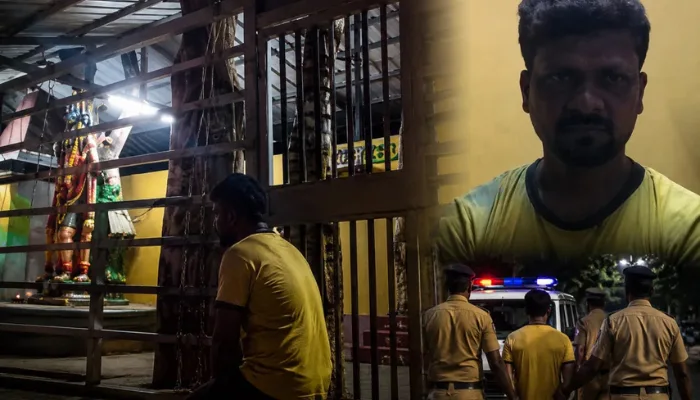
Case Summary
In Shiggaon, Haveri, Karnataka, the historic Anjaneya Swamy Temple was desecrated after a 31-year-old Muslim man, Mohammed Jaffer, entered its premises without authorisation and urinated inside the temple premises. The incident occurred at around 9:30 pm on Thursday, 20 August 2026, while Shravan rituals were underway. According to media reports, the local Hindu residents noticed Jaffer inside the temple premises, caught him and questioned him about his actions. During the confrontation, Jaffer confessed to urinating inside the premises, following which the locals handed him over to the police. Following the incident, Hindu residents and organisations staged protests and demanded strict action against Jaffer. The Hindu organisations also demanded that Jaffer himself clean the area he had soiled. A tense atmosphere prevailed in the area for some time. Police subsequently reached the location, took Jaffer into custody and brought the situation under control. Security was also increased around the temple and its surrounding area as a precautionary measure to prevent any untoward incident. During the preliminary police interrogation, it emerged that Jaffer had previously been sleeping in the vicinity of the temple and that no one had objected to his presence there. Police continued to investigate the circumstances surrounding his entry into the temple premises and the reason behind the act. The police had not established any specific motive behind the incident at that stage. Investigators continued to question Jaffer and examine the available evidence to determine the circumstances that led to the act and whether there was any specific intention behind it. Jaffer was subsequently arrested, and a case was registered against him under the relevant provisions of the Bharatiya Nyaya Sanhita (BNS). Further investigation into the incident, including the circumstances surrounding his entry into the temple premises and the desecration of the Hindu place of worship, remained underway. Reacting to the desecration, Hindu activist and Sri Ram Sena chief Pramod Muthalik said, “There is a Hanuman temple here, which was built by the local drivers’ association. Last night, around 9:30 p.m, Mohammed Jaffer, whom I consider anti-Hindu, entered the premises and desecrated the temple by urinating inside it. He has now been detained. I say that merely detaining him, registering a case, sending him to the police station or taking him to court will not be enough. He should be shot on sight and hanged. This is not just an insult to the temple in Shiggaon; it is an insult to the entire Hindu community.”
Why it is Hate Crime ?
The primary category selected in this case is: Attack on Hindu religious representations. The subcategory selected is: Desecration of Hindu religious symbols. Icons and symbols, or religious representations of a spiritual ideal, are widely revered in Hinduism. Iconography is of vital significance in the Hindu milieu. It helps connect people’s spiritual beliefs with the real world. Iconography within the Hindu faith takes several shapes and forms. Murtis are of great significance to Hindus, to which daily rituals, prayers and offerings are done. Besides the murtis, there are several other symbols which have deep significance in the Hindu faith – the Om and Swastika, for example. Since these Hindu religious symbols hold paramount importance in Hinduism, any desecration of symbols, icons, murtis, religious representations and manifestations is driven by animosity towards the faith itself, which manifests itself through these murtis, icons and symbols. Therefore, any desecration of these Hindu religious symbols and representations is considered religiously motivated hate crimes under this category. The other subcategory selected is: Breaking rules of place of worship. Sanatan Dharma is not a religion of one book, which is to say that while it has religious scriptures that form the central tenets of the faith, there are several traditions followed through thousands of years, mostly passed from generation to generation orally. One of these oral traditions or written traditions is the rules of specific temples. Certain temples have rules which are traditional, dependent on the worship of the presiding deities. These rules and traditions have been followed for thousands of years, whether they find scriptural mention or not. Such traditions are based on the nature and rules of worship of the presiding deity of that temple. Any non-compliance with these traditions owing to animosity towards the faith or for the sake of activism stems not only from a lack of faith in the presiding deity but also from disregard for the faith of the devotees of that deity/temple and implicit bias against the faith, the tradition and the deity itself. Since these specific traditions are central to the faith of the devotees of that specific temple and presiding deity, any non-compliance with these traditional rules would be considered a religiously motivated hate crime. The other subcategory selected is: Defiling religious customs. Sanatan Dharma is not a religion of one book, which is to say that while it has religious scriptures that form the central tenets of the faith, there are several traditions followed through thousands of years, mostly passed from generation to generation orally. There are several such customs and traditions that are followed by various Hindus and Hindu sects. Defiling these traditions and customs is a breach of an individual or group’s religious practices. Such practices can range from dietary restrictions like not eating non-vegetarian food for a certain period of the year, not eating non-vegetarian food at all, not eating beef since the cow is considered holy in Hinduism, the sanctity of religious customs followed in the house (like many ISCKON devotees), etc. Any malicious action leading to the breach of such traditions or defilement of these traditions owing to animosity towards the faith or for the sake of activism stems not only from the lack of faith in the religion itself but also from disregard for the faith of the devotees who follow the customs/traditions and implicit bias against the faith, the tradition itself. Since these specific traditions are central to the faith of the devotees of that specific sect of Hindus, any non-compliance with these traditional rules would be considered a religiously motivated hate crime. The case was included in the Hinduphobia Tracker because it involved the defilement of a historic Hindu place of worship. Mohammed Jaffer entered the Anjaneya Swamy Temple premises and urinated there, directly violating the sanctity of a space held sacred by Hindu devotees. A Hindu temple is not merely a physical structure but a consecrated space associated with the worship of the presiding Deity, where devotees perform prayers, puja, rituals and other religious observances. Hindu temples traditionally follow strict standards concerning cleanliness, purity and appropriate conduct, particularly within spaces where the Deity is worshipped and religious rituals are performed. Devotees are expected to maintain the sanctity of the temple premises by observing established customs and refraining from acts considered impure or disrespectful. The Anjaneya Swamy Temple is dedicated to Lord Hanuman, who is revered by Hindus as a symbol of devotion, strength, courage and righteousness. Therefore, the act of urinating inside the Hindu temple constituted a direct desecration of its sanctity and a violation of the religious customs governing the sacred premises. By carrying out an act that was wholly incompatible with the reverence and purity expected within the temple, the accused defiled a space set apart for Hindu worship and religious observance. The conduct showed deliberate disregard for the customs that devotees follow to preserve the sanctity of the temple and reduced a sacred religious space to an object of insult and contempt. It also directly affected the Hindu community associated with the temple, as the desecration of a place dedicated to their Deity constituted an affront to their faith and religious identity. The act therefore went beyond ordinary misconduct and amounted to conduct that defiled Hindu religious space, violated its established customs and offended the religious sentiments of Hindu devotees. The circumstances were particularly significant because the incident occurred while Shravan rituals were underway. Shravan is an important period of religious observance for Hindus, during which devotees undertake prayers, fasting, temple visits and other devotional practices. The Anjaneya Swamy Temple was therefore being used for religious purposes during an ongoing period of Hindu observance when the desecration took place. Defiling the premises at such a time compounded the religious significance of the violation by intruding upon a temple environment in which devotees were actively engaged in worship and observance. Overall, since this case meets the parameters of a religiously driven offence, it is being added to the hate crime database of the Hinduphobia Tracker.


Case Status
Arrested


Perpetrators Details
Perpetrators
Muslim Extremists
Perpetrators Range
One Person
Perpetrators Gender
male
 Sources




