Hindu sentiments outraged; derogatory remarks targeting Hinduism, Hindu deities and temples surfaced on social media
 Maharajganj, Uttar Pradesh, India
  18 August, 2026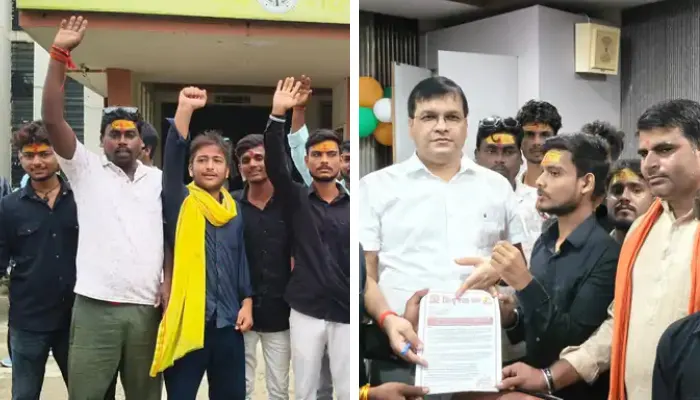
Case Summary
In Nautanwa, Maharajganj, Uttar Pradesh, Hindu sentiments were hurt after objectionable and provocative remarks targeting Hinduism, Hindu culture, Hindu saints, temples and Hindu deities were circulated on social media. The Hindu Raksha Dal protested against the content and demanded action against those responsible. Office-bearers and members of the Hindu Raksha Dal submitted a memorandum addressed to the District Magistrate through Tehsildar Karan Singh, demanding effective measures to curb such activities and action in accordance with the law against those responsible. The organisation stated that individuals on various social media platforms were making objectionable and provocative remarks concerning matters of religious faith. It further stated that such posts and statements were deliberately circulated and made viral, hurting religious sentiments and raising concerns that they could adversely affect the social atmosphere and communal harmony. Through the memorandum, the Hindu Raksha Dal demanded that the administration identify the individuals responsible for posting or circulating content that hurt religious sentiments on social media and take immediate action against them. The organisation also called for effective monitoring of such activities and necessary measures to prevent the recurrence of similar incidents in the future. The organisation's office-bearers further stated that freedom of expression should not be used as a pretext for making objectionable remarks against any religion, Hindu deities or religious places. They emphasised that such comments could adversely affect social harmony and called upon the administration to take timely action in such cases. During the submission of the memorandum, Hindu Raksha Dal president Satyam Soni was accompanied by Rampreet Kannaujiya, Aman Pahalwan, Ravi Gaur, Gulshan, Adarsh Tiwari, Chhotu Varun, Narayan, Ankit and several other members of the organisation. Tehsildar Karan Singh received the memorandum from the organisation's representatives. He stated that the memorandum was addressed to the District Magistrate and that the issues raised in it would be conveyed to the concerned authorities. He assured the representatives that the matter would be investigated and that necessary action would be taken in accordance with the rules, based on the facts established during the investigation. The members of the organisation expressed their expectation that the administration would conduct an impartial investigation and take strict action against those found responsible.
Why it is Hate Crime ?
The primary category selected for this case is: Hate speech against Hindus. The subcategory selected for this case is: Anti-Hindu slurs, mocking faith. Anti-Hindu slurs and the deliberate mocking of the Hindu faith owing to religious animosity involve the usage of derogatory terms, stereotypes, or offensive references to religious practices, symbols, or figures. One of the common anti-Hindu slurs used against Hindus is “cow-worshipper” and “cow piss drinker”. The intention of using this term is to demean and mock Hindus as a group and their religious beliefs, since Hindus consider the cow holy. Additionally, some symbols and the slurs attached to them have a historical context that exacerbates the insult, hate, stereotyping, dehumanisation and oppression against Hindus. Cow worship has been used for centuries to denigrate Hindus, insult their faith and oppress Hindus specifically as a religious group. There has been overwhelming documentation about how cow slaughter has been used to persecute Hindus, with cow meat being thrown in temples and places of worship. There has also been overwhelming documentation that cow meat (beef) has been force-fed to Hindus to either forcefully convert them to Islam or denigrate their faith. Apart from cow worship, the Swastika – which holds deep religious significance for Hindus – has also been misinterpreted and distorted to be used as a slur against Hindus. Similarly, the worship of the Shivling has been used by supremacist ideologies and religions to denigrate Hindus owing to religious animosity. Such slurs and denigration stem from inherent animosity and hate towards Hindus and their faith; therefore, it is categorised as hate speech targeted at Hindus specifically owing to their religious identity. This case was a clear example of religiously motivated hate speech, as the perpetrators made derogatory and provocative remarks specifically targeting Hinduism, Hindu religious beliefs, Hindu deities, Hindu culture, Hindu temples and Hindu saints. Hinduism holds profound religious and cultural significance for its followers and is one of the world's oldest living religious traditions. It encompasses a wide range of philosophical traditions, beliefs, practices, rituals and forms of worship that have shaped the religious identity of Hindus for centuries. For Hindu devotees, Hinduism is not merely an abstract set of beliefs but an integral part of their religious, cultural and spiritual identity. Consequently, denigrating the religion itself constitutes an attack on a faith that is deeply revered and practised by Hindus across the world. Hindu deities hold a central place in the religious lives of Hindu devotees. Deities such as Lord Shiva, Lord Vishnu, Goddess Durga, Lord Ganesha and numerous other divine forms are worshipped with deep reverence and are integral to Hindu religious traditions and spiritual practices. Temples, homes and other places of worship serve as spaces where devotees pray to and seek blessings from these deities. Making derogatory or provocative remarks about Hindu deities therefore targets figures who are regarded as sacred and worthy of profound reverence by the Hindu community. Hindu culture is also closely intertwined with Hindu religious identity. Its traditions, festivals, rituals, customs, art, literature and other cultural expressions have developed over centuries alongside the religious beliefs and practices of the Hindu community. For Hindus, these cultural traditions are expressions of their faith and form an important part of their collective identity. Denigrating Hindu culture therefore extends beyond criticism of a particular custom or practice and amounts to the denigration of a broader religious and cultural identity shared by millions of Hindus. Hindu temples hold immense religious significance as sacred spaces dedicated to worship and devotion. They are not merely physical structures but important centres of religious life where devotees gather to offer prayers, participate in rituals and celebrate religious festivals. Temples also serve as centres for the preservation and transmission of religious traditions, cultural practices and community life. Derogatory remarks directed at Hindu temples therefore target institutions and spaces that are deeply revered by Hindu devotees. Hindu saints likewise occupy an important position within Hindu religious traditions. Saints, sages, gurus and other spiritual figures have played a significant role in preserving, interpreting and transmitting Hindu philosophical, religious and spiritual traditions across generations. Hindu saints are regarded with deep reverence by their followers and the wider Hindu community. Denigrating Hindu saints and religious leaders therefore targets individuals and traditions that hold substantial spiritual and religious importance for Hindus. Therefore, making derogatory remarks against Hinduism and its deities, culture, temples, saints and other aspects held sacred and revered by the Hindu community demonstrated a clear pattern of religious hostility towards Hinduism and Hindus. These remarks were not directed at an individual or confined to a disagreement over a particular issue; rather, they targeted multiple components of Hindu religious and cultural identity, including the faith itself, its objects of worship, sacred spaces, traditions and revered spiritual figures. When a particular faith is singled out and subjected to mockery, contempt or denigration in this manner, such conduct goes beyond ordinary disagreement, criticism or debate and strikes at the collective religious identity of the community that follows it. By targeting multiple aspects of Hinduism that hold deep religious and spiritual significance for Hindus, the conduct demonstrated hostility directed specifically at the Hindu faith and the Hindu community, making it a clear case of a religiously driven hate crime. The fact that the remarks were circulated on social media further aggravated the nature of the incident. The public dissemination of derogatory content enabled it to reach a wider audience and extended the scope of the denigration beyond a private exchange. By circulating material that targeted multiple aspects of Hindu religious identity, the perpetrators exposed Hindu beliefs and objects of reverence to wider public ridicule and contempt. This deliberate dissemination of religiously targeted content reinforced the nature of the incident as a clear case of a religiously driven hate crime. Overall, since this case meets the parameters of a hate crime, it is being added to the hate crime database of Hinduphobia Tracker. Disclaimer: Hinduphobia Tracker records incidents based on the date on which the crime occurred rather than the date on which it was reported by the media. However, in the present case, the available media reports did not specify the exact date on which the derogatory remarks were made. Therefore, the date of publication of the media report, 19 August 2026, has been selected as the indicative incident date for documentation purposes only.


Case Status
Complaint filed


Perpetrators Details
Perpetrators
Unknown
Perpetrators Range
Unknown
Perpetrators Gender
unknown
 Sources




