Hindu police officer threatened by Muslim subordinate who declared 'This Is My Area' and threatened to rip out his intestines
 Ahmedabad, Gujarat, India
  13 August, 2026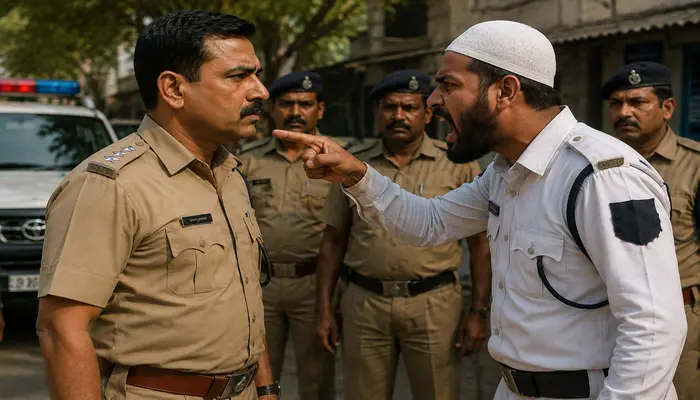
Case Summary
A Hindu police officer was threatened by his Muslim subordinate, who declared, "This is my area," after the officer reported his repeated absence from duty. The subordinate, Traffic Brigade (TRB) jawan Javed Khan, further threatened to "rip out" the officer's intestines and warned that he would see how the officer continued to perform his job. The incident took place on 14 August 2026 at the Vishala Beat under Ahmedabad's M Division Traffic Police Station. The Hindu officer, PSI Bharat Pandya, was responsible for supervising police personnel, Home Guards and TRB personnel deployed at traffic points within the Vishala Beat. On 13 August, Javed Khan remained absent from his assigned duty point, following which Pandya submitted an absence report to the Police Inspector in accordance with procedure. Javed was again absent on 14 August, and Pandya submitted another report. Javed arrived at around 3:30 pm on 14 August, when Pandya informed him that he had been marked absent. He returned at around 6:30 pm and asked to be marked present. Pandya informed him that his absence had already been reported to the Police Inspector and instructed him to first explain his absence to the senior officer before resuming duty. Javed then became agitated and began verbally abusing Pandya in the presence of other police personnel. He threatened the PSI, saying, "If you take any action against me, I will rip out your intestines." He further declared, "This is my area," and warned Pandya that he would see how the officer continued to sit in his position and perform his duties. Other police personnel intervened and brought the confrontation under control, following which Javed left the spot. Pandya subsequently informed his senior officers and made a detailed entry in the station diary. On the instructions of his superiors, a complaint was later registered against Javed Khan at Vasna Police Station.
Why it is Hate Crime ?
This case has been added to the tracker under the primary category- Hate Speech against Hindus. The subcategory selected is- Violent Threats. Violent threats, explicit, implicit or implied, is the most dangerous form of hate speech since it goes beyond discriminatory and prejudicial language to express the intent of causing harm to an individual or a group of people based on their religious identity and faith. There could be several different kinds of threats that are issued to Hindus based on religious animosity. An explicit threat would mean the direct threat of violence towards an individual Hindu, a group of Hindus or Hindus at large. Physical violence, death threats, threats of destruction of property belonging to Hindus and threats of genocide would mean explicit threats against Hindus for their religious identity. Implicit threats may not be a direct threat but implied through the use of symbols of actions – for example – in the Nupur Sharma case, other than explicit threats, there were also implicit threats when Islamists took to the streets to burn and beat her effigies. It implies that they want to do the same to Nupur Sharma – thereby is considered an implicit threat. Violent threats can be delivered in person, through letters, phone calls, graffiti, or increasingly through social media and other online platforms. It would be important to understand that a threat – explicit or implicit, online or offline – to an individual who happens to be a Hindu does not qualify as a religiously motivated threat. Such a threat, while vile and dangerous, could be owing to non-religious reasons and/or personal animosity. To qualify as a religiously motivated threat, it would need to exhibit an indication that the individual is being targeted for religious reasons and/or owing to his/her religious identity as a Hindu. The hostility directed at the police sub-inspector stemmed from a supremacist mindset that inherently rejected the lawful authority of a Hindu official. In many instances of religiously motivated friction, routine administrative actions taken by Hindu figures in positions of power are met with disproportionate, communalised aggression. The officer was targeted not merely as a supervisor enforcing workplace rules, but as a Hindu representative of the state whose authority the subordinate actively sought to undermine and openly defy. The explicit and graphic threats made the incident particularly serious. By threatening to cause extreme physical harm, the accused sought to frighten and intimidate the victim. The threats went beyond ordinary workplace misconduct and created fear of serious violence. As the victim was a Hindu police officer carrying out his official duties, the threats also had the effect of intimidating him while performing his lawful responsibilities. Furthermore, the assertion of territorial control over the jurisdiction transformed the confrontation into a communal challenge. By declaring the public workspace as his exclusive domain, the subordinate leveraged demographic assertiveness to establish his dominance and strip the Hindu officer of his legitimate, state-mandated jurisdiction. This reflected a broader, documented pattern where local demographic presence is weaponised to claim communal supremacy and subjugate Hindu officials. The threat functioned as an active enforcement of a perceived communal veto over the area, signalling that Hindu presence and authority were not welcome in a region the aggressor viewed as belonging to his own demographic. The public delivery of these threats served to amplify the humiliation and assert dominance over the victim's religious identity. Challenging the officer’s capacity to retain his professional position in front of other personnel was a strategic move to visually and socially degrade him. This public degradation demonstrated a clear intent to signal that Hindu authority is fragile and can be dismantled through aggressive intimidation. Consequently, the incident represented a direct attempt to subjugate a Hindu individual through the systematic application of fear and territorial supremacy.
Victim Details
Total Victim
1
Deceased
0
Gender
- Male 1
- Female 0
- Third Gender 0
- Unknown 0
Caste
- SC/ST 0
- OBC 0
- General 0
- Unknown 1
Age Group
- Minor 0
- Adult 1
- Senior Citizen 0
- Unknown 0


Case Status
Complaint registered


Perpetrators Details
Perpetrators
Muslim Extremists
Perpetrators Range
One Person
Perpetrators Gender
male
 Sources




