Hindus and their faith targeted on social media; Muslim preacher boasts of converting Hindu woman, mocks Hindu beliefs with Beef jibe, reveals plan to enter India and convert Hindus
 Mymensingh District, Bangladesh
  8 August, 2026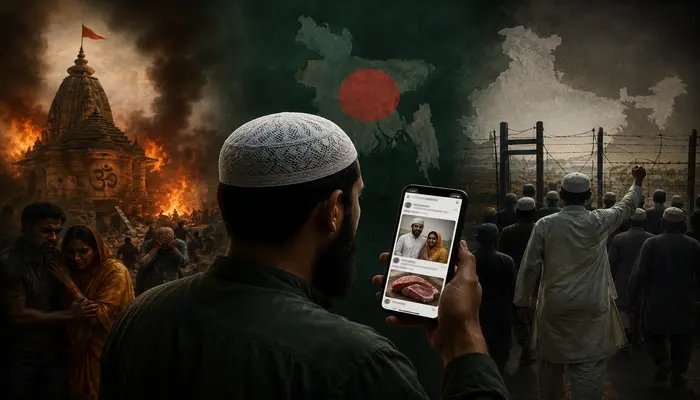
Case Summary
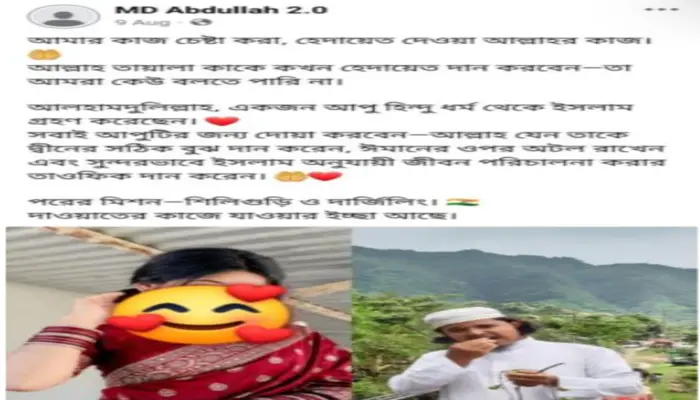
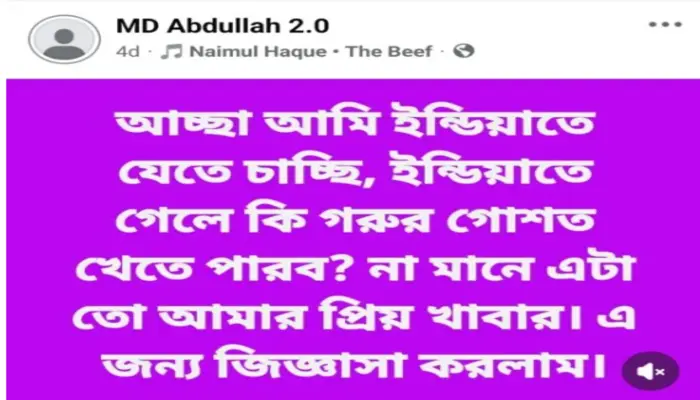
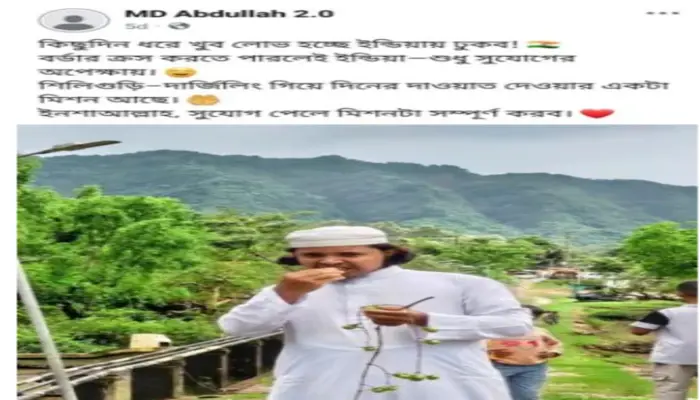
In Mymensingh, Bangladesh, a Muslim preacher, Md. Abdullah, made a series of statements in which he boasted of converting a Hindu woman to Islam and also declared that his next mission was to enter India and pursue conversions of Hindus in the Siliguri-Darjeeling region. On 9 August 2026, he shared a photograph of himself alongside a Hindu woman and gloated that he had facilitated her conversion to Islam. In the same post, he announced his intention to propagate Islam among Hindus in the Darjeeling and Siliguri regions of India. On 10 August, Abdullah shared another post, in which he enquired where he could find beef in India. In the background, he used Nazimul Haque's song "Beef". He also stated that beef was his favourite food. On 11 August, he expressed his desire to cross the international border and enter India. He reiterated his specific plans to pursue religious conversions within the Siliguri-Darjeeling area. Continuing his online activities on 13 August, he appealed to Muslims living in Assam and Tripura to contact him. His post received numerous responses, including invitations from individuals stating they resided in those border states. On 14 August, he announced the conversion of an Indian woman to Islam and asked his followers to pray for her. Through these social media posts, Abdullah expressed his intention to enter India, pursue the religious conversion of Hindus in the Siliguri-Darjeeling region, and establish contact with Muslims in Assam and Tripura to mobilise support for his sinister conversion campaign. This is not an isolated incident. In fact, this incident is part of an ongoing pattern of violence against Hindus in Bangladesh, where the members of the Hindu community have repeatedly faced persecution and disruptions to their religious festivals and gatherings. Hindu women and young girls have repeatedly been targeted for religious conversions, and such attacks on Hindu minorities have only become increasingly frequent and intensified since August 2024. This escalation of violence against Hindus in Bangladesh has unfolded in three distinct phases: first, following the ouster of Sheikh Hasina’s government in August 2024; second, after the death of Sharif Osman Bin Hadi in December 2025; and third, in the immediate aftermath of the 13th National Parliamentary Election 2026. Following the ouster of Sheikh Hasina, multiple reports documented attacks on Hindu homes, temples, and religious institutions, alongside intimidation campaigns, arson, and mob assaults targeting minority neighbourhoods. The Hinduphobia tracker has recorded 336 such incidents against the Hindu minority, underscoring the scale and persistence of anti-Hindu violence during this period. A further escalation occurred following the death of Sharif Osman Bin Hadi, a Muslim political activist and student leader known for his anti-Hindu and anti-India rhetoric. Hadi had been involved in political unrest after the fall of the Hasina government and was killed in Dhaka on 18 December 2025 during clashes. In the aftermath of his death, Hindu communities were blamed and subsequently targeted in retaliatory violence. Hindu homes were selectively set ablaze in multiple localities, forcing families to flee and leaving many displaced. The attacks appeared patterned rather than sporadic, with Muslim mobs focusing on Hindu neighbourhoods, properties, and religious symbols. Among the victims was Dipu Chandra Das, who was lynched to death and his body was set ablaze by a Muslim mob over false blasphemy allegations. The Hinduphobia tracker documented 51 incidents of anti-Hindu violence in the period following Hadi’s death alone. Such incidents underscore the vulnerability of the Hindu minority amid rising communal hostility and the weaponisation of religious accusations. Reports further indicated that posters and written materials calling for the extermination of Hindus were displayed in public spaces, signalling an alarming normalisation of genocidal rhetoric. When combined with acts of arson, vandalism, assault, and targeted intimidation, these developments suggest a coordinated environment of hostility aimed at terrorising the Hindu community and reinforcing majoritarian dominance. The third phase of violence was unleashed after the 13th National Parliamentary Election 2026. Within days of the announcement of results, Hindu families in districts such as Noakhali, Rangpur, Nilphamari, Sylhet, Thakurgaon, and Dinajpur reported coordinated attacks involving arson, looting, assault, and vandalism of temples and homes. In several instances, Hindu homes were selectively targeted, looted, and families were threatened with displacement.
Case Images
Why it is Hate Crime ?
The primary category selected in this case is- Hate Speech against Hindus. The subcategory selected is- Anti-Hindu slurs, mocking faith. Anti-Hindu slurs and the deliberate mocking of the Hindu faith owing to religious animosity involve the usage of derogatory terms, stereotypes, or offensive references to religious practices, symbols, or figures. One of the common anti-Hindu slurs used against Hindus is “cow-worshipper” and “cow piss drinker”. The intention of using this term is to demean and mock Hindus as a group and their religious beliefs since Hindus consider the cow holy. Additionally, some symbols and the slurs attached to them have a historical context that exacerbates the insult, hate, stereotyping, dehumanisation and oppression against Hindus. Cow worship has been used for centuries to denigrate Hindus, insult their faith and oppress Hindus specifically as a religious group. There has been overwhelming documentation about how cow slaughter has been used to persecute Hindus with cow meat being thrown in temples and places of worship. There has also been overwhelming documentation where cow meat (beef) has been force-fed to Hindus to either forcefully convert them to Islam or denigrate their faith. Apart from cow worship, the Swastika – which holds deep religious significance for the Hindus – has also been misinterpreted and distorted to use as a slur against Hindus. Similarly, the worship of the Shivling has been used by supremacist ideologies and religions to denigrate Hindus owing to religious animosity. Such slurs and denigration stem out of inherent animosity and hate towards Hindus and their faith, therefore, it is categorised as hate speech targeted at Hindus specifically owing to their religious identity. This incident contains multiple religious markers that make the targeting of Hindus central to the conduct. The preacher did not merely express a personal preference or speak about religion in general. He publicly boasted about converting a Hindu woman to Islam, announced plans to pursue the conversion of more Hindus in the Siliguri-Darjeeling region, referenced beef, and sought to establish contact with Muslims in Assam and Tripura to support his activities. The repeated focus on Hindus and their faith as the intended targets demonstrated that the religious identity of the victims was central to his stated objective. The conversion of the Hindu woman was itself presented as a source of pride. By publicly announcing that he had facilitated her conversion and asking followers to pray for another Hindu woman who had converted, the preacher portrayed the abandonment of Hinduism and adoption of Islam as a badge of honour. This goes beyond ordinary religious preaching because the stated objective was specifically to identify and convert members of another faith, with Hindus repeatedly singled out as the intended targets. The deliberate public inquiry regarding the availability of beef in India, accompanied by thematic music, represented a direct and calculated mocking of the Hindu faith. The cow holds profound sacred significance within Hinduism. Historically, the weaponisation of beef—including forced consumption, the desecration of sacred spaces with cow remains, and its use as an insult—has been deployed to persecute Hindus, humiliate their beliefs, and enforce religious conversions. Broadcasting an explicit desire for beef while simultaneously outlining a mission to convert Hindus in India directly leveraged this historical trauma. This messaging functioned to demean Hindu religious practices and deliberately degrade the community's core spiritual sensitivities, strictly aligning with the use of faith-based mockery. Furthermore, the strategic focus on entering sensitive Indian border regions, specifically the Siliguri corridor, Assam, and Tripura, to conduct religious propagation highlighted a broader agenda of demographic subversion. Utilising digital platforms to actively cultivate networks in these specific geographic areas demonstrated an intent to systematically undermine the local Hindu population. This approach mirrored established geopolitical patterns where demographic shifts are weaponised to marginalise native Hindu communities and create regional instability. Publicly mapping out a digital and physical mission to alter the religious landscape of these border states perpetuated deep-seated prejudice against the Hindus residing there. Ultimately, deploying a massive social media presence to broadcast these intertwined themes transformed the online activity into weaponised hate speech. The public nature of the posts served to normalise anti-Hindu hostility, allowing prejudicial attitudes to reach and influence a wide audience. By combining the historical insult associated with beef with a clear subversive agenda targeting Hindu women and sensitive border demographics, the digital campaign actively dehumanised the Hindu community. The conduct relied on inherent religious animosity to generate propaganda, fulfilling the criteria for hate speech designed to justify and encourage further prejudice against Hindus. The incident also needs to be viewed against the broader situation of Hindus in Bangladesh, where the Hindu minority has repeatedly faced attacks on temples, homes and businesses, along with killings, mob assaults, sexual violence, forced conversions and other forms of intimidation. The continuing insecurity faced by Hindus in Bangladesh has been cited by observers and organisations as evidence of a broader pattern of persecution against the community. In this context, the statements of a Bangladeshi preacher expressing an intention to enter India, target Hindus for religious conversion and establish contacts with Muslims in Assam and Tripura take on an additional cross-border dimension. While the available evidence does not establish that Abdullah has carried out these stated plans, his public statements and online outreach warrant scrutiny given the wider environment of anti-Hindu hostility documented in Bangladesh. Disclaimer: The available reports indicate that the posts were published as part of a series of social media activities in August 2026, with the earliest documented post dated 9th August 2026. The tracker records incident dates based on when the incident occurred, not when it was reported or published. In this case, 9th August 2026 has been used as the indicative incident date for documentation purposes only.


Case Status
Unknown


Perpetrators Details
Perpetrators
Muslim Extremists
Perpetrators Range
One Person
Perpetrators Gender
male
 Sources




