Hindu residents targeted for Christian conversion through inducements and 'miraculous healing' in Dhamtari, Chhattisgarh
 Dhamtari, Chhattisgarh, India
  17 August, 2026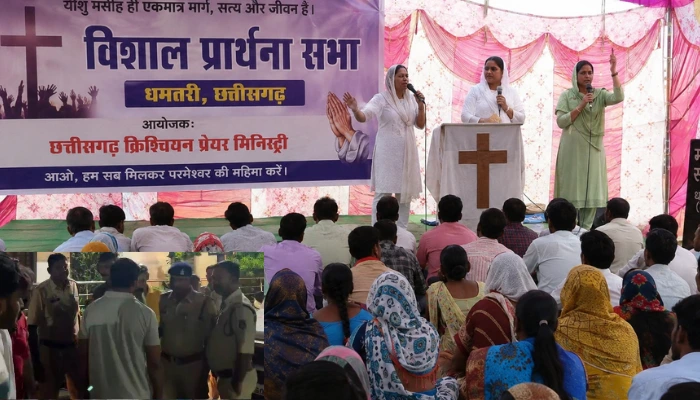
Case Summary
In the Risai Para area of Dhamtari, Chhattisgarh, Hindu residents were targeted for forced religious conversion by Christian missionaries. This occurred during a prayer meeting held at a local family’s home on 18 August 2026. The prayer meeting was being used to influence Hindus to convert to Christianity through promises of medical treatment and miraculous healing. According to media reports, the Hindu Jagran Manch, a Hindu organisation, arrived at a house in Risai Para where the prayer meeting was being organised. When its office-bearers and workers reached the location, they found three Christian women present at the gathering. The women were Christian pastors who had been brought from Kerala to conduct the prayer meeting and were attempting to influence the Hindus present to convert to Christianity. Hindu attendees suffering from serious illnesses were being offered inducements in the form of medical treatment and healing to encourage them to convert to Christianity. According to the Hindu Jagran Manch, people were being influenced through claims that their illnesses could be cured through the prayer meeting. This led to a prolonged commotion and slogan-shouting at the spot. Following the protest, Kotwali police reached the location and brought the situation under control. Police questioned the people present, the organisers and the three women and collected preliminary information about the gathering. Police said that an investigation was underway and that further legal action would be taken according to the facts established during the investigation. Chitresh Sahu, a city office-bearer of the Hindu Jagran Manch, said the organisation had received information that a prayer meeting was being held at the home of a sick person in Risai Para. He stated that Hindus were being pressured towards religious conversion by offering treatment for their illnesses and other inducements. He demanded a detailed and impartial investigation into the matter. The Hindu Jagran Manch submitted a memorandum to Kotwali police, demanding a detailed and impartial investigation and the registration of a First Information Report against those responsible. The organisation called for strict legal action against those found responsible. At the time of writing this report, the police investigation was ongoing.
Why it is Hate Crime ?
In this case, the primary category selected is: Predatory Proselytisation. The subcategory selected is: Conversion/attempts to convert by inducements. Predatory Proselytisation is not just limited to threat, harassment, force and violence, but it also has contours of stealth. In several cases, the Hindu victim is exploited to convert, with non-Hindus taking advantage of their poverty. In such cases, the Hindu victim who is suffering financially is offered monetary benefits, including lucrative offers for jobs, health treatment, education, etc, to induce the victim into changing his/her religion. In such cases, the religious identity of the victim and the aim to disenfranchise him from his faith form the heart of the crime. Also, taking advantage of and exploiting an individual’s economic vulnerabilities is widely acknowledged as exploitation, forms of which are often penalised by law. Such cases therefore are considered religiously motivated hate crimes since the victim’s religious identity forms the very heart of the crime itself. The other subcategory selected is: Proselytisation by grooming, brainwashing, manipulation or subtle indoctrination. Religious brainwashing essentially means the often subtle and forcible indoctrination to induce someone to give up their religious beliefs to accept contrasting regimented ideas. Religious grooming or brainwashing also involves propaganda and manipulation. It involves the systematic effort, driven by religious malice and indoctrination, to persuade “non-believers’ to accept allegiance, command, or doctrine to and of a contrasting faith. Cases of such grooming or brainwashing are far more nuanced than direct threats, coercion, inducement and violence. In such cases, it is often seen that there is repeated, subtle and continual manipulation of the victim to induce disaffection towards their own faith and acceptance of the contrasting faith of the perpetrator. While subtle indoctrination is widely acknowledged as predatory, an element which is often understated in such conversions or the attempts of such conversion is the role of loyalty and trust which might develop between the perpetrator and the victim. Fiduciary relationships are often abused to affect such religious conversion. For example, an educator transmitting religious doctrine of a competing faith to a Hindu student. The Hindu student is likely to accept what the teacher is transmitting owing to existence of the fiduciary relationship. The exploitation of the fiduciary relationship to religiously indoctrinate victims would also be included in this category. Since the underlying animosity towards the victim’s faith forms the basis of predatory proselytization, such cases are considered religiously motivated hate crimes. In this case, Hindu residents were specifically targeted for forced conversion to Christianity by Christian pastors who had been brought from Kerala to conduct a prayer meeting. The nature of the conversion efforts and their specific focus on Hindus demonstrate a targeted action against the Hindu community as a religious collectivity. When individuals or groups direct their efforts towards converting members of a particular religion, in this case, Hindus, it demonstrates a fundamental disregard for the faith and religious identity of those being targeted. Conversion efforts that seek to persuade individuals to abandon their existing faith through external inducements or pressure go beyond the ordinary sharing of a different belief system and instead seek to undermine their existing religious identity. In this context, the deliberate targeting of Hindu residents for conversion to Christianity reflects a lack of respect for Hinduism and its followers. Such efforts seek to detach Hindu victims from their faith and religious traditions, making this incident a clear example of a religiously motivated crime. The use of promises of medical treatment to encourage Christian conversion clearly demonstrates that these actions were not motivated solely by concern for the well-being of those suffering from illness. Instead, they were calculated attempts to exploit vulnerable Hindus, particularly those suffering from serious medical conditions, specifically because of their religion. By using the prospect of treatment and healing as an inducement for Hindus to change their faith, the Christian perpetrators were effectively taking advantage of vulnerable individuals desperate for relief from their illnesses. Such instances are seen in many cases where members of Christian missionary groups target vulnerable Hindus through various kinds of inducements to further their agenda of religious conversions. This form of incentive strips Hindus of their agency and dignity and results in conversions influenced by external pressure rather than genuine personal conviction. These were not random or isolated efforts, but deliberate attempts to undermine the Hindu faith, persuade Hindus to discard their religious identity, and convert to Christianity. Such acts demonstrate religious hostility towards Hindu victims and their faith, making this a religiously motivated crime. The use of supposed miraculous healing went further by linking the adoption of Christianity with the promise of relief from serious illnesses. Presenting religious conversion as a means through which individuals could obtain miraculous healing manipulates and brainwashes vulnerable people by creating a direct connection between abandoning their existing faith and receiving divine or supernatural benefits through Christianity. Such manipulation functions as a form of religious conditioning and brainwashing, particularly when directed at people who are already distressed or desperate because of illness. By portraying Christianity as the means to obtain healing while Hindu victims were being encouraged to abandon their existing faith, the perpetrators sought to reshape their religious beliefs through psychological and emotional influence rather than personal conviction. The use of miraculous healing claims in this manner therefore reflects hostility towards the existing Hindu faith of those being targeted and constitutes an attempt to undermine their religious identity, making the conversion effort religiously motivated. The fact that this incident occurred on 18 August 2026, just nine days after another incident of a similar nature was reported in Dhamtari on 9 August 2026, demonstrates that this was not an isolated occurrence. In the earlier incident, Hindus were targeted for conversion to Christianity after being lured to attend a prayer meeting. The occurrence of two such incidents within a span of nine days demonstrates a pattern of similar conversion activities targeting Hindus in the Dhamtari area of Chhattisgarh. This recurrence of similar crimes against Hindus, rather than isolated incidents, demonstrates a continuing pattern of efforts to undermine the religious identity of members of the Hindu community, making these acts religiously motivated and constituting a hate crime. These instances of targeted proselytisation activities stem from inherent hostility towards the victims' professed faith, since Abrahamic faiths believe that any non-adherent to their faith is subject to being dehumanised till they convert, making it a religiously motivated crime against Hindus. Therefore, this case is being added to the hate crime database of the Hinduphobia Tracker. Disclaimer: In this case, the perpetrator count has been recorded as three, referring to the three Christian female pastors identified as being involved in conducting the prayer meeting and the conversion efforts. Although other individuals, including the organisers of the gathering, were also involved, their total number was not specified in the available reports. Therefore, for documentation purposes, the perpetrator count has conservatively been recorded as three. This figure is a conservative estimate and is intended solely for documentation purposes. In this case, since the total number of Hindu victims targeted for religious conversion was not specified in the available reports, the victim count has been recorded as "Unknown".


Case Status
Complaint filed


Perpetrators Details
Perpetrators
Christian Extremists
Perpetrators Range
From 2 To 5
Perpetrators Gender
female
 Sources




