Hindu sentiments insulted; Muslim man circulates objectionable videos targeting Hindu deities on social media
 Basti, Uttar Pradesh, India
  18 August, 2026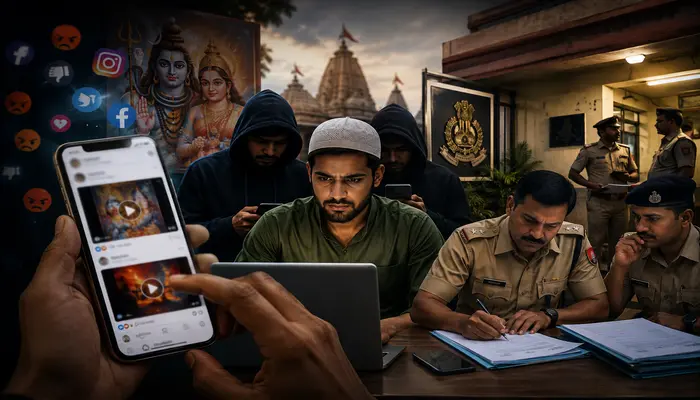
Case Summary
In Basti, Uttar Pradesh, a man named Zeeshan Ahmed, son of Ujjar, along with two other individuals, posted and circulated inflammatory videos on various social media platforms that contained derogatory comments about Hindu deities and offensive meme reels. The incident occurred within the jurisdiction of the Nagar Police Station. Ashok Verma, associated with the city unit of the Vishwa Hindu Mahasangh, submitted a formal complaint detailing the abusive comments and targeted content. The organisation highlighted that improper material targeting Hinduism, Hindu gods and goddesses, and Hindu sisters and daughters was circulated and requested strict legal action against those responsible for hurting the religious sentiments of the community. In response to the complaint, authorities at the Basti Nagar Police Station registered a First Information Report on 19 August 2026 at 7:12 pm. Police filed the case against Zeeshan Ahmed and two unidentified individuals under Section 196(1)(a) of the Bharatiya Nyaya Sanhita. Regarding the authorities involved, one report stated that Station House Officer Ram Prasad Yadav confirmed the receipt of the complaint, while another report stated that the officer was Ranjeet Singh Baghel. The investigation was handed over to Inspector Awadhesh Sharma, who examined the social media videos, specific dates, and the exact roles of the individuals involved.
Why it is Hate Crime ?
This case is being added to the tracker under the primary category: Hate Speech against Hindus. The subcategory selected is: Anti-Hindu slurs, mocking faith. Anti-Hindu slurs and the deliberate mocking of the Hindu faith owing to religious animosity involve the usage of derogatory terms, stereotypes, or offensive references to religious practices, symbols, or figures. One of the common anti-Hindu slurs used against Hindus is “cow-worshipper” and “cow piss drinker”. The intention of using this term is to demean and mock Hindus as a group and their religious beliefs since Hindus consider the cow holy. Additionally, some symbols and the slurs attached to them have a historical context that exacerbates the insult, hate, stereotyping, dehumanisation and oppression against Hindus. Cow worship has been used for centuries to denigrate Hindus, insult their faith and oppress Hindus specifically as a religious group. There has been overwhelming documentation about how cow slaughter has been used to persecute Hindus with cow meat being thrown in temples and places of worship. There has also been overwhelming documentation where cow meat (beef) has been force-fed to Hindus to either forcefully convert them to Islam or denigrate their faith. Apart from cow worship, the Swastika – which holds deep religious significance for the Hindus – has also been misinterpreted and distorted to use as a slur against Hindus. Similarly, the worship of the Shivling has been used by supremacist ideologies and religions to denigrate Hindus owing to religious animosity. Such slurs and denigration stem out of inherent animosity and hate towards Hindus and their faith, therefore, it is categorised as hate speech targeted at Hindus specifically owing to their religious identity. The creation and circulation of derogatory comments aimed at Hindu deities constituted a calculated attack on the fundamental tenets of the Hindu faith. By specifically selecting revered religious figures as subjects of abuse, the accused demonstrated clear religious animosity. This conduct went beyond ordinary offensive behaviour; it weaponised the community’s core spiritual beliefs to inflict emotional and psychological harm. The explicit focus on Hindu gods and goddesses established the religious identity of the victims as the primary motivation for the hostility. Furthermore, the dissemination of improper material concerning Hindu women served as a strategic tool to demean the broader religious group. In many instances of religiously motivated hostility, the dignity of women from a specific community is targeted to humiliate and assert dominance over that entire demographic. The victims in this context were singled out not merely as individuals, but explicitly as Hindu women, turning their religious affiliation into a vulnerability. This gendered dimension of the abuse highlighted a deep-seated contempt for the Hindu community as a whole. The utilisation of digital platforms and meme reels to spread these insults further evidenced a deliberate intent to mock and trivialise the Hindu faith. Meme formats are inherently designed for mass consumption and ridicule, making them potent vehicles for normalising anti-Hindu hostility. By packaging derogatory sentiments into shareable, inflammatory content, the perpetrators actively sought to amplify their disdain and encourage collective mockery of Hindu practices and identities. This systemic trivialisation directly fulfilled the criteria for the deliberate mocking of religious beliefs. Ultimately, these combined actions functioned to marginalise and intimidate Hindus by attacking both their sacred figures and their community members. Such targeted disparagement relied on the use of hostility and visual slurs to degrade the religious identity of the victims. The calculated nature of the abuse, stemming from inherent religious prejudice, firmly positioned the conduct as hate speech directed specifically at Hindus. The incident exemplified how digital spaces are leveraged to perpetuate anti-Hindu animosity and mock the faith on a public scale. Disclaimer: The Hinduphobia Tracker records incident dates based on when the crime occurred, not when it was reported or published. In this case, the available reports do not specify the exact date on which the accused posted the offensive content on social media. Therefore, 19 August 2026, the date on which the FIR was registered, has been used as the indicative incident date for documentation purposes only.


Case Status
Complaint registered


Perpetrators Details
Perpetrators
Muslim Extremists
Perpetrators Range
From 2 To 5
Perpetrators Gender
male
 Sources




