Hindu community intimidated through Islamic supremacist slogan for protesting against illegal cow slaughter in Assam
 Silchar, Assam, India
  1 August, 2026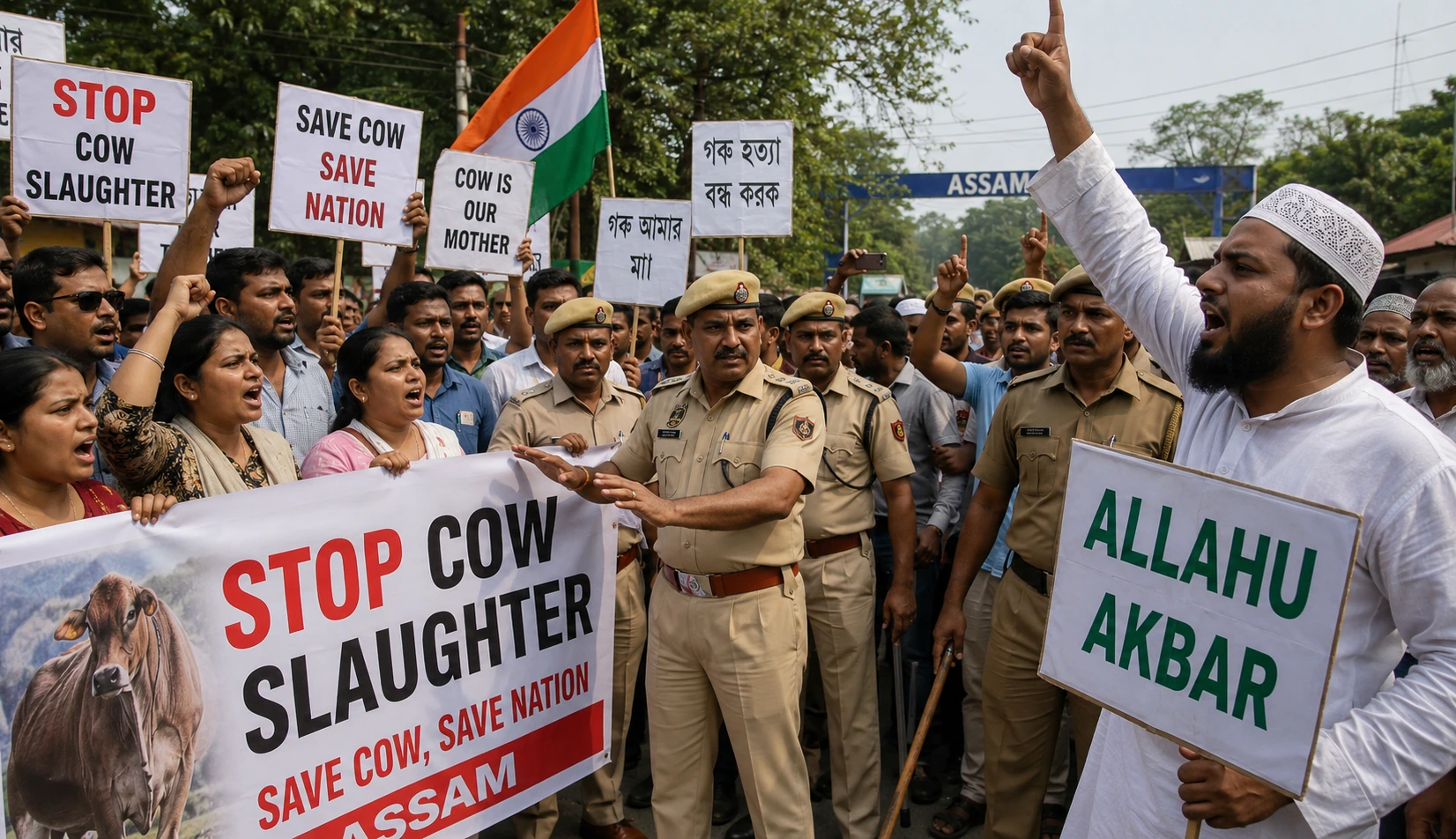
Case Summary
In Silchar, Assam, members of the Hindu community were intimidated by a Muslim man raising the Islamic supremacist slogan “Allahu Akbar” after an illegal cow slaughter was exposed in the Ghoniala area of Malugram. The incident unfolded after information emerged that a cow had been slaughtered at a house in the locality and that its meat was being transported to different homes. According to information available, on 2nd August 2026, Bajrang Dal members received information at around 9 am about the cow slaughter at a house in the Malugram Ghoniala Road area. Acting on the information, they intercepted an e-rickshaw carrying cow meat in Ghoniala. The Muslim e-rickshaw driver was stopped and handed over to the police, who subsequently detained him along with another Muslim individual from the house where the slaughter had taken place. Around two kilograms of beef were also handed over to the police. During the ensuing protest, a Muslim individual present at the scene raised the slogan “Allahu Akbar”, intimidating the Hindu protesters and further aggravating the confrontation. Following this, some protesters thrashed one of the accused before the police intervened and took him into custody. A total of three people were detained in connection with the incident. Following the seizure, Bajrang Dal members staged a road blockade and raised slogans including “Jehadi Mindset Murdabad” and “Islamic Jehadis Murdabad”, demanding strict legal action against those responsible. The protesters questioned whether the State Government’s ban on cow slaughter was being effectively enforced and said that such incidents repeatedly hurt Hindu religious sentiments. Addressing the media, a Bajrang Dal activist said that the organisation had received information around 9 am that a cow had been slaughtered in the Malugram Ghoniala Road area and that its meat was being delivered to different homes. He said that around two kilograms of suspected beef had been handed over to the police and questioned whether the ban on cow slaughter was being effectively enforced. He further warned that, if legal action was not taken within 24 hours, the organisation would intensify its protest and block all roads leading to Malugram. Police and Central Reserve Police Force personnel were deployed in the area to prevent further confrontation. Cachar Additional Superintendent of Police Rajat Kumar Pal said that the police had received information about the incident and immediately reached the spot. He said that additional police personnel and Central Reserve Police Force personnel were deployed to bring the situation under control and assured that a thorough investigation would be conducted and appropriate legal action would follow based on its findings. At the time of reporting, the situation remained under control, and the police investigation was underway.
Why it is Hate Crime ?
This case is being added to the tracker under the primary category: Hate Speech against Hindus. The subcategory selected is: Violent Threats. Violent threats, explicit, implicit or implied, is the most dangerous form of hate speech since it goes beyond discriminatory and prejudicial language to express the intent of causing harm to an individual or a group of people based on their religious identity and faith. There could be several different kinds of threats that are issued to Hindus based on religious animosity. An explicit threat would mean the direct threat of violence towards an individual Hindu, a group of Hindus or Hindus at large. Physical violence, death threats, threats of destruction of property belonging to Hindus and threats of genocide would mean explicit threats against Hindus for their religious identity. Implicit threats may not be a direct threat but implied through the use of symbols of actions – for example – in the Nupur Sharma case, other than explicit threats, there were also implicit threats when Islamists took to the streets to burn and beat her effigies. It implies that they want to do the same to Nupur Sharma – thereby is considered an implicit threat. Violent threats can be delivered in person, through letters, phone calls, graffiti, or increasingly through social media and other online platforms. It would be important to understand that a threat – explicit or implicit, online or offline – to an individual who happens to be a Hindu does not qualify as a religiously motivated threat. Such a threat, while vile and dangerous, could be owing to non-religious reasons and/or personal animosity. To qualify as a religiously motivated threat, it would need to exhibit an indication that the individual is being targeted for religious reasons and/or owing to his/her religious identity as a Hindu. This case highlighted a clear instance of religiously motivated intimidation, in which a Muslim man raised “Allahu Akbar” slogans in response to Hindus protesting against cow slaughter. The backdrop of the incident is essential to understanding its religious nature. The Hindu community was protesting against cow slaughter, an issue that directly affected its deeply held religious beliefs and sentiments. To understand why cow slaughter evokes such profound anguish within Hindu society, one must first understand what the cow represents within Hindu civilisation. The cow is not merely regarded as an animal or livestock but is revered as Gau Mata, symbolising motherhood, nurturing, sacrifice, compassion and life-giving abundance. Its sacred status is rooted in centuries of Hindu belief and practice and is closely connected to the wider Hindu tradition of reverence for the feminine and the Divine Mother, reflected in the worship of goddesses such as Durga, Lakshmi, Saraswati and Kali. Vedic literature refers to the cow as Aghnya, meaning one that should not be harmed or killed, while cow-derived products also hold an important place in Hindu rituals, ceremonies and religious observances. For Hindus, therefore, the cow is a sacred symbol intimately connected to their religion, culture and civilisational identity. Consequently, the Hindu community's opposition to cow slaughter in this case stemmed directly from the profound religious significance that the cow holds within Hinduism. Therefore, the slaughter of a cow is deeply offensive to all Hindus and causes profound hurt to their religious sentiments. In this case, the Hindu community, including its activists, was protesting against the illegal slaughter of a cow in Assam and seeking action against those Muslim perpetrators who were responsible. Importantly, they did not take the law into their own hands but pursued the matter through legal channels, following which the police arrived and action was taken against the perpetrators. It was in response to this protest and the lawful action initiated against the illegal cow slaughter that a Muslim man raised “Allahu Akbar” slogans. While “Allahu Akbar” is an Islamic religious expression and its use by itself does not constitute hate speech, the context in which it was raised in this incident is significant. The slogan was raised in opposition to Hindus protesting against an act that had deeply hurt their religious sentiments, thereby introducing an explicit religious dimension into the confrontation. In this context, its use functioned as a means of confronting and intimidating the Hindu protesters through the invocation of Islamic religious identity. The incident therefore demonstrated religious hostility towards the Hindu community because of the specific context and apparent intent behind the use of the slogan. The deliberate invocation of an Islamic religious slogan against Hindus who were lawfully protesting against illegal cow slaughter could reasonably be understood as an attempt to intimidate and threaten the community and transform the confrontation into one of a religious nature. The issue was not merely the use of a religious expression in isolation but the manner in which it was deployed directly against Hindus protesting over an act they considered an affront to their faith. Given this context, the slogan was an assertion of Islamic religious dominance intended to confront the Hindu community, aggravate communal tensions and demonstrate hostility towards Hindu beliefs and sentiments. Notably, this was not the first time “Allahu Akbar” slogans had been used to intimidate Hindus. In several previous instances, Muslim extremists have weaponised the slogan as a battle cry during acts of aggression, using it to intimidate Hindus and project religious dominance. This reflects a broader pattern seen in other incidents of violence targeting Hindus, their homes, temples, processions and businesses, including the 2020 anti-Hindu riots in Delhi, the 2022 Karauli violence in Rajasthan, the Jahangirpuri riots in Delhi, the September 2025 Bareilly clashes surrounding the “I Love Mohammad” poster controversy, and the December 2025 lynching of Dipu Chandra Das in Mymensingh, Bangladesh. In each of these instances, the slogan accompanied acts of aggression directed against Hindus and their religious institutions, reinforcing the fact that it had been used as a tool of mobilisation, intimidation and the assertion of religious dominance. The use of such slogans during acts of violence underscores how religious expressions are deployed by Muslims to legitimise aggression in the name of Allah. This pattern is evident in multiple incidents where Muslim mobs launch attacks against non-Muslims, particularly Hindus, using religious slogans both as a battle cry and as a means of framing violence as divinely sanctioned. The invocation of such slogans amid stone pelting, arson, and communal riots reflects a mindset in which perpetrators believe their actions align with religious duty, thereby dehumanising Hindu victims and encouraging further violence. This dynamic contributes to the normalisation of hostility against Hindus, who are targeted for their religious identity and their participation in cultural or religious practices. The repeated use of such slogans during coordinated acts of intimidation and violence reveals an underlying pattern of religious intolerance in which aggression is sanctified under the guise of faith-driven retaliation. The same pattern is observed very clearly in this current case. Overall, since this case meets the parameters of a hate crime, it is being added to the hate crime database of the Hinduphobia Tracker.


Case Status
Unknown


Perpetrators Details
Perpetrators
Muslim Extremists
Perpetrators Range
One Person
Perpetrators Gender
unknown
 Sources




