Minor Hindu girl converted to Islam and married to Muslim man; found dead four months after marriage
 Jhenaidah District, Bangladesh
  16 August, 2026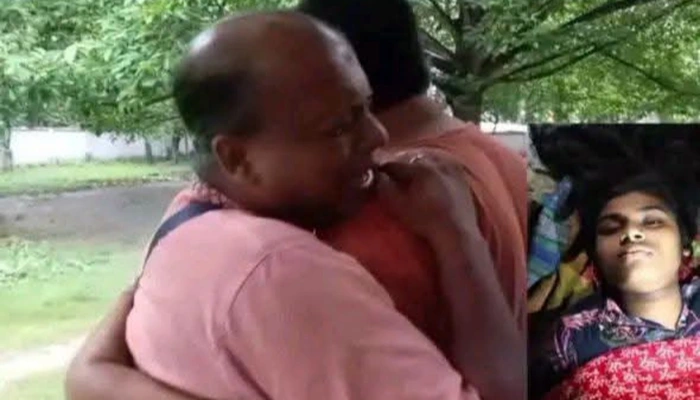
Case Summary
In Gilabaria village, Bangladesh, a 14-year-old Hindu girl was forcibly converted to Islam before her marriage to a Muslim man. Later, she was found dead inside a room at her Muslim husband's residence. The minor Hindu girl was identified as Sujata Karmakar Barma alias Mariam Khatun, daughter of Sanad Karmakar. According to information provided by the family, the minor Hindu girl was converted to Islam before being married to Md Sajjad Hossain. Following the marriage, she was living at her husband’s residence. She was found dead approximately four months after the marriage. On Monday, 17 August 2026, at around 10:30 am, Priya Khatun, wife of Md Saurav Hossain, 21, found Mariam dead inside a room of the house. Priya Khatun raised an alarm after discovering her, following which family members rushed to the room. The incident was subsequently reported to the police. Police recovered Mariam’s body and began the necessary legal procedures. An unnatural death case was filed by the police in connection with the incident. Police stated that the actual cause of death would be determined through the investigation and completion of the necessary legal procedures. Authorities had not publicly confirmed the cause of death. This incident occurred against the backdrop of the continuing persecution of Hindus in Bangladesh, where the community has repeatedly faced attacks on its places of worship, religious symbols, and festivals. Incidents targeting Hindu temples and disrupting religious observances have become increasingly frequent since August 2024, indicating that such acts are not isolated but form part of a broader pattern of hostility towards the Hindu minority. The escalation of anti-Hindu violence in Bangladesh has unfolded in three distinct phases: first, following the ouster of Sheikh Hasina's government in August 2024; second, after the death of Sharif Osman Bin Hadi in December 2025; and third, in the aftermath of the 13th National Parliamentary Election in 2026. During these periods, multiple incidents involving attacks on Hindu temples, homes, businesses, and religious gatherings were reported across the country. Following the removal of Sheikh Hasina's government, reports documented attacks on Hindu homes, temples, and religious institutions, alongside intimidation campaigns, arson, vandalism, and mob violence targeting minority communities. The Hinduphobia Tracker has documented 336 incidents of anti-Hindu violence during this period, highlighting the scale and persistence of hostility faced by the Hindu minority. A further escalation followed the death of Sharif Osman Bin Hadi, after which Hindu communities were blamed and targeted in retaliatory attacks. Hindu homes were selectively set ablaze, places of worship were attacked, and families were displaced in several districts. The Hinduphobia Tracker documented 51 incidents of anti-Hindu violence during this phase alone, reflecting the continued vulnerability of the community amid rising communal tensions. The third wave of violence emerged following the 13th National Parliamentary Election in 2026. Within days of the declaration of results, reports from several districts described coordinated incidents involving arson, looting, assaults, vandalism of Hindu temples, and attacks on Hindu homes. Seen in the context of the continuing pattern of anti-Hindu violence in Bangladesh, the coercive conversion and marriage of a minor Hindu girl reflected the broader climate of hostility and intimidation faced by the Hindu minority in the country.
Why it is Hate Crime ?
The primary category selected in this case is: Predatory Proselytisation. Within this, the subcategory selected is: Proselytisation by grooming, brainwashing, manipulation and subtle indoctrination. The tertiary category selected is: Conversion of minor Religious brainwashing essentially means the often subtle and forcible indoctrination to induce someone to give up their religious beliefs to accept contrasting regimented ideas. Religious grooming or brainwashing also involves propaganda and manipulation. It involves the systematic effort, driven by religious malice and indoctrination, to persuade “non-believers’ to accept allegiance, command, or doctrine to and of a contrasting faith. Cases of such grooming or brainwashing are far more nuanced than direct threats, coercion, inducement and violence. In such cases, it is often seen that there is repeated, subtle and continual manipulation of the victim to induce disaffection towards their own faith and acceptance of the contrasting faith of the perpetrator. While subtle indoctrination is widely acknowledged as predatory, an element which is often understated in such conversions or in the attempts at such conversion is the role of loyalty and trust which might develop between the perpetrator and the victim. Fiduciary relationships are often abused to affect such religious conversion. For example, an educator transmitting religious doctrine of a competing faith to a Hindu student. The Hindu student is likely to accept what the teacher is transmitting owing to the existence of the fiduciary relationship. The exploitation of the fiduciary relationship to religiously indoctrinate victims would also be included in this category. Since the underlying animosity towards the victim’s faith forms the basis of predatory proselytisation, such cases are considered religiously motivated hate crimes. The second primary category selected in this case is: Crime against women in relationships and other sexual crimes. Within this, the subcategory selected is: Brainwashed and/or groomed. The tertiary category selected is: Conversion of a minor. In our database, we have not added incidents where women have converted to another religion of their free will, and no allegations of forced/involuntary conversion have been made. However, there are certain cases of conversion where the consent itself is a result of the brainwashing or grooming of a minor by the non-Hindu perpetrator trying to victimise a woman for her Hindu religious identity. The phenomenon of grooming points to non-Hindu perpetrators identifying their Hindu victims’ vulnerabilities and exploiting them over months and sometimes years to extract the supposed ‘consent’ to convert their religion. In most cases of grooming, the victims are minors or the grooming started when the victim was a minor. In other cases of grooming, the non-Hindu perpetrator brainwashes and grooms a minor victim to extract their trust and then proceeds to rape them repeatedly with the intent of converting them to their faith. It is pertinent to understand here that when the victim is a minor, the ‘consent’ to convert or enter into a romantic relationship with an adult itself is redundant – addressed by POCSO. While every case of conversion of a minor and incidents of establishing a physical relationship with a minor by an adult is a crime, for this database, a case would be considered a hate crime only if there is a distinct religious angle to the grooming. For example, in the UK, if a Hindu minor is targeted by Pakistani grooming gangs, it would be considered a hate crime because the victims are specifically targeted owing to their non-Muslim religious identity with the perpetrators being Muslim. In other cases, if a Hindu minor is brainwashed into entering a physical relationship with the non-Hindu adult perpetrator and the family alleges grooming/brainwashing of the minor to convert her religion, it would form a part of this database. If the victim is a Hindu adult, the case would form a part of this database only if the victim herself says that she was brainwashed/groomed to convert her religion. However, if the victim is deceased (murdered or otherwise), the case would form a part of this database if her family/friends provided testimony that the victim was brainwashed/groomed to convert her religion. Since these crimes have a distinct religious angle where the victim is being targeted owing to her Hindu religious identity, these cases are considered a hate crime. The other sub-category selected here is - Forced conversion before marriage. In such cases, a non-Hindu man is in a relationship with a Hindu woman when the pressure to convert her religion begins to manifest. In such cases, typically, two patterns emerge. First, when the relationship is consensual, and the religious identity of the perpetrator is known to the Hindu woman in the relationship, however, at some point during the relationship, the non-Hindu man starts to force the victim to convert her religion and give up her Hindu religious identity. The second is when the woman gets into a marriage with the man pretending to share her faith. Later, when the truth is revealed, the man starts pressuring the woman to convert her religion and give up her religious identity. In both the situations, the methods used to force the victim to convert her religion often revolve around force-feeding beef, forcing her to wear hijab, forcing her to read the Kalma or even pressurizing the victim to do ‘Nikah’, which is marriage under Islamic law, with a prerequisite being conversion to Islam. Cases where a Hindu woman consensually converts to Islam in a relationship will be left out of the hate crime database, even though it could be argued in several cases that the conversion was a result of religious brainwashing. This incident has been included in the tracker because it has multiple religious markers. Here, a minor Hindu girl was groomed, converted to Islam, had her name changed and married to a Muslim man. Approximately four months after the marriage, the girl was found dead at her husband's place. The sequence of events did not involve a voluntary change of faith arising from independent religious conviction. Instead, it involved targeting a Hindu minor, which led to her conversion, the changing of her name, and a subsequent nikah. The clearest religious marker in this case is that the victim's Hindu identity was not merely incidental to the events but was actively replaced through a formal religious process. Sujata Karmakar Barma alias Mariam Khatun was converted to Islam before marriage with Md Sajjad Hossain. This element gave the incident a distinct religious dimension, as it was a religiously motivated attempt to sever her connection with her original faith and impose another religious identity upon her. Additionally, ever her name was changed and she was given a Muslim. This was to erase her past Hindu identity and impose Islamic identity on her. It was not a matter of personal choice; it was coercion rooted in hostility towards the victim's Hindu identity. Such an attempt reflects religious animosity because the act was not simply about personal differences but about erasing the victim’s Hindu faith, making it a religiously motivated crime. Furthermore, the Hindu victim was a minor, which essentially means that the element of consent and genuine change of conscience was missing ab initio. It is a well-established fact that children are more susceptible to manipulation since they are still developing emotionally, cognitively, and socially. Their brains are not fully mature, making them more susceptible to influence and less capable of critically evaluating information. Thus, it is evident that a Hindu minor was converted against her will in this case, as opposed to it being voluntary. Since the underlying offence in this case is against a minor girl of a specific faith and involves subtle tactics of indoctrination, which obviously stem from a bias against the Hindu faith, this case has been documented as a hate crime. The timing of her death four months after conversion and marriage prompts questions about her treatment during that period, particularly because of her age. Since she was 14, important questions include whether her conversion and marriage were genuinely voluntary, whether she remained in contact with her Hindu family after leaving the faith, and whether she faced pressure to adopt Islamic practices or sever ties with her previous religious identity. Such acts are carried out by Muslim perpetrators due to indoctrination by Islamic theology, which advocates that all non-Muslims (referred to as kafirs) are inferior and subject to subjugation unless they convert to Islam or live under Islamic rule (dhimmitude). These ideas are not mere abstractions; they manifest in actions where non-Muslims, especially Hindus in India, are seen as targets for religious domination, coercion, or humiliation. This theological framework fosters an "us versus them" mindset, in which any assertion of Hindu identity or religious freedom is seen not only as undesirable but as a threat to Islamic supremacy. As a result, perpetrators who are shaped by such teachings feel justified, even morally obligated, to harass, suppress, or violently attack Hindus, particularly when Hindus assert their religious rights or resist conversion. Such acts, therefore, are not isolated but driven by a broader ideological hostility towards Hindus as non-believers and reflect an attempt to impose religious dominance. Notably, the incident occurred against the backdrop of an increasingly hostile environment for Hindus in Bangladesh. As documented by the Hinduphobia Tracker, the period following the ouster of Sheikh Hasina's government in August 2024, the violence after the death of Sharif Osman Bin Hadi, and the unrest following the 2026 parliamentary elections witnessed repeated attacks on Hindu homes, temples, businesses, and religious institutions. Within this broader climate of anti-Hindu violence, the repeated targeting of Hindus and their faith assumes greater significance. It reflects the vulnerability of Hindus who publicly assert their religious identity in an environment where organised hostility against Hindu symbols has become increasingly normalised.
Victim Details
Total Victim
1
Deceased
0
Gender
- Male 0
- Female 1
- Third Gender 0
- Unknown 0
Caste
- SC/ST 0
- OBC 0
- General 0
- Unknown 1
Age Group
- Minor 1
- Adult 0
- Senior Citizen 0
- Unknown 0


Case Status
Complaint filed


Perpetrators Details
Perpetrators
Muslim Extremists
Perpetrators Range
One Person
Perpetrators Gender
male
 Sources




