Hindu minorities threatened with violence by Islamic leader in Chattogram, Bangladesh
 Chittagong, Chittagong Division, Bangladesh
  25 July, 2026
Case Summary
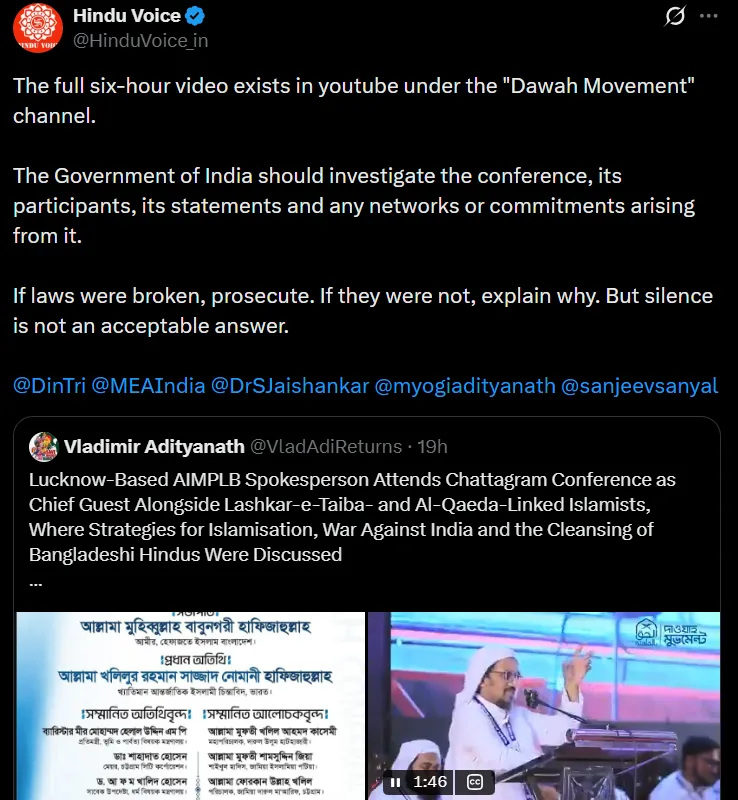
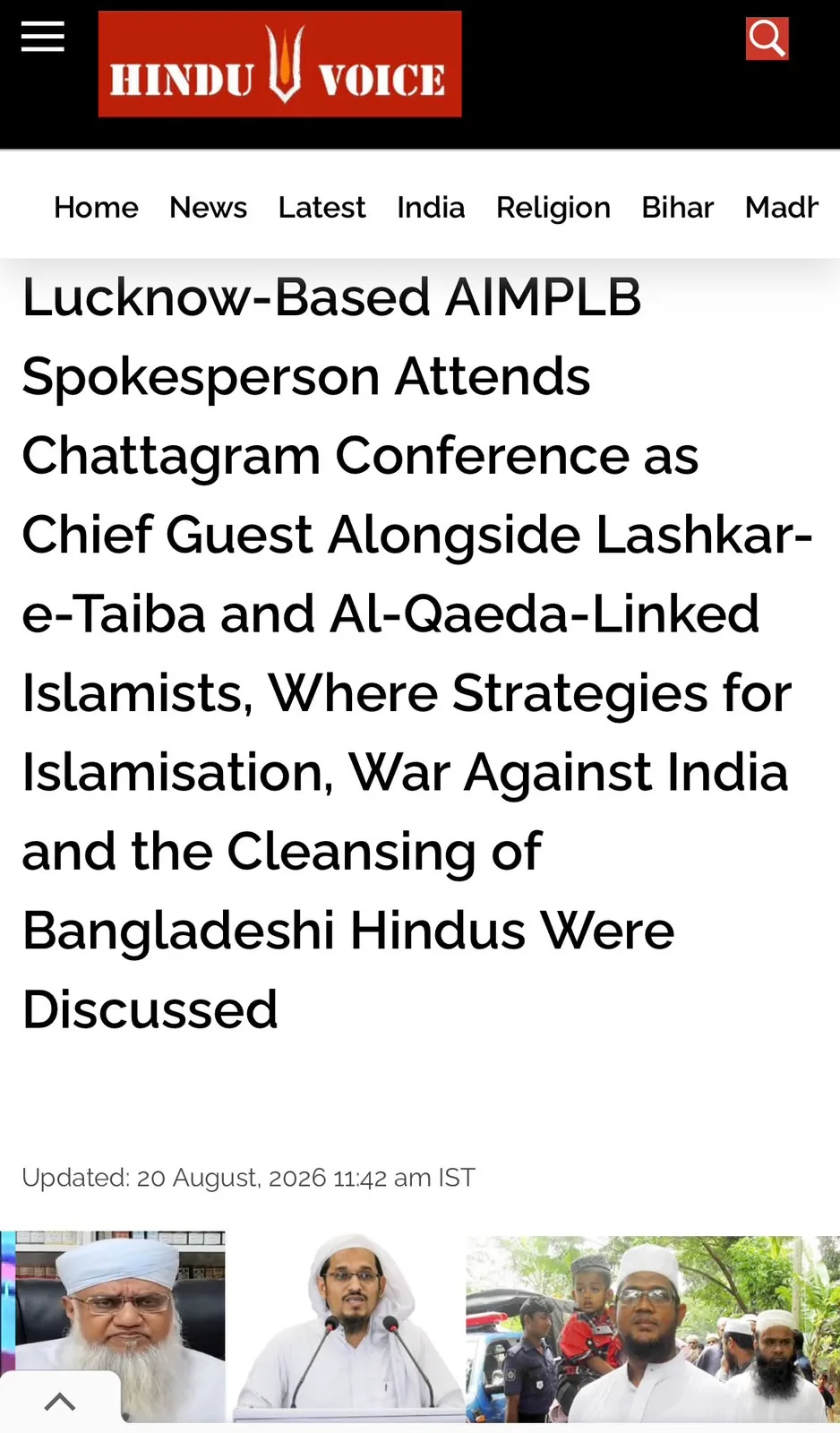
In Chattogram, Bangladesh, the Hindu community was subjected to violent threats by Islamic leader Harun Izhar. During an Islamic religious conference, Izhar threatened Hindus and the International Society for Krishna Consciousness (ISKCON) with violence. He stated that Hindus could be killed easily and that he would not need to carry out the violence himself, as his supporters were sufficient to do so. At the time of writing this report, Harun Izhar was the Joint General Secretary of Hefazat-e-Islam and was linked to Al-Qaeda, an Islamic terrorist organisation. The accused Izhar had attended a six-hour-long Dawah Conference held at the Engineers’ Institute in Chattogram on 26 July 2026, with the stated aim of increasing coordination and spreading Islamic awareness across the Indian subcontinent. During the conference, Izhar claimed that Indian media outlets were conducting a smear campaign against the Dawah Movement by publishing photographs of Islamic preachers alongside leaflets and portraying its conferences as fundamentalist and militant. He then directed his remarks towards Hindus in Chattogram and specifically named the International Society for Krishna Consciousness (ISKCON), falsely accusing the organisation and local Hindus of provoking his followers. Izhar stated that his group had the power to strike back and warned Hindus not to mistake his patience for weakness. He further threatened to physically confront those supported by the Hindu community and said that his group would deliver a ‘befitting reply’. He also stated that Hindus could be killed easily and that he would not need to carry out such violence himself because his supporters were sufficient to execute it. The conference also focused on expanding a Deobandi interpretation of Islam in India and Bangladesh, particularly through India’s border states, and on increasing coordination between Muslims in the two countries. Izhar delivered a speech and participated in an onstage group discussion during the event. Maulana Khalilur Rahman Sajjad Nomani, a Lucknow-based spokesperson and senior member of the All India Muslim Personal Law Board (AIMPLB), attended the conference as the chief guest. Jashimuddin Rahmani, leader of the Ansarullah Bangla Team, an Al-Qaeda-inspired organisation affiliated with Al-Qaeda in the Indian Subcontinent (AQIS), also addressed the gathering. Muhibullah Babunagari, the Amir of Hefazat-e-Islam, participated in the conference as well. Following Izhar’s statements, a United Nations Security Council monitoring team released a report expressing concern over the growing influence and radicalisation of Al-Qaeda in Bangladesh. The report noted that Al-Qaeda in the Indian Subcontinent (AQIS) was evolving into a major regional terrorist network operating through small, clandestine units. Notably, Izhar had previously been arrested by Bangladeshi authorities in 2009 over ties with Lashkar-e-Taiba, another Islamic terrorist organisation. Izhar also had a long record of extremist involvement. Following a 2013 explosion at his family’s madrasa in Lalkhan Bazar that killed three people, police recovered grenades and explosive materials, leading to criminal cases against him. He was arrested again in March 2021 for inciting violent protests and faced eleven criminal cases across Dhaka, Chittagong, and Rajshahi before obtaining bail in 2023. In December 2025, he also interfered with law enforcement during attacks targeting Indian diplomatic interests in Chittagong. This incident is part of an ongoing pattern of violence against Hindus in Bangladesh, where the community has repeatedly faced persecution and disruptions to their religious festivals and gatherings. Such attacks on Hindu minorities have become increasingly frequent and intensified since August 2024. This escalation of violence against Hindus in Bangladesh has unfolded in three distinct phases: first, following the ouster of Sheikh Hasina’s government in August 2024; second, after the death of Sharif Osman Bin Hadi in December 2025; and third, in the immediate aftermath of the 13th National Parliamentary Election 2026. Following the ouster of Sheikh Hasina, multiple documents recorded attacks on Hindu homes, temples, and religious institutions, alongside intimidation campaigns, arson, and mob assaults targeting minority neighbourhoods. The Hinduphobia Tracker has recorded 336 such incidents against the Hindu minority, underscoring the scale and persistence of anti-Hindu violence during this period. A further escalation occurred following the death of Sharif Osman Bin Hadi, a Muslim political activist and student leader known for his anti-Hindu and anti-India rhetoric. Hadi had been involved in political unrest after the fall of the Hasina government and was killed in Dhaka on 18 December 2025 during clashes. In the aftermath of his death, Hindu communities were blamed and subsequently targeted in retaliatory violence. Hindu homes were selectively set ablaze in multiple localities, forcing families to flee and leaving many displaced. The attacks appeared patterned rather than sporadic, with Muslim mobs focusing on Hindu neighbourhoods, properties, and religious symbols. Among the victims was Dipu Chandra Das, who was lynched to death and his body set ablaze by a Muslim mob over false blasphemy allegations. The Hinduphobia Tracker documented 51 incidents of anti-Hindu violence in the period following Hadi’s death alone. Such incidents underscore the vulnerability of the Hindu minority amid rising communal hostility and the weaponisation of religious accusations. Posters and written materials calling for the extermination of Hindus were displayed in public spaces, signalling an alarming normalisation of genocidal rhetoric. When combined with acts of arson, vandalism, assault, and targeted intimidation, these developments suggest a coordinated environment of hostility aimed at terrorising the Hindu community and reinforcing majoritarian dominance. The third phase of violence was unleashed after the 13th National Parliamentary Election 2026. Within days of the announcement of results, Hindu families in districts such as Noakhali, Rangpur, Nilphamari, Sylhet, Thakurgaon, and Dinajpur sustained coordinated attacks involving arson, looting, assault, and vandalism of temples and homes. In several instances, Hindu homes were selectively targeted, looted, and families were threatened with displacement.
Case Images

Why it is Hate Crime ?
This case has been documented under the selected primary category: Hate speech against Hindus. Under this, the selected secondary category is: Violent threats. Violent threats, explicit, implicit or implied, are the most dangerous form of hate speech since it goes beyond discriminatory and prejudicial language to express the intent of causing harm to an individual or a group of people based on their religious identity and faith. There could be several different kinds of threats that are issued to Hindus based on religious animosity. An explicit threat would mean a direct threat of violence towards an individual Hindu, a group of Hindus or Hindus at large. Physical violence, death threats, threats of destruction of property belonging to Hindus and threats of genocide would mean explicit threats against Hindus for their religious identity. Implicit threats may not be a direct threat but implied through the use of symbols or actions – for example – in the Nupur Sharma case, other than explicit threats, there were also implicit threats when Islamists took to the streets to burn and beat her effigies. It implies that they want to do the same to Nupur Sharma – thereby is considered an implicit threat. Violent threats can be delivered in person, through letters, phone calls, graffiti, or increasingly through social media and other online platforms. It would be important to understand that a threat – explicit or implicit, online or offline – to an individual who happens to be a Hindu does not qualify as a religiously motivated threat. Such a threat, while vile and dangerous, could be owing to non-religious reasons and/or personal animosity. To qualify as a religiously motivated threat, it would need to exhibit an indication that the individual is being targeted for religious reasons and/or owing to his/her religious identity as a Hindu. This case constitutes a clear instance of religiously motivated hate speech directed at the Hindu community. Harun Izhar did not merely express disagreement with a particular individual or organisation; he openly threatened Hindus with violence and stated that they could be killed easily. He further suggested that he would not even need to personally carry out such violence because his followers were sufficient to execute it. By invoking the prospect of violence against people on the basis of their Hindu identity and presenting his supporters as a force capable of carrying out such threats, Izhar's statements went beyond ordinary inflammatory rhetoric and amounted to an explicit communal threat directed at Hindus. The threats were particularly significant because Izhar did not confine his hostility to a single person or isolated group. He specifically targeted the wider Hindu community and named the International Society for Krishna Consciousness (ISKCON), a globally recognised Hindu religious organisation devoted to the worship and propagation of the teachings of Lord Krishna and the Vaishnava tradition. ISKCON represents an important religious institution for millions of Hindus in India, Bangladesh, and across the world. By threatening both Hindus collectively and a prominent Hindu religious organisation, Izhar directed his hostility towards Hindu religious identity itself. His warning that Hindus should not mistake his patience for weakness, his assertion that his group had the power to retaliate, his threat to deliver a ‘befitting reply’, and his statement that Hindus could be killed easily collectively demonstrate deep-seated religious hostility. Such threats reflect overt anti-Hindu bigotry and religious fanaticism, making this a clear instance of religiously driven hate speech against Hindus. The context in which these statements were made further underscores their religious character. Izhar delivered these threats during an Islamic religious conference attended by multiple Islamic scholars and leaders. Among those present was Maulana Khalilur Rahman Sajjad Nomani, a Lucknow-based Islamic scholar and senior member of the All India Muslim Personal Law Board (AIMPLB), who attended as the chief guest. The gathering also included Jashimuddin Rahmani, leader of the Ansarullah Bangla Team, and Muhibullah Babunagari, the Amir of Hefazat-e-Islam. The fact that the threats were issued in the course of a coordinated religious gathering centred on Islamic preaching, religious outreach and greater coordination among Muslims in India and Bangladesh reinforces the religious undertones of the incident. The statements were not made in an isolated or purely personal context but at a major Islamic conference attended by prominent religious figures, making them a clear instance of a communal threat directed against Hindus. The participation of Islamic figures from both Bangladesh and India places the incident within a wider regional context and demonstrates how anti-Hindu hostility propagated by Islamic extremist circles transcends national borders. Sajjad Nomani's presence as the chief guest showed that the conference brought together Islamic religious figures from across the subcontinent, while its discussions explicitly focused on strengthening coordination between Muslims in India and Bangladesh and expanding a Deobandi interpretation of Islam through India's border states. Against this backdrop, the collective hostility towards Hindus expressed at the gathering takes on a significance that extends beyond Bangladesh alone. The incident also reflects the idea of transnational Muslim unity embodied in the concept of the 'Ummah', a global Muslim community that transcends national boundaries and emphasises solidarity among Muslims. The participation of Islamic figures from different countries, coupled with calls for greater coordination among Muslims across borders, demonstrates how a shared religious identity fosters transnational networks of ideological and religious solidarity. When such a platform simultaneously becomes a space for openly threatening Hindus, it exposes the deep-rooted hostility and bigotry directed against the Hindu community. In this context, the collective threats against Hindus cannot be viewed merely as the expressions of an isolated individual; they reflect a broader ideological milieu in which transnational religious solidarity and coordinated mobilisation coexist with, and potentially reinforce, collective hostility towards Hindus. Izhar's own history further heightens the seriousness of his statements and provides important context for assessing the threat they posed to Hindus. He had previously faced criminal cases linked to Islamic extremism, including his arrest in 2009 over ties with Lashkar-e-Taiba; the criminal cases that followed the 2013 explosion at his family's madrasa in which three people were killed, and police recovered grenades and explosive materials; and his arrest in March 2021 for inciting violent protests. He also faced eleven criminal cases across Dhaka, Chittagong and Rajshahi before obtaining bail in 2023. This history indicates that his threats against Hindus cannot be dismissed as casual, random or isolated remarks made without any broader pattern of involvement in violent Islamist activity. Given his past and his connections with radical Islamic networks, his declaration that Hindus could be killed easily and that his followers were capable of carrying out such violence carries particular significance. The statements therefore raise a serious possibility that such threats could extend beyond threats and translate into actual violence against Hindus. The incident also occurred against the backdrop of continuing insecurity and violence faced by Hindus in Bangladesh following Sheikh Hasina's political exile and the subsequent political upheaval. During this period, Hindu individuals, homes, businesses, and places of worship had faced repeated attacks and intimidation, contributing to an atmosphere of fear and vulnerability within the community. Against this backdrop, an influential Islamic leader publicly declaring that Hindus could be killed easily and suggesting that his followers were capable of carrying out such violence substantially increases the seriousness of the threat. The remarks reflect and reinforce an already hostile environment in which Hindus face heightened insecurity because of their religious identity, making the incident a clear case of religiously motivated hate speech with the potential to encourage further violence. Overall, since this case meets the parameters of a religiously driven offence, it is being added to the hate crime database of the Hinduphobia Tracker.


Case Status
Unknown


Perpetrators Details
Perpetrators
Muslim Extremists
Perpetrators Range
One Person
Perpetrators Gender
male
 Sources




