Hindu man called "kafir" and brutally attacked by Muslim mob amidst chants of Allahu Akbar
 Jaipur, Rajasthan, India
  15 August, 2026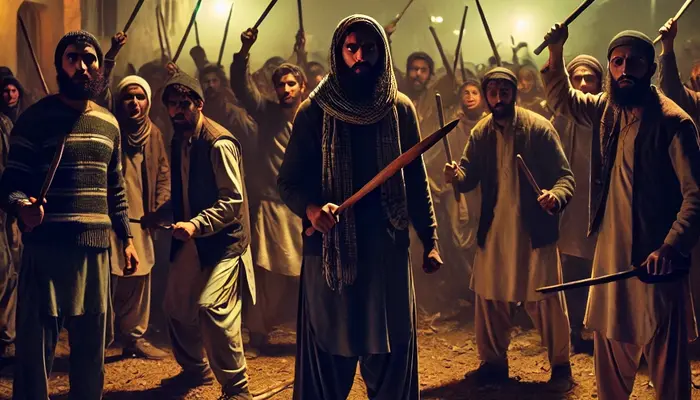
Case Summary
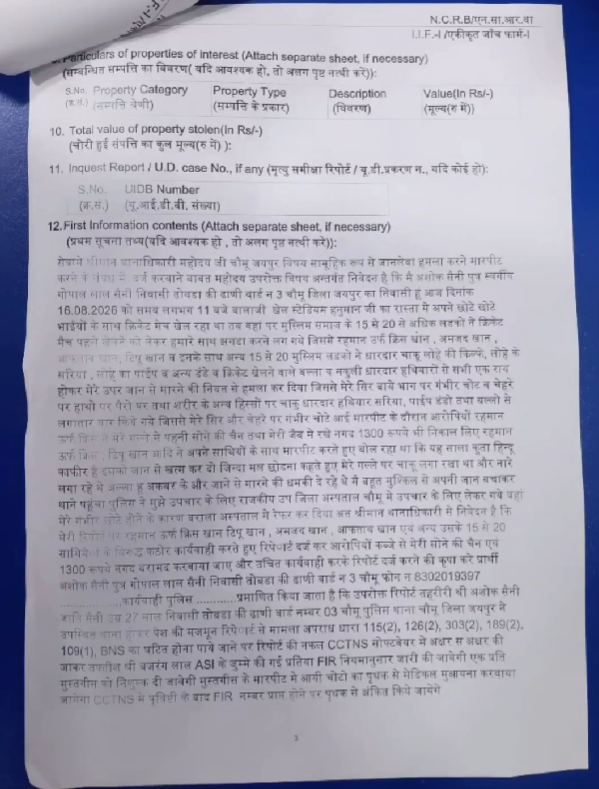
In Chomu, Jaipur, Rajasthan, a Hindu man named Ashok Saini (27) was brutally attacked by a Muslim mob, who confronted him over playing cricket. According to the FIR, on 16 August 2026, at around 11:00 am, Ashok Saini, 27, was playing cricket with his younger brothers at Balaji Khel Stadium on Hanuman Ji Ka Rasta in Chomu. During this time, Rahman alias Kris Khan, Amjad Khan, Aftab Khan, Tipu Khan and Pintu Khan, along with 15–20 Muslim men, confronted the Hindu man. They then assaulted Saini with knives, iron rods, pipes, sticks, cricket bats and other sharp-edged weapons. Saini sustained injuries to the left side of his head, face, hands, legs and other parts of his body. During the assault, Rahman alias Kris Khan took the gold chain Saini was wearing and ₹1,300 in cash from his pocket. The FIR further recorded that Rahman alias Kris Khan, Tipu Khan and others shouted, “yeh kutta Hindu kafir hai, isko jaan se khatam kar do" (This dog is a Hindu kafir, kill him, do not leave him alive) while a knife was held against Saini’s neck and the assailants raised “Allahu Akbar” slogans and threatened to kill him. Saini managed to escape and reach the police station, after which police took him to the Government Sub-District Hospital in Chomu for treatment. Owing to the seriousness of his injuries, he was subsequently referred to another hospital. The police registered the complaint under Sections 115(2), 126(2), 303(2), 189(2) and 109(1) of the Bharatiya Nyaya Sanhita (BNS), and the investigation was assigned to ASI Bajrang Lal. A separate medical examination of Saini’s injuries was also ordered.
Case Images
Why it is Hate Crime ?
This case has been added to the tracker under the primary category of - Attack not resulting in death. Within it, the sub-category selected here is - Attacked for Hindu identity. In several cases, Hindus are attacked merely for their Hindu identity without any perceived provocation. A classic example of this category of religiously motivated hate crime is a murder in 2016. 7 ISIS terrorists were convicted for shooting a school principal in Kanpur because they got ‘triggered’ seeing the Kalava on his wrist and tilak that he had put. In this, the Hindu victim had offered no provocation except for his Hindu religious identity. The motivation for the murder was purely religious, driven by religious supremacy. Such cases where Hindus are targeted merely for their religious identity would be documented as a hate crime under this category. The other sub-category selected here is - Communal clash/attack. Communal clash is a form of collective violence that involves clashes between groups belonging to different religious identities. For a communal clash between Hindus and non-Hindus to qualify as a religiously motivated hate crime, the trigger of the violence itself would have to be anti-Hindu in essence. For example, if there is a Hindu religious procession that comes under attack from a non-Hindu mob and after the initial attack, Hindus retaliate in self-defence, leading to a communal clash between the two religious communities. While at a later stage, both communities are involved in the clash/violence, the initial trigger of the violence was by the non-Hindu mob against the Hindus and therefore, it could safely be termed as an anti-Hindu violence. Further, the trigger would also have to be religiously motivated. In the cited example, the attack by the non-Hindu mob was against religious processions and therefore, can be concluded to be religiously motivated. In some cases, the trigger may be non-religious, however, it develops into religious violence against Hindus at a later stage. In such cases too, the foundational animosity towards Hindus becomes the motivating factor of the crime and therefore, it would be classified as a religiously motivated hate crime against Hindus under this category. The other primary category selected is- Hate speech against Hindus, and the subcategory selected within this is- Anti-Hindu slurs, mocking faith. Anti-Hindu slurs and the deliberate mocking of the Hindu faith owing to religious animosity involve the usage of derogatory terms, stereotypes, or offensive references to religious practices, symbols, or figures. One of the common anti-Hindu slurs used against Hindus is “cow-worshipper” and “cow piss drinker”. The intention of using this term is to demean and mock Hindus as a group and their religious beliefs since Hindus consider the cow holy. Additionally, some symbols and the slurs attached to them have a historical context that exacerbates the insult, hate, stereotyping, dehumanisation and oppression against Hindus. Cow worship has been used for centuries to denigrate Hindus, insult their faith and oppress Hindus specifically as a religious group. There has been overwhelming documentation about how cow slaughter has been used to persecute Hindus with cow meat being thrown in temples and places of worship. There has also been overwhelming documentation where cow meat (beef) has been force-fed to Hindus to either forcefully convert them to Islam or denigrate their faith. Apart from cow worship, the Swastika – which holds deep religious significance for the Hindus – has also been misinterpreted and distorted to use as a slur against Hindus. Similarly, the worship of the Shivling has been used by supremacist ideologies and religions to denigrate Hindus owing to religious animosity. Such slurs and denigration stem out of inherent animosity and hate towards Hindus and their faith, therefore, it is categorised as hate speech targeted at Hindus specifically owing to their religious identity. The other sub-category selected here is - Violent threats. Violent threats, explicit, implicit or implied, is the most dangerous form of hate speech since it goes beyond discriminatory and prejudicial language to express the intent of causing harm to an individual or a group of people based on their religious identity and faith. There could be several different kinds of threats that are issued to Hindus based on religious animosity. An explicit threat would mean the direct threat of violence towards an individual Hindu, a group of Hindus or Hindus at large. Physical violence, death threats, threats of destruction of property belonging to Hindus and threats of genocide would mean explicit threats against Hindus for their religious identity. Implicit threats may not be a direct threat but implied through the use of symbols of actions – for example – in the Nupur Sharma case, other than explicit threats, there were also implicit threats when Islamists took to the streets to burn and beat her effigies. It implies that they want to do the same to Nupur Sharma – thereby is considered an implicit threat. Violent threats can be delivered in person, through letters, phone calls, graffiti, or increasingly through social media and other online platforms. It would be important to understand that a threat – explicit or implicit, online or offline – to an individual who happens to be a Hindu does not qualify as a religiously motivated threat. Such a threat, while vile and dangerous, could be owing to non-religious reasons and/or personal animosity. To qualify as a religiously motivated threat, it would need to exhibit an indication that the individual is being targeted for religious reasons and/or owing to his/her religious identity as a Hindu. This case qualified as a religiously motivated hate crime because the assault on Hindu man Ashok Saini in Chomu, Jaipur, was accompanied by explicit anti-Hindu abuse, religiously targeted death threats and the use of Islamic religious slogans during the violence. What began as a dispute over playing cricket escalated into mob violence in which Saini was specifically identified as a Hindu and abused as a “kafir” while the attackers threatened to kill him. The religious references made during the assault established that the violence was not confined to an ordinary dispute over access to a cricket ground, but involved hostility directed at the victim on account of his Hindu identity. The strongest religious marker in the case was the language used against Saini during the assault. The Muslim mob specifically told him, “This dog is a Hindu kafir, kill him, do not leave him alive.” The use of the term “Hindu kafir” explicitly identified the victim's religious identity while dehumanising him and calling for his death. This was not generic abuse arising from a quarrel over cricket. In Islamic terminology, “kafir” refers to non believers and is often used in a derogatory or hostile manner against Hindus and other non-Muslims. The attackers specifically invoked Saini being Hindu while threatening to kill him, demonstrating that his religious identity formed part of the hostility expressed during the attack. The religious hostility was further demonstrated by the use of “Allahu Akbar” slogans while the assault was taking place. The presence of an Islamic religious slogan alongside the explicit identification of the victim as a Hindu kafir and threats to kill him gave the assault a clear communal dimension. Traditionally, this slogan is a chant of glorification; however, Muslim extremists have weaponised it as a battle cry to intimidate Hindus and assert Islamic supremacy. In this case, the Muslim group raised it precisely as they launched their attack, mirroring patterns in other similar incidents: the 2020 Delhi anti-Hindu riots, where Muslim mobs targeted Hindu homes and temples; the 2022 Karauli violence in Rajasthan with Hindu shops set ablaze; the Jahangirpuri riots in Delhi assaulting Hindu processions; and the September 2025 Bareilly clashes amidst the "I Love Mohammad" poster controversy. This slogan signals not devotion, but zealous threats against Hindus for their identity. These religious slogans are weaponised to create fear and legitimise aggression against Hindus. In this case, too, the slogan was used in the immediate context of violence and intimidation directed at a Hindu victim, reinforcing the religious character of the attack. It is important to state that such acts are carried out by Muslim perpetrators due to indoctrination by Islamic theology, which advocates that all non-Muslims, including Hindus (referred to as kafirs), are inferior and subject to subjugation unless they convert to Islam or live under Islamic rule (dhimmitude). These ideas are not mere abstractions; they manifest in actions where non-Muslims, especially Hindus in India, are seen as targets for religious domination, coercion, or humiliation. This theological framework fosters an "us versus them" mindset, in which any assertion of Hindu identity or religious freedom is seen not only as undesirable but as a threat to Islamic supremacy. As a result, perpetrators who are shaped by such teachings feel justified, even morally obligated, to harass, suppress, or violently attack Hindus, particularly when Hindus assert their religious rights or resist religious coercion. As a result, Muslim perpetrators invoke such doctrines to justify coercive attempts to target non-Muslims, particularly Hindus, portraying submission to Islam as a means of abandoning Kufr (a state of disbelief in Islam or disbelief in Islam). Such acts, therefore, are not isolated but driven by a broader ideological hostility towards Hindus as non-believers and reflect an attempt to impose Islamic dominance. This case was also not a random isolated incident, but a premeditated attack motivated by bias and hatred against Hindus. Therefore, it is being added to the hate crime database of the Hinduphobia Tracker. Furthermore, the manner in which the assault escalated further reinforced its severity. Saini had been playing cricket with his younger brothers when more than 15–20 Muslim men confronted them over playing the game. The group then attacked Saini with knives, iron rods, an iron pipe, sticks, cricket bats and other sharp-edged weapons, while chanting Islamic slogans. Such a disproportionate response to a minor altercation highlights the underlying animosity the members of the Muslim community hold against Hindus. These actions reflect a dangerous mindset of Islamic supremacy that demands dominance and submission through violence. In such cases, even minor, non-religious provocations are met with aggressive retaliation when the victim is Hindu, revealing an alarming pattern of identity-driven hostility that defines such hate crimes. The willingness to resort to collective violence against Hindus over a routine altercation demonstrates that the victims were not merely targeted as individuals involved in a dispute, but also because of their visible religious identity as Hindus. This disproportionate reaction is rooted in a mindset of Islamic supremacy, wherein Muslims view Hindus as socially and religiously inferior. This supremacist attitude fosters disdain and aggression, especially when a Hindu does not submit or “yield” in a dispute or an argument. The belief that Hindus lack equal standing leads to violent enforcement of dominance, often under the pretext of minor disagreements. Several past incidents underscore this grim reality. The 2019 Hauz Qazi violence is a glaring example. A simple parking dispute escalated into a full-scale communal attack against Hindus in the heart of Delhi. Hindu residents—including women and children—and their sacred Durga Mandir were targeted mercilessly by Muslims. Hindu idols were destroyed, the temple desecrated, and the community subjected to physical assault. The disappearance of a 17-year-old Hindu boy during the violence highlighted the grave dangers Hindus endure, as he was beaten for his faith and forced to flee for his life. This incident exposed how routine conflicts are exploited to unleash communal violence against Hindus, leaving the community traumatised and demanding justice. Similarly, the Hinduphobia Tracker has previously documented numerous instances where non-religious triggers sparked communal violence against Hindus by Muslims. For example, on 30th May 2025, in Dewran Garhiya village, Farrukhabad, Uttar Pradesh, a minor verbal altercation between two Hindu men and a Muslim man escalated into a violent assault by a large Muslim mob, inflaming communal tensions. In another incident on 7th July 2025 in Bhavna Nagar, Raipur, Chhattisgarh, a Hindu family was brutally attacked by a Muslim mob of nearly 80 people following a simple dispute over garbage disposal. Victims suffered severe injuries from sharp weapons. Similarly, on 22nd June 2025 in Ghongade Basti, Solapur, Maharashtra, a minor road dispute led to a targeted communal assault on Hindus by a large Muslim mob, sparking widespread clashes. Taken together, the explicit reference to Saini as a “Hindu kafir”, the threat to kill him, the use of “Allahu Akbar” slogans during the assault, and the disproportionate collective violence established clear religious markers in the incident. The case therefore met the parameters for inclusion as a religiously motivated hate crime in the Hate Crime Database of the Hinduphobia Tracker.
Victim Details
Total Victim
1
Deceased
0
Gender
- Male 1
- Female 0
- Third Gender 0
- Unknown 0
Caste
- SC/ST 0
- OBC 0
- General 0
- Unknown 1
Age Group
- Minor 0
- Adult 1
- Senior Citizen 0
- Unknown 0


Case Status
Complaint filed


Perpetrators Details
Perpetrators
Muslim Extremists
Perpetrators Range
From 10 to 100
Perpetrators Gender
male
 Sources




