Hindu temple targeted by Muslims in Jalna; saffron flags burned, temple land encroached upon, non-vegetarian food consumed on premises
 Jalna, Maharashtra, India
  16 August, 2024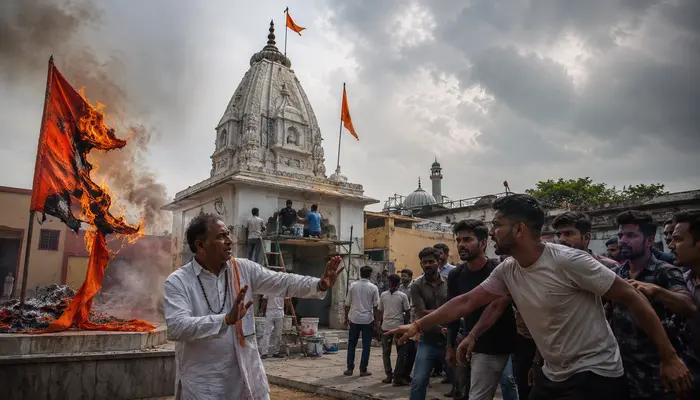
Case Summary
In Jalna, Maharashtra, the Khadkeshwar Mahadev Temple was subjected to several acts of religious disrespect, including the burning of saffron flags, the encroachment of temple land, and the consumption of non-vegetarian food on the temple premises. On 17 August 2024, during Shravan, saffron flags that were installed on the premises of the Khadkeshwar Mahadev Temple were set on fire by Muslim men. Jalna District President Umesh Kute revealed that the perpetrators were associated with a local madrasa located approximately 100 metres from the temple. Kute also informed that the madrasa had been built on temple land. The Jai Bajrang Foundation further said that individuals associated with the madrasa sat on platforms in the temple area and deliberately consumed non-vegetarian food there. Maulanas of the madrasa were putting young children forward to carry out acts intended to provoke the Hindu community and create tension. Two years later, in August 2026, a group of Muslim men were playing games in the same temple premises, causing inconvenience to devotees. After a ball was struck during the game, the Hindu priest asked the youths to move farther away and play elsewhere. The Muslim men responded by abusing and threatening the priest. Subsequently, a video circulated on social media that showed Muslim youths verbally abusing workers who were voluntarily engaged in painting work at the temple. The incident involving the priest and the video involving the workers added to the concerns that were already raised by the Jai Bajrang Foundation regarding activities taking place around the temple. Following the confrontation, members of the Jai Bajrang Foundation raised concerns regarding the incidents around Shri Khadkeshwar Mahadev Temple. The organisation called for police intervention, protection for the priest and devotees, and action against those responsible. The activists also warned that they would intensify their protest if the administration failed to act. On 17th August 2026, a delegation from the Jai Bajrang Foundation visited Kadim Jalna Police Station. The delegation included founder Vipulbhaiya Rai, founder vice president Vinodbhaiya Raut, Jalna District President Umesh Kute, and other members and office-bearers of the organisation. During the visit, the delegation raised the issue and sought police intervention and appropriate action. The police assured the delegation that those involved would be warned and that appropriate legal action would be considered after an inquiry. The issues concerning the burning of saffron flags, encroachment upon temple land, consumption of non-vegetarian food on the temple premises, and acts intended to provoke the temple community had been raised by the Jai Bajrang Foundation.
Why it is Hate Crime ?
This incident has been added to the Hinduphobia Tracker under the category: Attack on Hindu religious representations. Within this, the first sub-category selected is: Desecration of Hindu religious symbol. Icons and symbols, or a religious representation of a spiritual ideal, are widely revered in Hinduism. Iconography is of vital significance in the Hindu milieu. It helps connect people’s spiritual beliefs with the real world. Iconography within the Hindu faith takes several shapes and forms. Murtis are of great significance to Hindus, to which daily rituals, prayers and offerings are performed. Besides the murtis, there are several other symbols which have deep significance in the Hindu faith – the Om and Swastika, for example. Since these Hindu religious symbols hold paramount importance in Hinduism, any desecration of symbols, icons, murtis, religious representations and manifestations is driven by animosity towards the faith itself, which manifests itself through these murtis, icons and symbols. Therefore, any desecration of these Hindu religious symbols and representations is considered a religiously motivated hate crime under this category. The second subcategory selected in this case is: Breaking rules of place of worship Sanatan Dharma is not a religion of one book, which is to say that while it has religious scriptures that form the central tenets of the faith, there are several traditions followed through thousands of years, mostly passed from generation to generation orally. One of these oral traditions or written traditions is the rules of specific temples. Certain temples have rules which are traditional, dependent on the worship of the presiding deities. These rules and traditions have been followed for thousands of years, whether they find scriptural mention or not. Such traditions are based on the nature and rules of worship of the presiding deity of that temple. Any non-compliance with these traditions owing to animosity towards the faith or for the sake of activism stems not only from the lack of faith in the presiding deity but also from disregard for the faith of the devotees of that deity/temple and implicit bias against the faith, the tradition and the deity itself. Since these specific traditions are central to the faith of the devotees of that specific temple and presiding deity, any non-compliance with these traditional rules would be considered a religiously motivated hate crime. The third subcategory selected is: Defiling religious customs Sanatan Dharma is not a religion of one book, which is to say that while it has religious scriptures that form the central tenets of the faith, there are several traditions followed through thousands of years, mostly passed from generation to generation orally. There are several such customs and traditions that are followed by various Hindus and Hindu sects. Defiling of these traditions and customs is a breach of an individual or group’s religious practices. Such practices can range from dietary restrictions like not eating non-vegetarian food for a certain period of the year, not eating non-vegetarian food at all, not eating beef since the cow is considered holy in Hinduism, the sanctity of religious customs followed in the house (like many ISCKON devotees), etc. Any malicious action leading to the breach of such traditions or defilement of these traditions owing to animosity towards the faith or for the sake of activism stems not only from the lack of faith in the religion itself but also from disregard for the faith of the devotees who follow the customs/traditions and implicit bias against the faith, the tradition itself. Since these specific traditions are central to the faith of the devotees of that specific sect of Hindus, any non-compliance with these traditional rules would be considered a religiously motivated hate crime. The fourth subcategory selected in this case is: Encroachment or illicit takeover of temple land/land near temple. In Hinduism, a temple is the abode of the Deity. The Deity in the Temple is consecrated, thereby making it a real, breathing entity. Hindus believe that not just the Deity but the temple premises themselves are sacred to Hindus since Hindus hold the faith that the entire Temple space is an amalgamation of the divine energy of the deity. Not only the Temple but the Temple premises in their entirety are considered sacred by Hindus. In several cases, the premises of the Temple and/or religious centre are illicitly taken over by institutions belonging to other faiths – like the Waqf board or the Church. Other times, the temple property, land or the property of religious centres are illicitly encroached by non-Hindu groups. Any illicit takeover or encroachment is a crime an initio; however, when non-Hindu groups illicitly take over or encroach the sacred land of Hindus, it is an affront to the Hindu community and is therefore classified as a religiously motivated hate crime under this category. This case has been added to the tracker because it includes targeting of a Hindu temple with seveal acts of defiling its sanctity, through burning of saffron flags installed at the temple during Shravan, encroachment upon temple land through the construction of a madrasa approximately 100 metres from the temple, and consumption of non-vegetarian food on platforms within the temple area. Hindu temples hold profound religious significance as sacred spaces where devotees worship deities, perform rituals, offer prayers, and observe established religious customs. The sanctity of a temple is therefore central to Hindu religious practice, and conduct that disrespects or interferes with the religious character of such a space can cause harm to Hindu religious sentiments. Any deliberate act that violates the sanctity of a Hindu temple or disregards the norms governing its sacred premises therefore has a direct religious dimension. The first religious marker in this case was the burning of the sacred saffron flags installed on the temple premises. Saffron holds significant religious and cultural importance in Hinduism and is closely associated with Hindu religious identity, devotion, and sacred spaces. Burning such a symbol within a Hindu temple therefore went beyond ordinary property damage, as the act directly targeted a religious representation associated with the Hindu faith. The location of the incident further strengthened its religious significance because the flags were installed within the premises of a Hindu place of worship, where they represented the religious character of the site. The deliberate destruction of a prominent Hindu religious symbol in such a setting therefore demonstrated hostility towards Hindu religious expression and constituted an act of disrespect directed at the religious identity and sentiments of the Hindu community. The second religious marker in this case is that the madrasa was built on temple land. The construction constituted unauthorised occupation or use of land that belonged to a Hindu temple. Such occupation is an infringement on property associated with a Hindu place of worship and is a disrespect towards the temple’s religious and sacred character. Temple land is merely ordinary property or a commercial asset; it is inseparable from the temple ecosystem itself. Land attached to a temple holds religious sanctity, supports the functioning and preservation of the temple, and remains intrinsically connected to the Deity and the religious institution. Any attempt to usurp or unlawfully occuply such land therefore goes beyond an ordinary property dispute and constitutes an affront to a sacred Hindu institution. The third important religious marker in this case was the consumption of non-vegetarian food within the temple premises. Hindu temples are governed by religious customs and practices intended to preserve the sanctity and purity of the space, and restrictions on non-vegetarian food are observed at many Hindu places of worship. Consuming such food within the premises of a Hindu temple therefore constituted a direct disregard for the religious norms governing the sacred space. The conduct was particularly significant because it took place within the temple premises rather than in an ordinary public area, thereby directly interfering with the religious character and customary practices of the place of worship. In the context of the other incidents involving the temple, this act indicated a deliberate disregard for Hindu religious customs and contributed to a broader pattern of conduct that disrespected the sanctity of the Hindu temple and the religious sentiments of its devotees. The cumulative circumstances of this case demonstrated that the incidents were not merely ordinary but involved conduct that was hostile towards a Hindu religious institution and its devotees. The burning of saffron flags, encroachment upon temple land, consumption of non-vegetarian food within the temple premises, and verbal abuse and threats directed at the Hindu priest and temple workers were deliberate acts that disregarded the sanctity of the temple and Hindu religious sentiments. Taken together, these bore the hallmarks of religiously motivated hate crimes directed against Hindu religious expression. Therefore, this case has been included in the Hinduphobia tracker. Disclaimer: The Hinduphobia tracker records incident dates based on when the crime occurs, rather than when the media reports it. In this case, 17 August 2024 is used as the indicative incident date because the media report stated that the incidents occurred approximately two years earlier, while no specific date of the incident was mentioned. Accordingly, the date has been derived by taking two years back from the article’s publication date of 17 August 2026. This date had been recorded for documentation purposes only.


Case Status
Unknown


Perpetrators Details
Perpetrators
Muslim Extremists
Perpetrators Range
Unknown
Perpetrators Gender
unknown
 Sources




