Anti-Hindu prejudice on display; Ambedkarite politician maligns Hindu society and revered Hindu organisation
 Delhi, India
  29 July, 2026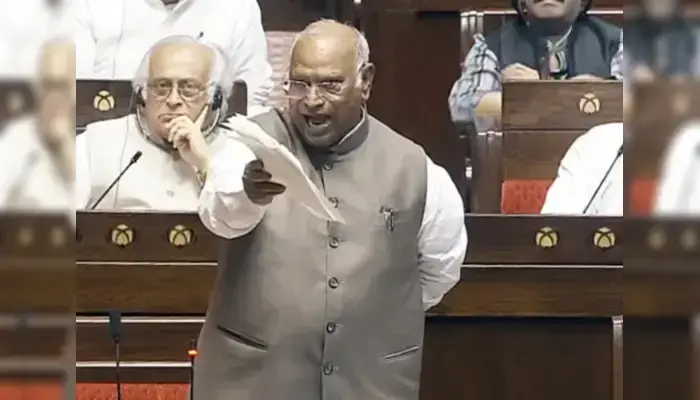
Case Summary
Hindu sentiments were outraged after Indian politician Mallikarjun Kharge, while speaking in the Rajya Sabha on 30 July 2026, made derogatory remarks about the Manusmriti and claimed that its provisions were the curriculum of the Rashtriya Swayamsevak Sangh (RSS). The incident occurred on 30 July 2026, during a Rajya Sabha debate on the Public Examinations (Prevention of Unfair Means) Amendment Bill, 2026, when Congress president and Leader of the Opposition Mallikarjun Kharge referred to the Manusmriti while discussing changes to the education system. Kharge criticised changes to the education system and its curriculum and claimed that Manusmriti contained provisions under which a Shudra who listened to the Vedas would have his ears filled with shards, whose tongue would be cut off for reciting the Vedas, and whose body would be dismembered for retaining their words. He then said, “These provisions in the Manusmriti are the curriculum of the RSS,” and condemned what he described as such ideas being introduced into the education system. Kharge also criticised the appointment of RSS-linked individuals to university positions and linked the issue to wider concerns over access to education and caste-based discrimination. Kharge’s remarks triggered strong objections from members of the BJP-led treasury benches. Leader of the House J. P. Nadda demanded that the quotations attributed to the Manusmriti be authenticated and questioned their relevance to the Bill under discussion. He stated that such remarks could create unrest and insisted that only the original text should be quoted in Parliament. Following the uproar, the Rajya Sabha Chair directed that Kharge’s remarks be expunged from the proceedings. BJP MP Sudhanshu Trivedi also objected to Kharge’s reference, describing it as a wrong reference and citing historical and textual arguments concerning the Manusmriti and the distinction between ancient Shudras and modern Scheduled Castes.
Why it is Hate Crime ?
The primary category selected is- Hate Speech against Hindus. The subcategory selected is- Anti-Hindu slurs, mocking faith. Anti-Hindu slurs and the deliberate mocking of the Hindu faith owing to religious animosity involve the usage of derogatory terms, stereotypes, or offensive references to religious practices, symbols, or figures. One of the common anti-Hindu slurs used against Hindus is “cow-worshipper” and “cow piss drinker”. The intention of using this term is to demean and mock Hindus as a group and their religious beliefs since Hindus consider the cow holy. Additionally, some symbols and the slurs attached to them have a historical context that exacerbates the insult, hate, stereotyping, dehumanisation and oppression against Hindus. Cow worship has been used for centuries to denigrate Hindus, insult their faith and oppress Hindus specifically as a religious group. There has been overwhelming documentation about how cow slaughter has been used to persecute Hindus with cow meat being thrown in temples and places of worship. There has also been overwhelming documentation where cow meat (beef) has been force-fed to Hindus to either forcefully convert them to Islam or denigrate their faith. Apart from cow worship, the Swastika – which holds deep religious significance for the Hindus – has also been misinterpreted and distorted to use as a slur against Hindus. Similarly, the worship of the Shivling has been used by supremacist ideologies and religions to denigrate Hindus owing to religious animosity. Such slurs and denigration stem out of inherent animosity and hate towards Hindus and their faith, therefore, it is categorised as hate speech targeted at Hindus specifically owing to their religious identity. The other sub-category selected is - Anti-Hindu subversion and prejudice. Hate speech is defined as any speech, gesture, conduct, writing, or display that is prejudicial against a specific individual and/or group of people, which is leading to or may lead to violence, prejudicial action or hate against that individual and/or group. Media plays a specific and overarching reach in perpetuating prejudicial attitudes towards a community owing to unfair, untrue coverage and/or misrepresentation/misinterpretation, selective coverage and/or omission of facts of/pertaining to issues affecting a specific religious group. This type of bias can dehumanise the victim group, making it easier for others to justify harmful actions against them, which aligns with the objectives of hate speech laws aimed at preventing such harm. It is often observed that the media takes a prejudicial stand against the Hindu community driven by their need to shield the aggressor community which happens to be a numeric minority, however, is the one perpetrating violence against Hindus. For example, the media is often quick to contextualise religiously motivated crimes against Hindus, omit or misrepresent facts that point towards religiously motivated hate crimes, justify and/or downplay religiously motivated hate crimes or simply present fake news to stereotype Hindus. Such media bias leads to the denial of persecution and is often used to dehumanise Hindus, leading to justification for violence against them. For example, the media covered several fake allegations of Hindus targeting Muslims and forcing them to chant Jai Shree Ram. Most of these cases were proved false and fabricated after police investigation. These fake news reports were subsequently never retracted or clarified. Such fake news led to the justification of violence and dehumanisation of Hindus based on the argument that since Hindus targeted Muslims and forced them to chant Jai Shree Ram, the dehumanisation of Hindus and violence against them was par for the course and merely a retaliation. Such media bias leads to prejudicial portrayal of Hindus and offers a justification for violence against them and therefore, is considered hate speech under this category. This case has been included in the tracker because Mallikarjun Kharge’s remarks targeted the Rashtriya Swayamsevak Sangh (RSS), a prominent Hindu organisation, by associating it with caste-based discrimination and practices. The religious dimension was significant because the RSS has historically worked towards strengthening Hindu social unity and identity and is an important organisational expression of Hindu civilisational and cultural interests. It has dedicated itself to the upliftment of Hindus through selfless social service, nation-building initiatives, character development, and fostering unity across caste, class, and gender lines under a shared Hindu identity. Targeting such an organisation therefore carried implications beyond criticism of a political or social body, particularly when it was portrayed as an embodiment of discriminatory Hindu social practices. By portraying the RSS as the vehicle through which discriminatory provisions of the Manusmriti were supposedly being introduced into the education system, the remarks did not merely criticise an individual policy or political position; they placed a prominent Hindu organisation within a narrative of caste oppression and social exclusion. The RSS was used as a proxy to target the wider Hindu community, with the underlying objective being to portray Hindu society itself as inherently casteist, divided and oppressive. The targeting of an organisation associated with Hindu social cohesion was significant because it enabled the broader Hindu identity to be attacked through its institutional representative. Rather than limiting the criticism to a particular RSS policy or activity, the remarks connected the organisation to historical caste practices and, by extension, presented the wider Hindu social and religious framework through the same lens. The remarks also used caste identity as the principal framework through which the Hindu community was discussed. By invoking the historical category of Shudras and presenting the Manusmriti’s caste-related passages as representative of the RSS’s supposed outlook, the discourse attempted to divide Hindus across caste identities rather than treating them as one under a shared religious and civilisational identity. The emphasis on the oppression of one Hindu caste category by another was intended to frame Hindu society itself as fundamentally divided between oppressors and victims. This is significant from a hate-crime perspective because religious hostility does not necessarily manifest through direct insults against every member of a faith; it can also operate through narratives designed to delegitimise the institutions, traditions and internal bonds that sustain a religious community. The caste framing was particularly consequential because Hindu society has historically contained diverse communities, traditions and social groups while retaining a broader religious and civilisational identity. Presenting caste divisions as the defining feature of Hindu society weakens this wider cultural identity by encouraging members of particular communities to view themselves primarily through caste antagonism rather than their shared Hindu identity. In this context, the reference to Shudras was not confined to a historical discussion of a text. It was incorporated into a contemporary political attack in which the RSS was presented as representing or perpetuating the discriminatory side of that history. The resulting narrative sought to encourage Hindu communities to interpret their religious identity through a framework of intra-Hindu hostility, particularly by portraying one section as victims and another as beneficiaries or defenders of an oppressive social order. Furthermore, the use of the Manusmriti in this context was also significant. The Manusmriti is an ancient Dharmashastra and one among several Hindu legal and ethical texts that emerged within particular historical and social contexts. Hindu religious thought has never been based upon a single universally binding legal scripture, and the Manusmriti does not function as a governing religious code for contemporary Hindus. Hindu philosophical and religious traditions encompass numerous scriptures, schools of thought, Smritis, epics and local traditions, with different texts and traditions sometimes differing substantially on questions of social conduct and duty. Consequently, treating selected passages from the Manusmriti as representative of Hinduism as a whole, and then linking those passages to a contemporary Hindu organisation, reduces the complexity and plurality of Hindu religious traditions to a selective narrative of caste oppression. This distinction matters because the remarks did not simply discuss whether particular historical verses were objectionable. They used those verses to characterise a present-day Hindu organisation and, by extension, the Hindu social order with which it was associated. The argument therefore moved from criticism of an ancient text to the contemporary delegitimisation of a Hindu institution. Such framing contributed to prejudice by presenting Hindu identity as inseparable from practices that many contemporary Hindus neither follow nor regard as authoritative. It also placed the burden of responsibility for historical texts upon Hindus today, despite the diversity of Hindu traditions and the absence of a single central authority that determines religious doctrine for all Hindus. The RSS was specifically brought into a discourse about the supposed discriminatory character of Hindu traditions, thereby connecting a contemporary Hindu institution with negative representations of Hindu religious and social heritage. This contributed to the broader portrayal of Hindu institutions and Hindu identity as inherently associated with caste discrimination. The incident consequently went beyond a conventional political disagreement over education policy or the interpretation of an ancient text. The RSS was singled out because of its prominent role in Hindu social and cultural life, while caste identity was invoked to portray Hindu society as internally oppressive and divided. This combination had the effect of attacking both an important Hindu institution and the broader idea of Hindu social cohesion. The remarks therefore constituted religiously targeted hate speech because they contributed to the denigration of Hindu identity and a prominent Hindu organisation by associating both with an inherently discriminatory social order and by exploiting caste divisions within the Hindu community.


Case Status
Unknown


Perpetrators Details
Perpetrators
Others
Perpetrators Range
One Person
Perpetrators Gender
male
 Sources




