Minor Hindu girl befriended using false Hindu identity; subjected to gang rape by Muslim men in Chirang, Assam
 Chirang, Assam, India
  23 July, 2026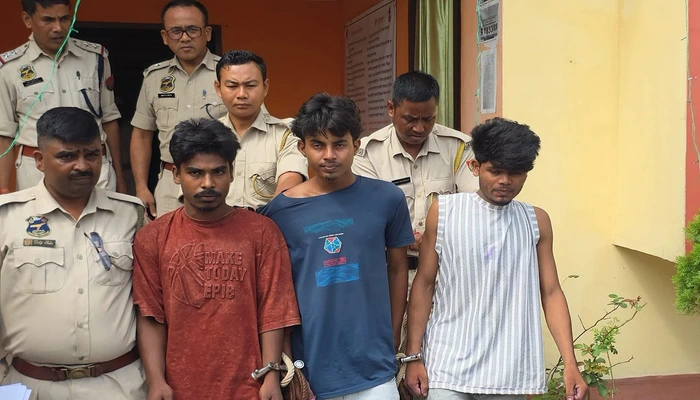
Case Summary
In Chirang district, Assam, a minor Hindu girl belonging to the tribal community was befriended by a Muslim man using a false Hindu identity. She was subsequently lured to a rented house, where she was gang-raped by him and his two associates. The incident took place on 24th July 2026 at a rented house in Chatipur, in the Bartalowa area. The perpetrators were identified as Nasirul Sheikh, Pir Mohammad and Harunul Hasan. According to the reports, Nasirul Sheikh, a resident of Bartalowa in Chirang district, contacted the victim, who was a Class 10 student, through social media, using a Hindu name to gain her trust. He subsequently invited her to meet him and took her to the rented premises, where he and his two associates, Pir Mohammad, aged 25, of Agomani in Dhubri district, and Harunul Hasan, aged 29, of Barpathar in Bongaigaon district, gang-raped her. The accused also recorded a video of the entire assault. Following the assault, the accused threatened the girl that the video would be made public if she disclosed the incident to anyone. The girl initially refrained from disclosing the incident due to fear and later informed her parents. However, the video was subsequently circulated on social media by the perpetrators. After the girl informed her parents, her family approached the police and lodged a complaint at Runikhata Police Station on 15th August 2026. Based on the complaint and the victim's statement, police registered a First Information Report (FIR) and arrested all three accused on 15th August 2026. Police seized their mobile phones as part of the investigation. The minor's statement was recorded, and she underwent a medical examination. During the investigation, police took Nasirul Sheikh to the crime scene. According to police reports, Sheikh attacked a constable and attempted to flee. Police subsequently fired at him, and he sustained a gunshot wound to his right leg. He was taken to JSB Civil Hospital in Kajalgaon for treatment. The case was registered under relevant provisions of the Bharatiya Nyaya Sanhita (BNS), the Protection of Children from Sexual Offences (POCSO) Act, 2012, and the Information Technology Act. On 18th August 2026, a protest demonstration was organised at Kajalgaon in Chirang district against the gang rape. The Chirang District Committee of the All Assam Tribal Sangha led the protest, with support from the All Bodo Students' Union (ABSU), All Bodo Women Welfare Federation (ABWWF), All Rabha Students' Union (ARSU), All Assam Students' Union (AASU), All Bodo Minority Students' Union (ABMSU), Bodo Sahitya Sabha (BSS) and All Assam Tribal Youth League (AATYL). Students from various educational institutions and members of the supporting organisations participated in the dharna and held placards. The protesters demanded stringent punishment for those found guilty and justice for the victim. They also demanded capital punishment for those convicted under the POCSO Act, adequate compensation for the victim and her family, an end to atrocities against girl students, and improved safety and security for students and the general public. They further called for strict enforcement of law and order to curb anti-social and illegal activities in the region.
Why it is Hate Crime ?
The primary category selected in this case is: Crimes against women in relationships and other sexual crimes. Within this, the subcategory selected is: Man pretends to be Hindu. The tertiary category selected is: Name changed. When a non-Hindu man pretends to be a Hindu to deceive a Hindu woman into a relationship, the act is seen as triggered by malafide intentions. In some cases, the woman eventually accepts the man’s original religious identity and converts after the man’s identity is revealed. These cases could be argued as cases of religious brainwashing and a result of the pressure a woman feels after getting into a relationship with a man. The woman, it can be argued, also changed her religious identity because of the stigma she believes she might face if she chooses to walk out of a deceptive relationship. However, for the purpose of documenting hate crimes, the cases in this subcategory are limited to those where there is explicit violence aimed at religious conversion against the wishes of the victim (force-feeding beef, blackmailing with intimate videos, rape on refusal to convert, etc), or if the woman herself complains of the man’s religious deception. In such cases, it is established that the deception of the non-Hindu man had a specific aim of religious conversion or targeting of the victim due to her Hindu religious identity, therefore making it a religiously motivated hate crime. In this case, the minor Hindu girl was deceived by a Muslim man pretending to be Hindu. After this, he lured her to a rented house, where he and his two Muslim accomplices subjected her to gang rape. The perpetrator's act of deception by posing as a Hindu itself demonstrated a clear bias and malicious intent towards the victim’s religion. By hiding his true identity, the Muslim man manipulated the Hindu girl's trust and targeted her under false pretences, indicating a deliberate effort to exploit the girl based on her religious background. Additionally, the false identity enabled him to establish contact with and gain the trust of the minor girl, facilitating the subsequent act of luring her to the rented premises. This constituted a direct violation of her right to make an informed decision regarding whom she chooses to trust and interact with, as well as an infringement upon her religious identity. Thus, the perpetrator’s deliberate decision to hide his religious identity strongly underscored the religious motive behind this crime. In such instances, identity concealment is not just a deceptive tactic for personal reasons but a calculated strategy rooted in religious profiling and targeting. The perpetrator was aware that the victim, being Hindu, would likely refuse his advances if she knew his real identity, and he circumvented this by lying, which directly pointed to a religiously driven intent. By using a false Hindu identity to gain the trust of a minor Hindu girl and subsequently luring her to a private premises, the perpetrator exploited her religious identity as part of the process through which she was targeted. This deception reflected a larger pattern where Hindu girls and women are specifically singled out using false identities by Muslim men, often with coercion or sexual exploitation in mind. Such targeted victimisation based on religion not only demonstrated a fundamental disregard for Hinduism but also exposed a deeper animosity toward Hindus and their beliefs. In this case, the deception was followed by the gang rape of the minor Hindu girl by the perpetrator and his two Muslim accomplices, demonstrating that the victimisation extended from religious targeting to severe sexual violence. The sexual assault did not occur independently of the circumstances in which the victim had been targeted; rather, it followed the deliberate targeting of a Hindu minor and was carried out by the same Muslim men who had gained access to her through religious deception. The fact that the victim was specifically targeted as a Hindu and subsequently subjected to gang rape by the perpetrators made her religious identity directly relevant to the nature of the sexual violence she endured. The assault therefore constituted more than an isolated act of sexual exploitation and reflected the continuation of the religiously targeted victimisation. The combination of religious targeting and subsequent sexual violence demonstrated religious animosity and constituted a form of religiously motivated sexual violence. A particularly significant aspect of the incident was that the victim was a minor. The interaction was built on deception from the outset, with the perpetrator concealing his religious identity to gain her trust. Given her age and lack of maturity, the victim was particularly vulnerable to manipulation and coercion and could not be expected to fully comprehend the implications of the situation in which she was placed. The perpetrator exploited this vulnerability by using a false Hindu identity to gain access to her before subjecting her to sexual violence. The deliberate targeting of a minor Hindu girl through religious deception and subsequent sexual exploitation therefore constituted a serious form of religiously motivated victimisation. Since this case meets the parameters of a hate-driven offence, it is being added to the Hate Crime database of the Hinduphobia Tracker. Disclaimer: The Hinduphobia Tracker records incident dates based on when the victim's ordeal begins rather than when the incident is reported by the media. However, in the present case, media reports have not specified the exact date when the victim's ordeal began, including when she was befriended by the Muslim perpetrator posing as a Hindu. Therefore, the earliest date mentioned in the reports, 24th July 2026, when the victim was subjected to gang rape, has been selected as the indicative incident date for documentation purposes.
Victim Details
Total Victim
1
Deceased
0
Gender
- Male 0
- Female 1
- Third Gender 0
- Unknown 0
Caste
- SC/ST 1
- OBC 0
- General 0
- Unknown 0
Age Group
- Minor 1
- Adult 0
- Senior Citizen 0
- Unknown 0


Case Status
Arrested


Perpetrators Details
Perpetrators
Muslim Extremists
Perpetrators Range
From 2 To 5
Perpetrators Gender
male
 Sources




