Hindu temple’s sanctity violated; inappropriate dance reel recorded inside its premises in Sitapur, Uttar Pradesh
 Sitapur, Uttar Pradesh, India
  16 August, 2026
Case Summary
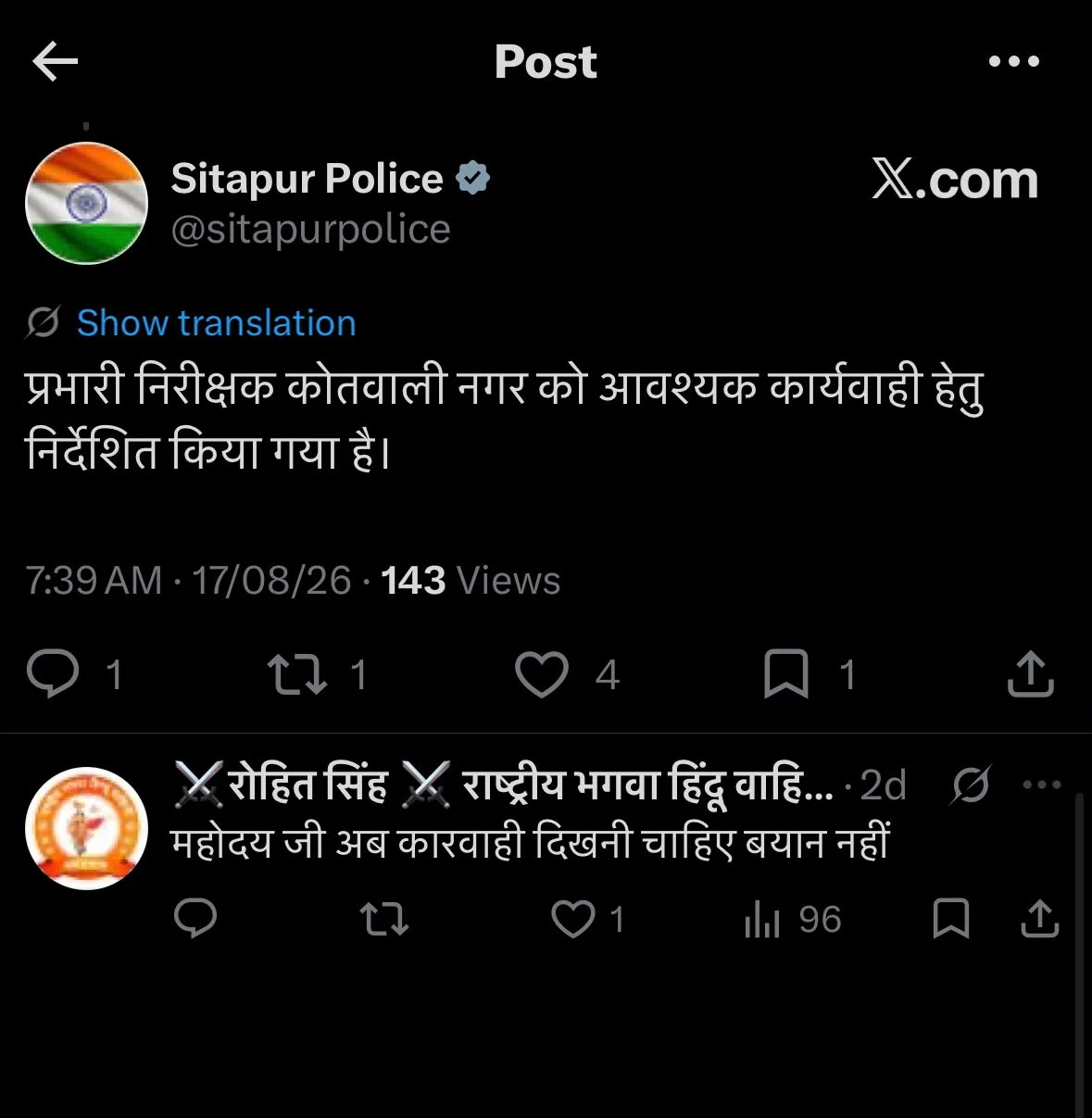
In Sitapur, Uttar Pradesh, Hindu religious sentiments were outraged after a woman named Mohini recorded an inappropriate dance reel inside the premises of the 200-year-old Baba Shyam Nath Temple. It was a revered Hindu place of worship dedicated to Lord Shiva. The incident came to light when local activist Rohit Singh, District Head of the Rashtriya Bhagwa Hindu Vahini and Gau Rakshak Dal, raised the matter on X and sought immediate action against Mohini for recording the inappropriate video inside the temple premises. Singh posted videos in which she was seen making inappropriate dance reels inside the temple premises to inappropriate songs. In response, the official Sitapur Police account confirmed that the incident had occurred and stated that the Inspector-in-Charge of Kotwali Nagar had been directed to take necessary legal action. The incident offended Hindu devotees by using the sacred premises of a revered Hindu temple for inappropriate reel recording and undermining the sanctity of a holy place of Hindu worship. Following the complaint, the police directed the concerned officer to take necessary legal action.
Case Images

Why it is Hate Crime ?
The primary category for this case is: Attack on Hindu religious representations. The subcategory for this case is: Breaking rules of a place of worship. Sanatan Dharma is not a religion of one book; while it has religious scriptures that form the central tenets of the faith, several traditions have been followed for thousands of years, mostly passed down orally from generation to generation. One of these oral or written traditions is the rules of specific temples. Certain temples have rules which are traditional rules, dependent on the worship of the presiding deities. These rules and traditions have been followed for thousands of years, whether or not they find scriptural mention or not. Such traditions are based on the nature and rules of worship of the presiding deity of that temple. Any non-compliance with these traditions owing to animosity towards the faith or for the sake of activism stems not only from a lack of faith in the presiding deity but also from disregard for the faith of the devotees of that deity/temple and implicit bias against the faith, the tradition and the deity itself. Since these specific traditions are central to the faith of the devotees of that specific temple and presiding deity, any non-compliance with these traditional rules would be considered a religiously motivated hate crime. The other subcategory selected is: Defiling religious customs. Sanatan Dharma is not a religion of one book, which is to say that while it has religious scriptures that form the central tenets of the faith, there are several traditions followed through thousands of years, mostly passed from generation to generation orally. There are several such customs and traditions that are followed by various Hindus and Hindu sects. Defiling of these traditions and customs is a breach of an individual or group’s religious practices. Such practices can range from dietary restrictions like not eating non-vegetarian food for a certain period of the year, not eating non-vegetarian food at all, not eating beef since the cow is considered holy in Hinduism, the sanctity of religious customs followed in the house (like many ISCKON devotees), etc. Any malicious action leading to the breach of such traditions or defilement of these traditions owing to animosity towards the faith or for the sake of activism stems not only from the lack of faith in the religion itself but also from disregard for the faith of the devotees who follow the customs/traditions and implicit bias against the faith, the tradition itself. Since these specific traditions are central to the faith of the devotees of that specific sect of Hindus, any non-compliance with these traditional rules would be considered a religiously motivated hate crime. This case was a clear example of a religiously driven hate crime because the sanctity of a Hindu temple was desecrated when an inappropriate dance reel was recorded inside its sacred premises. To understand the nature of this violation, it is important to understand the religious significance of temples in Hinduism. Hindu temples are regarded as sacred spaces where devotees worship deities, offer prayers, perform rituals, seek blessings and cultivate a spiritual connection with the divine. Hindus regard the consecrated image of a deity within a temple as a sacred manifestation of the divine presence, making the temple more than an ordinary physical structure or public space. The architecture, sanctum, idols, rituals, offerings, customs and established rules of conduct collectively contribute to preserving the sacred character of the temple. Such rules and customs are not arbitrary restrictions but form part of the religious practices through which devotees maintain the sanctity, purity and spiritual atmosphere of the place of worship. The recording of an inappropriate dance reel inside the temple premises therefore constituted a deliberate violation of the sacred customs and standards of conduct associated with the place. By engaging in inappropriate dancing and recording entertainment content within the temple, the perpetrator disregarded the religious purpose of the premises and desecrated the sanctity attached to its traditions and customs. This disregard for established religious practices demonstrated hostility towards the sacred character of the Hindu temple and amounted to a clear case of a religiously driven hate crime. The incident reflected the perpetrator’s disregard for the sanctity of the temple and the religious sentiments of Hindus who regard it as a sacred place of worship. Using the temple premises for inappropriate entertainment content undermines its religious significance and devotional environment, making the incident a clear case of a hate crime. Since the incident meets the parameters of a hate crime, it is being added to the hate crime database of the Hinduphobia Tracker. Disclaimer: The Hinduphobia Tracker records the incident date based on when the crime occurred or when the victim's ordeal began. Since the exact date of the incident is unavailable, the date on which the incident was first brought to public attention through social media by the complainant is taken as the incident date. Accordingly, the incident date for this case is recorded as 17 August 2026, the date on which the complainant posted about the incident on social media.


Case Status
Complaint filed


Perpetrators Details
Perpetrators
Others
Perpetrators Range
One Person
Perpetrators Gender
female
 Sources




