Hindu villagers, including minors, lured to attend prayer meetings and indoctrinated with religious texts to convert to Christianity in Bilaspur, Chhattisgarh
 Bilaspur, Chhattisgarh, India
  16 August, 2026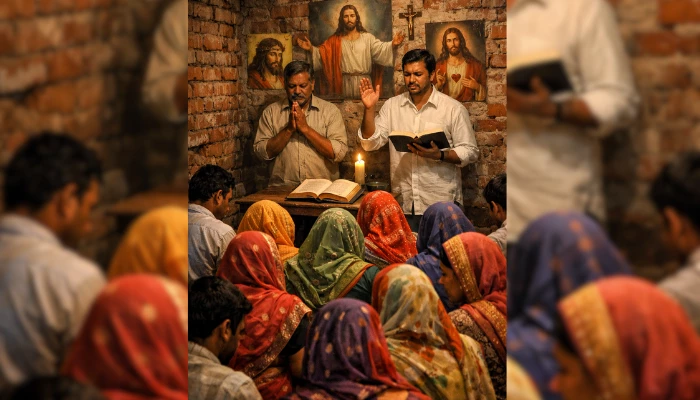
Case Summary
In Navagaon, Ratanpur, Bilaspur, Chhattisgarh, Hindu villagers, including children, were lured into attending Christian prayer meetings by members of a Christian missionary group. They were indoctrinated with the Bible and Christian teachings with the intention of converting them to Christianity. According to media reports, many Hindu villagers, including men, women and children, were lured into attending prayer meetings held at the house of a Christian man named Motilal Sahu. During the meetings, the attendees were made to read the Bible and were taught Christian religious teachings as part of efforts to convert them to Christianity. A video circulated on social media showing Bajrang Dal members entering the prayer meeting along with local police and stopping the conversion activities. The video showed a large number of men, women and children attending the meeting, with Bibles being used during the gathering and Christian teachings being imparted to the Hindu attendees. Bajrang Dal workers were also heard saying that some Hindu women had stopped wearing sindoor (a Hindu religious symbol worn by married Hindu women in the parting of their hair to signify their marital status) after attending the prayer meetings. Videos of the meetings showed a large number of men, women and children participating in the gatherings. The police reached the spot along with Bajrang Dal members and stopped the prayer meeting. A few Christians involved in the conversion activities were arrested. However, at the time of reporting, the exact number of people arrested was not clear.
Why it is Hate Crime ?
The primary category in this case is: Predatory Proselytisation. The selected subcategory selected is: Proselytisation by grooming, brainwashing, manipulation or subtle indoctrination. The tertiary categories selected are: Pattern of targeting Hindus and Conversion of minor. Religious brainwashing essentially means the often subtle and forcible indoctrination to induce someone to give up their religious beliefs to accept contrasting regimented ideas. Religious grooming or brainwashing also involves propaganda and manipulation. It involves the systematic effort, driven by religious malice and indoctrination, to persuade “non-believers’ to accept allegiance, command, or doctrine to and of a contrasting faith. Cases of such grooming or brainwashing are far more nuanced than direct threats, coercion, inducement and violence. In such cases, it is often seen that there is repeated, subtle and continual manipulation of the victim to induce disaffection towards their own faith and acceptance of the contrasting faith of the perpetrator. While subtle indoctrination is widely acknowledged as predatory, an element which is often understated in such conversions or the attempts of such conversion is the role of loyalty and trust which might develop between the perpetrator and the victim. Fiduciary relationships are often abused to affect such religious conversion. For example, an educator transmitting religious doctrine of a competing faith to a Hindu student. The Hindu student is likely to accept what the teacher is transmitting owing to existence of the fiduciary relationship. The exploitation of the fiduciary relationship to religiously indoctrinate victims would also be included in this category. Since the underlying animosity towards the victim’s faith forms the basis of predatory proselytization, such cases are considered religiously motivated hate crimes. In this case, Hindu villagers, including children, were lured into attending Christian prayer meetings by Christian missionaries and were subjected to religious indoctrination with the objective of converting them to Christianity. The perpetrators specifically directed their conversion efforts towards members of the Hindu community rather than conducting general religious outreach. The targeted nature of these activities was significant because the victims were selected on the basis of their Hindu religious identity and were then exposed to sustained efforts to change that identity. When individuals or groups specifically focus their conversion activities on members of a particular faith, it demonstrates that the religious identity of the targeted community is central to the conduct. In this case, the Christian perpetrators specifically targeted Hindus for conversion, demonstrating disregard for their existing faith, traditions and religious identity. The objective was not merely to introduce Hindu villagers to another belief system but to persuade them to abandon Hinduism and adopt Christianity, making the religious identity of the victims an integral part of the offence. The prayer meetings were also used as a means of facilitating these conversion activities. The meetings were presented as prayer gatherings, but the Hindu attendees were made to read the Bible and were subjected to Christian religious teachings with the objective of converting them to Christianity. The term “prayer meeting” ordinarily denotes a gathering for worship, prayer and spiritual reflection within a particular faith. In this case, however, the meetings were used to bring Hindu villagers into an environment where Christian religious teachings were systematically imparted to them for the purpose of conversion. This deliberate use of a religious gathering to attract members of another faith and subsequently subject them to conversion efforts demonstrated the targeted and religiously motivated nature of the conduct. The Hindu villagers were not merely exposed to Christianity in passing; they were brought together and indoctrinated with Christian teachings as part of an organised conversion effort directed at them because they were Hindus. The Christian perpetrators also used the Bible and Christian religious teachings as instruments of indoctrination. The use of the religious scriptures of one faith to systematically influence members of another faith and induce them to abandon their existing religion was a direct attack on the religious beliefs and identity of the Hindu victims. This was particularly significant because the Bible was not simply present at the meetings as a religious text; it was actively used in the process through which Hindu attendees were subjected to Christian teachings and targeted for conversion. The organised use of Christian religious literature, combined with the deliberate selection of Hindu attendees, demonstrated that the incident was part of a structured proselytisation effort rather than an isolated act of evangelism. The conduct sought to weaken the victims’ adherence to Hinduism and replace their existing religious identity with Christianity, thereby making the Hindu faith of the victims a central factor in the offence. The impact of these activities on the Hindu community further demonstrated their religious character. Bajrang Dal workers stated that some Hindu women had stopped wearing sindoor after attending the prayer meetings. Sindoor is a traditional Hindu religious symbol worn by married Hindu women in the parting of their hair and is associated with marital status and Hindu cultural and religious practice. The fact that Hindu women stopped wearing this symbol after attending the Christian prayer meetings demonstrated the effect that the conversion activities had on their existing Hindu religious practices. This was not merely a change in personal preference unrelated to religion; it involved the abandonment of a recognisable Hindu religious and cultural practice following participation in meetings conducted for Christian conversion. The change therefore demonstrated the extent to which the conversion activities affected the religious identity and practices of the Hindu women who attended them. The case also involved Hindu children, which made the conduct particularly serious. The victims being minors means the element of consent and genuine change of conscience was missing ab initio. Minors, due to their young age and lack of maturity, are particularly vulnerable to manipulation and coercion. They do not have the ability to fully understand the implications of converting to another religion, and the Christian perpetrators purposely targeted and exploited this vulnerability of the minor victims. Since this case exemplifies the use of coercion and manipulation to achieve religious conversion, it is a blatant act of a religiously motivated hate crime against Hindus. The cumulative circumstances established that this was not merely an instance of Christians practising or sharing their faith. Hindu villagers, including children, were specifically targeted through Christian prayer meetings, religious texts and teachings to facilitate their conversion from Hinduism to Christianity. The activities directly affected the religious identity and practices of the Hindu victims, including the abandonment of sindoor by some Hindu women. The targeted nature of the conversion efforts, the use of Christian religious material and the inclusion of children demonstrated an attempt to undermine the Hindu religious identity of the victims. Therefore, the incident constituted an anti-Hindu hate crime involving predatory proselytisation. These instances of targeted proselytisation activities stem from inherent hostility towards the victims' professed faith, since Abrahamic faiths believe that any non-adherent to their faith is subject to being dehumanised till they convert, making it a religiously motivated crime against Hindus. Therefore, this case is being added to the hate crime database of the Hinduphobia Tracker. Disclaimer: In this case, the total number of perpetrators involved in or arrested for the conversion activities was not specified in the available reports. However, the conversion activities took place at the house of Christian man Motilal Sahu. Therefore, the perpetrator count was conservatively recorded as one, referring only to the identified individual whose residence was used for the conversion activities. This figure was recorded for documentation purposes only and did not indicate that Motilal Sahu was the only person involved. In this case, multiple Hindu men, women and children were targeted for conversion. However, the exact number of Hindu victims involved in the conversion activities was not specified in the available reports. Therefore, the victim count was recorded as unknown for documentation purposes. The Hinduphobia Tracker records incident dates based on when the crime occurred rather than when it was reported by the media. However, the exact date on which the conversion activities took place was not specified in the available reports. Therefore, the date on which the incident was first published in the media, 17 August 2026, was recorded as the indicative incident date for documentation purposes.


Case Status
Arrested


Perpetrators Details
Perpetrators
Christian Extremists
Perpetrators Range
One Person
Perpetrators Gender
male
 Sources




