Hindu temple access obstructed by madrasa encroachment, disrupting religious practices in Gujarat
 Rajpipla, Gujarat, India
  16 January, 2026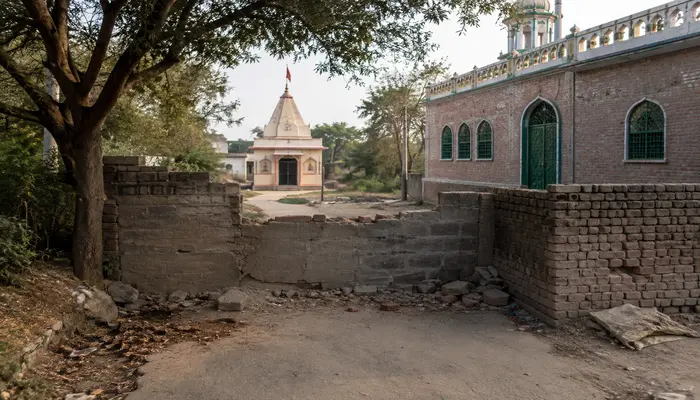
Case Summary
In Vajeriya village of Tilakwada taluka, Narmada district, Gujarat, access to a local Mataji temple was obstructed after an illegal encroachment by a madrasa (Islamic religious institution) blocked the main road leading to the shrine. The obstruction caused considerable difficulty for Hindu devotees and local residents seeking to access the temple and also disrupted religious practices of the Hindu community. According to media reports, the villagers stated that the encroachment had previously been brought to the attention of the authorities, but no action had been taken to remove the obstruction and restore access. The issue became more urgent with the approaching Sheetla Satam fair, a Hindu religious festival that attracts a large number of devotees to the Mataji temple. The villagers expressed concern that the blocked road would cause significant inconvenience to devotees and local residents and interfere with their religious practices and sentiments. The villagers subsequently petitioned the Tilakwada Taluka Development Officer and other concerned authorities, demanding an immediate investigation and removal of the encroachment. They sought the reopening of the road before the upcoming religious festivities and gave the authorities four days to restore access. They further stated that failure to act within the stipulated period would lead them to stage a protest on Gandhi Chindhya Marg. At the time of writing this report, the matter remained pending before the concerned authorities, with villagers awaiting action to restore access to the temple.
Why it is Hate Crime ?
This case has been added to the tracker under the primary category: Restriction/ban on Hindu religious practice. Within this, the subcategory selected is: Restriction on expression of Hindu identity. An example of the state-affected prejudicial and targeted orders against the Hindu community would be a government denying the right of a Hindu or a group of Hindus to hold a religious procession owing to the animosity of non-Hindu groups. Denial of the religious right of the Hindus to assuage the non-Hindu group which harbours animosity to a point where it could lead to violence against Hindus is not only a failure of law and order but is a prejudicial order against Hindus, denying them their fundamental rights to express their religious identity. An example of a hate crime against Hindus by a non-Hindu would be a non-Hindu institution forcing its Hindu employees to abandon religious symbols that a Hindu would wear as an expression of faith owing to inherent prejudice against the faith professed by the victim or a non-Hindu group of people restricting a Hindu group from constructing a place of worship simply because the demography of the area in which the temple is being built is dominated by non-Hindus. Such actions are driven by religious animosity and/or prejudice against Hindus and their faith and would therefore be categorized as a hate crime. This case is a clear instance of the restriction of Hindus’ ability to practise their faith. An encroachment by an Islamic institution blocked the main access route to a Hindu place of worship, directly preventing Hindu devotees from freely reaching the Mataji temple, gathering for worship and participating in traditional religious customs. The obstruction went beyond a routine civic dispute over land or public access because it specifically deprived Hindu devotees of convenient access to their sacred space. By cutting off the main road leading to the temple, the encroachment created a direct barrier to Hindu religious expression and interfered with the community's fundamental ability to worship and observe its religious traditions. The impact was particularly serious ahead of the Sheetla Satam fair, when large numbers of devotees were expected to visit the temple and participate in religious observances. The encroachment disproportionately affected the Hindu community by choking the specific pathway required to reach the Hindu shrine. The location of the obstruction established its direct religious impact: it was placed on the main route used by devotees to access a Hindu place of worship. Such an obstruction functioned as a tool of territorial and religious pressure, forcing Hindu devotees to face considerable difficulty simply to reach their temple and participate in religious gatherings. It restricted the Hindu community's ability to use its sacred space freely and disrupted the normal exercise of religious practices. By obstructing access to a Hindu deity's shrine, the encroachment effectively imposed the footprint of another religious institution over the movement and religious activities of Hindu devotees and marginalised Hindu religious practice in the public sphere. The incident reflects a wider pattern in which non-Hindu groups or institutions assert dominance by encroaching upon and obstructing Hindu religious spaces. Such actions function as tools of territorial and religious intimidation, restricting the Hindu community's ability to freely access, occupy and use spaces associated with its faith. In this case, blocking the main road to the Mataji temple directly interfered with the community's established route to its sacred site and threatened to disrupt a major Hindu religious gathering. The obstruction therefore did not merely create inconvenience for road users; it disrupted the physical access necessary for worship and religious observance. Forcing Hindu devotees to confront an obstruction in order to reach their temple undermined their ability to participate freely in their traditional customs and asserted a physical restriction over the community's religious presence. Furthermore, the persistent administrative inaction amounted to a prejudicial failure to protect the Hindu community's ability to practise its faith. The villagers had already brought the matter to the authorities' attention, yet the obstruction remained in place, and access to the temple was not restored. This prolonged inaction allowed the restriction on Hindu religious practice to become entrenched and permitted an obstruction affecting a Hindu place of worship to continue unchecked. The villagers were ultimately compelled to petition the Tilakwada Taluka Development Officer and other concerned authorities, demanding that the encroachment be removed and the road reopened before the Sheetla Satam festivities. By failing to clear the obstruction despite prior representations, the authorities allowed a physical barrier to Hindu religious practice to persist. The encroachment and the continued failure to restore access therefore constituted a direct and sustained restriction on Hindus' ability to worship, observe their religious customs, and freely access their place of worship. Since this case meets the parameters of a hate-driven offence, it is being added to the hate crime database of the Hinduphobia Tracker. Disclaimer: The exact date of when the encroachment by the madrasa began was not specified in the available sources. However, the sources indicate that the issue had been raised with the authorities approximately eight months before the report. The tracker records incident dates based on when the crime occurred rather than when it was reported or published. In this case, 17th January 2026 has been used as the indicative incident date, based on the available timeline. This date has been recorded for documentation purposes only


Case Status
Complaint filed


Perpetrators Details
Perpetrators
Muslim Extremists
Perpetrators Range
Unknown
Perpetrators Gender
unknown
 Sources




