Hindu man induced and pressured to convert by Muslim man; assaulted and abused with casteist slurs upon refusing
 Faridpur, Uttar Pradesh, India
  11 January, 2026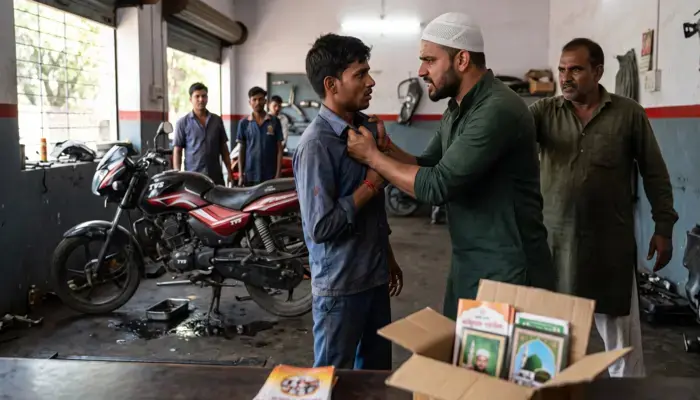
Case Summary
In Faridpur, Bareilly, Uttar Pradesh, a Dalit Hindu man named Ravi Sagar was induced and pressured to convert to Islam by his Muslim colleague Taufiq and his family. When the victim refused, he was threatened with death, subjected to casteist abuse, and brutally assaulted by the accused. According to reports, Ravi and Taufiq were colleagues and worked together at a TVS motorcycle agency in Mohalla Farrakhpur. During their employment, the two men developed a close friendship, and Taufiq began visiting Ravi's home. Approximately six months prior to the assault, Taufiq began pushing his religious beliefs onto Ravi, attempting to persuade him to embrace Islam. Taufiq promised him respect and a better life after adopting Islam. When Ravi showed no interest and refused to convert, Taufiq began insulting him with casteist slurs. The harassment escalated on 12 July 2026, when Taufiq and his family aggressively pressured Ravi and his family to convert to Islam and issued severe threats against his life. The following day, on 13 July 2026, while Ravi was at his workplace, Taufiq, accompanied by his father, Shamsher, and his brother, Tausif, arrived at the motorcycle agency and brutally assaulted Ravi. Ravi initially approached the local police station to file a complaint, but the officers scolded him, chased him away, and refused to register the case. Seeking justice, Ravi sent a written complaint by post to the Senior Superintendent of Police. Acting on the orders of the Senior Superintendent of Police, a First Information Report was registered on 15 August 2026 against Taufiq, Shamsher, and Tausif. The case was filed under charges of harassment and forced religious conversion, and the authorities subsequently launched a search to apprehend the accused individuals.
Why it is Hate Crime ?
The primary category selected in this case is- Predatory Proselytisation. The subcategory selected is - Proselytisation by grooming, brainwashing, manipulation or subtle indoctrination. Religious brainwashing essentially means the often subtle and forcible indoctrination to induce someone to give up their religious beliefs to accept contrasting regimented ideas. Religious grooming or brainwashing also involves propaganda and manipulation. It involves the systematic effort, driven by religious malice and indoctrination, to persuade “non-believers’ to accept allegiance, command, or doctrine to and of a contrasting faith. Cases of such grooming or brainwashing are far more nuanced than direct threats, coercion, inducement and violence. In such cases, it is often seen that there is repeated, subtle and continual manipulation of the victim to induce disaffection towards their own faith and acceptance of the contrasting faith of the perpetrator. While subtle indoctrination is widely acknowledged as predatory, an element which is often understated in such conversions or the attempts of such conversion is the role of loyalty and trust which might develop between the perpetrator and the victim. Fiduciary relationships are often abused to affect such religious conversion. For example, an educator transmitting religious doctrine of a competing faith to a Hindu student. The Hindu student is likely to accept what the teacher is transmitting owing to existence of the fiduciary relationship. The exploitation of the fiduciary relationship to religiously indoctrinate victims would also be included in this category. Since the underlying animosity towards the victim’s faith forms the basis of predatory proselytization, such cases are considered religiously motivated hate crimes. The other sub-category selected here - Conversion/ attempts to convert by inducement Predatory Proselytisation is not just limited to threat, harassment, force and violence, but it also has contours of stealth. In several cases, the Hindu victim is exploited to convert, with non-Hindus taking advantage of their poverty. In such cases, the Hindu victim who is suffering financially is offered monetary benefits, including lucrative offers for jobs, health treatment, education, etc, to induce the victim into changing his/her religion. In such cases, the religious identity of the victim and the aim to disenfranchise him from his faith form the heart of the crime. Also, taking advantage of and exploiting an individual’s economic vulnerabilities is widely acknowledged as exploitation, forms of which are often penalised by law. Such cases therefore are considered religiously motivated hate crimes since the victim’s religious identity forms the very heart of the crime itself. The other sub-category selected here is - Harassment, threats, coercion for conversion. Harassment covers a wide range of behaviours of an offensive nature. It is commonly understood as behaviour that demeans, humiliates, and intimidates a person, including threats and coercion. Harassment and threats, in this case, find their root on discriminatory grounds which has the effect of nullifying a person’s rights or infringing upon his freedom to exercise his right specifically owing to the victim’s religious identity. Verbal and physical threats and psychological or physical harassment are often used against Hindu victims because they choose to practice their professed religion. Religious harassment also includes forced and involuntary conversions by harassment, threats or coercion. Coercion includes intimidatory tactics like force-feeding a Hindu victim beef to convert to another religion, forceful circumcision etc. In several cases documented, non-Hindu perpetrators or those who harbour specific animosity towards Hinduism, harass victims simply based on their religious identity. Such cases often also include harassment to ensure the Hindu victim abandons his/her professed religion and adopts the religion of the perpetrator. Such cases where Hindu victims are harassed to convert to the perpetrator’s religion are rooted in animosity towards the victim’s religious identity and are therefore documented as religiously motivated hate crimes. Another primary category selected is- Attack not resulting in death. The subcategory selected is- Attacked for refusal to convert. When there is pressure, threat or coercion employed upon the Hindu victim to convert to a different religion, in several cases, the victim refuses to succumb to the pressure/threats. Once the victim refuses, the perpetrator proceeds to attack/assault the victim owing to his/her refusal to convert. In such cases, the pressure/threat/intimidation/coercion/violence itself is driven by animosity towards the victim’s Hindu faith. The violence then is another hate crime driven by the victim’s refusal to abandon his professed faith, Hinduism, and convert to the religion of a non-Hindu perpetrator. Since the victim’s faith is at the heart of the pressure to convert and the ensuing violence towards the victim, such cases are considered religiously motivated hate crimes. The third primary category selected here is - Hate speech against Hindus. Within it, the sub-category selected is Anti-Hindu slurs, mocking faith. Anti-Hindu slurs and the deliberate mocking of the Hindu faith owing to religious animosity involve the usage of derogatory terms, stereotypes, or offensive references to religious practices, symbols, or figures. One of the common anti-Hindu slurs used against Hindus is “cow-worshipper” and “cow piss drinker”. The intention of using this term is to demean and mock Hindus as a group and their religious beliefs since Hindus consider the cow holy. Additionally, some symbols and the slurs attached to them have a historical context that exacerbates the insult, hate, stereotyping, dehumanisation and oppression against Hindus. Cow worship has been used for centuries to denigrate Hindus, insult their faith and oppress Hindus specifically as a religious group. There has been overwhelming documentation about how cow slaughter has been used to persecute Hindus with cow meat being thrown in temples and places of worship. There has also been overwhelming documentation where cow meat (beef) has been force-fed to Hindus to either forcefully convert them to Islam or denigrate their faith. Apart from cow worship, the Swastika – which holds deep religious significance for the Hindus – has also been misinterpreted and distorted to use as a slur against Hindus. Similarly, the worship of the Shivling has been used by supremacist ideologies and religions to denigrate Hindus owing to religious animosity. Such slurs and denigration stem out of inherent animosity and hate towards Hindus and their faith, therefore, it is categorised as hate speech targeted at Hindus specifically owing to their religious identity. This incident represents a clear and unmistakable hate crime, driven by an aggressive intent to erase the victim's Hindu identity. The Muslim perpetrator engaged in a sustained, prolonged campaign of religious coercion, explicitly targeting Ravi Sagar’s socio-religious background as a Dalit Hindu. By promising material comforts and societal respect in exchange for adopting Islam, the accused weaponised the victim's social standing to force an involuntary conversion. This calculated pressure demonstrated a fundamental hostility towards the victim’s right to freely practise his professed faith, reducing his religious identity to a target for erasure. The progression from subtle religious indoctrination to overt coercion further demonstrated the religiously motivated nature of the conduct. The perpetrator did not immediately resort to force; instead, he first cultivated familiarity and used the existing friendship to gradually introduce and promote his religion to the victim over several months. This sustained effort to influence the victim’s religious beliefs was significant because it established that the subsequent conversion pressure was not an isolated disagreement but the culmination of a deliberate attempt to alter the victim’s religious identity. When the victim did not respond to this religious persuasion, the conduct escalated into promises of respect and material comforts in return for conversion, followed by intimidation and violence when he continued to refuse. This progression showed that the victim was being targeted specifically because of his religious identity and his unwillingness to abandon it. The escalation from subtle indoctrination to inducement and ultimately to coercion therefore provided a clear indication of religious animosity and demonstrated that the violence was connected to the victim’s refusal to surrender his Hindu identity. Pressuring a Hindu individual to discard his religious faith and embrace another was a direct attack on his religious identity and dignity. It was not a matter of personal choice; it was coercion rooted in hostility towards the victim's Hindu identity. Such an attempt reflects religious animosity because the act was not simply about personal differences but about erasing the victim’s Hindu faith, making it a religiously motivated crime. When the coercive tactics failed to secure a religious conversion, the underlying religious animosity manifested as targeted verbal abuse. The deliberate use of caste-based slurs following the victim's refusal to embrace Islam was a direct attack on his dignity and Hindu identity. It can be argued that a caste-specific slur was aimed at his micro identity of belonging to the Dalit section of the Hindu community and not her Hindu identity itself. However, as far as Abrahamic religions are concerned, the micro identities of caste, region, and language are secondary. It is the religious identity that drives the animosity of the perpetrator against the Hindu victim. In this case, while the accused hurled caste abuses at the victim, the animosity was driven by his animosity towards Hinduism and Hindus. Furthermore, the immediate trigger of the casteist slurs and violence was itself the victim's refusal to convert to Islam, makes it a religiously motivated hate crime against the victim. The religious hostility further escalated when the demands expanded to encompass the victim's entire household. The involvement of the perpetrator's family members in issuing severe threats highlights a collective effort to impose their religion on a Hindu family. The demand that the whole family abandon their beliefs transformed the harassment from an individual dispute into a systemic assault on the religious autonomy of a Hindu household, underscoring the deep-seated intolerance driving the perpetrators' actions. Ultimately, the severe physical violence inflicted upon the victim was the direct and violent consequence of his resolute refusal to succumb to the conversion demands. The perpetrators resorted to brutal physical force and death threats as retribution against a Hindu man who protected his faith. Assaulting a victim physically for rejecting a different religion vividly illustrates that the attack was entirely rooted in anti-Hindu animus. This violent punishment for maintaining one's religious identity confirms the incident as a definitive religiously motivated hate crime. In this context, the assault was not merely an interpersonal or workplace dispute; it was the violent enforcement of a demand that a Hindu man abandon his faith, making his religious identity and his refusal to convert central to the motive behind the attack. Taken together, the sustained religious persuasion, inducements to convert, pressure extended to the victim’s family, caste-based abuse following his refusal, and subsequent physical assault formed a clear pattern of escalating religious coercion. The violence was directly connected to Ravi Sagar’s refusal to abandon his Hindu identity, making his religion a central factor in the hostility and establishing the incident as a religiously motivated hate crime. Disclaimer: The exact date of when the Hindu man and the Muslim perpetrator first came into contact was not specified in the available sources. However, the sources indicate that around six months before the assault, the perpetrator began discussing Islam with the victim and urging him to convert. The tracker records incident dates based on when the crime occurred rather than when it was reported or published. In this case, 12th January 2026 has been used as the indicative incident date, based on the reported beginning of the victim’s ordeal. This date has been recorded for documentation purposes only
Victim Details
Total Victim
1
Deceased
0
Gender
- Male 1
- Female 0
- Third Gender 0
- Unknown 0
Caste
- SC/ST 1
- OBC 0
- General 0
- Unknown 0
Age Group
- Minor 0
- Adult 1
- Senior Citizen 0
- Unknown 0


Case Status
Complaint registered


Perpetrators Details
Perpetrators
Muslim Extremists
Perpetrators Range
From 2 To 5
Perpetrators Gender
male
 Sources




