Minor Hindu students forced to perform in burqa at school’s Independence Day event in Gonda, Uttar Pradesh
 Gonda, Uttar Pradesh, India
  14 August, 2026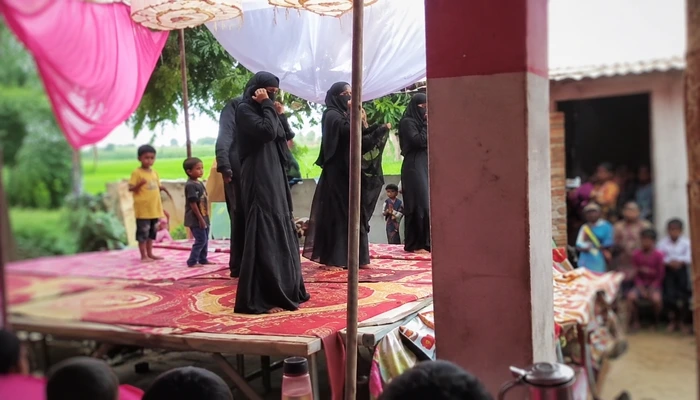
Case Summary
During an Independence Day celebration at Knowledge Beam Academy in Ausani Bujurg, Gonda, minor Hindu girl students were forced to perform in burqa and niqabs. A video of the performance was circulated on social media, showing four to five Hindu girl students dressed in burqas and niqabs dancing to a Bhojpuri song on stage. The performance took place during the school's Independence Day cultural programme, which was organised around 2 p.m. on 15 August 2026. The video triggered outrage and drew strong reactions from the Hindu community. Several people objected to the use of burqas and niqabs during the performance and demanded action against the school management and those responsible for organising the programme. Following the controversy, school manager Ram Suresh issued a video statement and apologised for the incident. He confirmed that the students who performed while wearing burqas and niqabs were Hindus and that the presentation was intended only as an entertainment and cultural performance. The incident subsequently came under the scrutiny of the district education authorities. Gonda Basic Education Officer Amit Kumar Singh ordered an investigation into the matter and said that the entire incident would be examined. The school's principal, P.P. Verma, also stated that the institution's recognition was granted only up to Class 8, while teaching was conducted up to the intermediate level. The authorities informed that the school's recognition and other aspects of the institution's functioning would also be examined as part of the inquiry.
Why it is Hate Crime ?
The primary category selected in this case is: Predatory Proselytisation. Within this, the subcategory selected is: Proselytisation by grooming, brainwashing, manipulation and subtle indoctrination. Religious brainwashing essentially means the often subtle and forcible indoctrination to induce someone to give up their religious beliefs to accept contrasting regimented ideas. Religious grooming or brainwashing also involves propaganda and manipulation. It involves the systematic effort, driven by religious malice and indoctrination, to persuade “non-believers’ to accept allegiance, command, or doctrine to and of a contrasting faith. Cases of such grooming or brainwashing are far more nuanced than direct threats, coercion, inducement and violence. In such cases, it is often seen that there is repeated, subtle and continual manipulation of the victim to induce disaffection towards their own faith and acceptance of the contrasting faith of the perpetrator. While subtle indoctrination is widely acknowledged as predatory, an element which is often understated in such conversions or the attempts of such conversion is the role of loyalty and trust which might develop between the perpetrator and the victim. Fiduciary relationships are often abused to affect such religious conversion. For example, an educator transmitting religious doctrine of a competing faith to a Hindu student. The Hindu student is likely to accept what the teacher is transmitting owing to the existence of the fiduciary relationship. The exploitation of the fiduciary relationship to religiously indoctrinate victims would also be included in this category. Since the underlying animosity towards the victim’s faith forms the basis of predatory proselytization, such cases are considered religiously motivated hate crimes. This case has been included in the Hinduphobia Tracker because Hindu girl students were forced to wear burqas and niqabs, imposing visible markers of another religion on minors who follow the Hindu faith. The issue therefore went beyond clothing or a school activity. The girls were made to adopt religiously associated Islamic attire despite their own Hindu identity, effectively placing another faith's symbols upon them and diminishing their ability to express their own religious identity. The fact that the students were minors makes the incident more serious. Children are particularly impressionable and dependent on adults in positions of authority. Repeatedly making Hindu children adopt the symbols, dress, or practices of another religion can gradually make such conduct appear normal and acceptable to them. What begins as forced participation in another religion's outward practices can therefore weaken a child's own religious identity and make them more receptive to further religious influence. The use of burqas and niqabs is particularly significant because these are recognisable markers of Islamic religious and cultural identity. Forcing Hindu students to wear them effectively turned religious symbols into instruments of conditioning. The concern is not simply that the children were dressed differently, but that they were made to publicly adopt an appearance associated with a faith they did not profess. The timing of the incident further adds to its significance. The students were made to wear Islamic attire during an Independence Day programme, a public national occasion. Instead of allowing Hindu children to participate while retaining their own religious identity, the activity required them to publicly assume the visible markers of another faith. This reduced their Hindu identity to something that could be set aside for participation and presented religious conformity as ordinary. The incident can therefore be viewed as a subtle form of religious grooming of minors. Grooming does not necessarily begin with an explicit demand for conversion. It can begin by repeatedly exposing children to another religion's symbols and practices and encouraging or compelling them to adopt those markers until they cease to appear foreign. When such conduct is directed at Hindu minors, it can gradually dilute their attachment to their own religious identity and create conditions in which later religious pressure or conversion becomes easier. The distinction between ordinary exposure to another faith and religious conditioning lies in choice. Children may naturally learn about different religions, cultures, and traditions, but forcing Hindu minors to wear another religion's religious attire removes that choice. They are not simply learning about another faith but being made to participate in its outward expression. Taken together, the forced imposition of Islamic attire, the young age of the students, and the public nature of the activity demonstrate a pattern of religious manipulation aimed at normalising another religious identity among Hindu children. The incident therefore reflects religious coercion and psychological conditioning of minors and warrants its inclusion in the Hinduphobia Tracker. Disclaimer: The victim count has been recorded as 5 because media reports put the number of affected students at four to five. Since the reports indicated a possible fifth victim and did not conclusively establish that the number was limited to four, the Tracker has used the higher figure of five to ensure that the potential number of victims is not understated.
Victim Details
Total Victim
5
Deceased
0
Gender
- Male 0
- Female 5
- Third Gender 0
- Unknown 0
Caste
- SC/ST 0
- OBC 0
- General 0
- Unknown 5
Age Group
- Minor 5
- Adult 0
- Senior Citizen 0
- Unknown 0


Case Status
Unknown


Perpetrators Details
Perpetrators
Unknown
Perpetrators Range
Unknown
Perpetrators Gender
unknown
 Sources




