Hindus community vilified as Turkish documentary portrays Hindu groups and religious concerns as anti-Muslim hatred
 India
India  10 August, 2026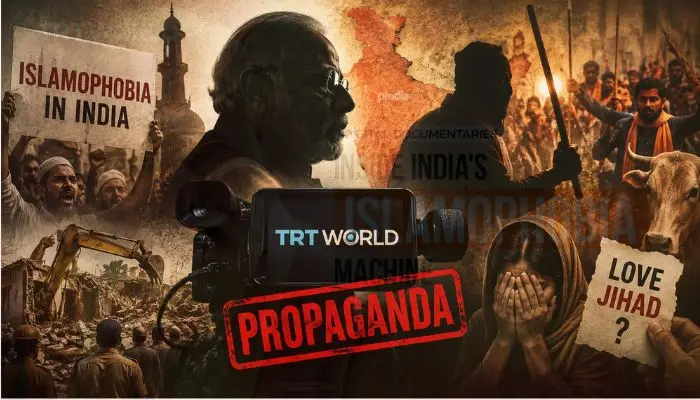
Case Summary
Anti-Hindu rhetoric was propagated, in which the Hindu community was vilified through a predominantly anti-Hindu and anti-India framing in a documentary by the Turkish state broadcaster TRT World. The documentary was published on 10 August 2026 and focused on selected accounts of alleged mob violence, demolitions, police action and the activities of Gau Rakshaks to construct a narrative of systematic persecution of Muslims, while omitting or minimising instances in which Hindus had been targeted by Muslim mobs and individuals. The documentary maliciously portrayed Gau Rakshaks in a negative light, calling them “cow-vigilantes” involved in violence against Muslims and presenting their activities as part of a wider system of anti-Muslim hostility operating with the backing of BJP governments. It also associated Hindu rights groups and Gau Rakshaks featured in the documentary with the broader issue of “Islamophobia”. TRT World also downplayed religiously motivated crimes against Hindu women, talking about “love jihad”, presenting them as Muslim men being targeted by “Hindu extremists” and the “Hindutva regime”. The documentary maliciously framed the Hindu community’s concerns surrounding such cases as criticism and intolerance towards interfaith marriages, thereby presenting Hindu opposition to “love jihad” within a narrative of anti-Muslim hostility. The documentary further claimed that Muslim-owned homes and shops were being demolished, portraying isolated incidents of encroachment-related demolition as the wider pattern of anti-Muslim discrimination. It also described the Citizenship Amendment Act (CAA) as “discriminatory” and presented it as a factor that contributed to the 2020 Delhi riots. The documentary featured advocate Sanjay Hegde, who claimed that BJP governments and police administrations essentially protected Hindu perpetrators in episodes of organised violence against Muslims. It also featured activist Aasif Mujtaba, who claimed that the 2020 Delhi riots, the 2013 Muzaffarnagar riots and the 2002 Gujarat riots were anti-Muslim riots and stated that Muslims had not received justice. The documentary therefore repeatedly placed Hindu groups, Hindu activists, Gau Rakshaks, the BJP and the broader “Hindutva” movement within a narrative of anti-Muslim hostility. Hindu participation in the film was primarily presented through the framework of “Islamophobia”, while the documentary's central argument characterised Hindu-majority India under the BJP-led government as an environment in which Muslims faced systematic discrimination, violence and hostility.
Why it is Hate Crime ?
The primary category selected in this case is: Hate Speech against Hindus. The subcategory selected is: Anti-Hindu subversion and prejudice. The tertiary category selected is: Anti-Hindu fake news or downplaying. Hate speech is defined as any speech, gesture, conduct, writing, or display that is prejudicial against a specific individual and/or group of people, which is leading to or may lead to violence, prejudicial action or hate against that individual and/or group. Media plays a specific and overarching reach in perpetuating prejudicial attitudes towards a community owing to unfair, untrue coverage and/or misrepresentation/misinterpretation, selective coverage and/or omission of facts of/pertaining to issues affecting a specific religious group. This type of bias can dehumanise the victim group, making it easier for others to justify harmful actions against them, which aligns with the objectives of hate speech laws aimed at preventing such harm. It is often observed that the media takes a prejudicial stand against the Hindu community driven by their need to shield the aggressor community which happens to be a numeric minority, however, is the one perpetrating violence against Hindus. For example, the media is often quick to contextualise religiously motivated crimes against Hindus, omit or misrepresent facts that point towards religiously motivated hate crimes, justify and/or downplay religiously motivated hate crimes or simply present fake news to stereotype Hindus. Such media bias leads to the denial of persecution and is often used to dehumanise Hindus, leading to justification for violence against them. For example, the media covered several fake allegations of Hindus targeting Muslims and forcing them to chant Jai Shree Ram. Most of these cases were proved false and fabricated after police investigation. These fake news reports were subsequently never retracted or clarified. Such fake news led to the justification of violence and dehumanisation of Hindus based on the argument that since Hindus targeted Muslims and forced them to chant Jai Shree Ram, the dehumanisation of Hindus and violence against them was par for the course and merely a retaliation. Such media bias leads to prejudicial portrayal of Hindus and offers a justification for violence against them and therefore, is considered hate speech under this category. This incident qualified as an anti-Hindu hate incident because the TRT's content did not merely criticise a political government, individual politician or specific policy. Instead, the documentary repeatedly and maliciously framed issues involving Hindus through a collective religious lens and portrayed Hindu religious activism, Hindu organisations and Hindu responses to communal and religious issues as manifestations of hatred against Muslims. The significance of the case therefore lay in the manner in which Hindu identity and Hindu-related concerns were collectively associated with violence, extremism and intolerance. The documentary was structured around the premise that an organised system of anti-Muslim hatred existed in India. It used selected accounts of mob violence, demolitions, police action and Gau Rakshaks to construct this narrative. The element of hate arose primarily from the portrayal's collective character. Rather than restricting criticism to particular individuals accused of misconduct, the documentary falsely portrayed these incidents as proof of hostility towards Muslims. For example, Gau Rakshaks were portrayed as violent groups backed by the government and primarily engaged in harassing or attacking Muslims. This framing was significant because it presented incidents involving Gau Rakshaks as manifestations of anti-Muslim hatred, without acknowledging that their stated objective was to prevent cow smuggling and slaughter, irrespective of the religion of those involved. By focusing on cases in which Muslims were involved, the documentary presented cow-protection actions as being driven by hostility towards Muslims rather than by opposition to cow smuggling or slaughter, which itself is illegal in many states of India. This created a broader negative portrayal of the Hindu cow-protection movement by associating its religious concerns with communal hatred and violence. An equally important issue was the documentary's treatment of the cow's religious significance. For many Hindus, the cow is revered as Gau Mata and holds a deeply sacred place in Hindu religious life. Opposition to cow slaughter is therefore not merely a political or communal position but is rooted in religious belief and reverence for the animal. By presenting cow protection primarily as anti-Muslim hostility, the documentary stripped the issue of its Hindu religious context and failed to acknowledge why the cow holds such significance for Hindus. In effect, a deeply held Hindu belief was recast as communal prejudice, while the religious basis of the cow protection movement was pushed out of the narrative. The documentary also treated the Hindu community's concerns surrounding ‘love jihad’ as evidence of anti-Muslim prejudice. According to the source, the documentary presented criticism of ‘love jihad’ as criticism of interfaith marriage generally, while completely ignoring cases involving religious deception, sexual exploitation, blackmail and pressure to convert to Islam. The Hinduphobia Tracker has documented 1441 cases of Love Jihad between 1 January 2023 and 17 August 2026. Therefore, the effect of such framing was the denial of the suffering of Hindu women and the portrayal of concerns of the Hindu community as inherently motivated by hatred towards Muslims. Furthermore, the treatment of communal violence provided another important element. The documentary featured voices presenting episodes such as the 2020 Delhi Riots, the 2013 Muzaffarnagar riots and the 2002 Gujarat violence primarily as instances of anti-Muslim violence, while all these incidents of communal violence had overwhelmingly Hindu victims. The hate element was therefore not simply that the documentary discussed communal violence; rather, it was the selective framing in which Hindu victimisation and Muslim-perpetrated violence were substantially omitted while Hindus were collectively positioned on the perpetrator side. Such framing could contribute to a hostile representation of Hindus by reducing a religious community involved in complex communal conflicts to the role of aggressor while excluding the experiences of Hindus who had themselves been victims. For example, in the 2020 Delhi Anti-Hindu riots, the documentary presented the violence through a narrative of Muslim victimisation without ignoring Hindu victims such as Intelligence Bureau officer Ankit Sharma and Delhi Police Head Constable Ratan Lal. The relevance to an anti-Hindu hate classification lay in this imbalance: when a documentary presents communal violence while systematically foregrounding Muslim victimhood and omitting Hindu victims, it contributes to a narrative in which Hindu suffering becomes invisible, and Hindus are collectively represented as the source of communal violence. The documentary's treatment of the Citizenship Amendment Act similarly contributed to the anti-Hindu framing by presenting the legislation primarily as discriminatory towards Muslims while giving insufficient attention to the stated purpose of providing a citizenship pathway to persecuted non-Muslim minorities from Pakistan, Afghanistan and Bangladesh. Thus, a policy specifically concerning persecuted non-Muslim minorities was presented as evidence of hostility towards Muslims, while the religious persecution experienced by Hindu and other non-Muslim communities received little comparable consideration. Another factor supporting the hate-speech classification was the pattern of associating Hindu resistance or activism with ‘Islamophobia’. The documentary featured Hindu rights activists and Gau Rakshaks not to provide a balanced account of their stated concerns, but principally to depict their grievances and opposition to Islamist activity as ‘Islamophobic’. This was important because it shifted the focus from evaluating specific conduct to characterising Hindu activism itself as prejudicial. Where an entire religious community's organisations, concerns or defensive responses are repeatedly presented as expressions of hatred towards another religious group, the content can reinforce negative stereotypes about that community. Another concerning element was the documentary's repeated use of terms such as "Hindu extremists" and the "Hindutva regime" to vilify Hindus and portray Hindu identity, assertion, and cultural organisation as inherently threatening. 'Hindutva' is often used as a euphemism to make the targeting of Hindus more palatable. Hindutva is essentially a unifying ideology for Hindus, which became imperative for Hindus to find and preserve their cultural identity, which was being eroded and attacked due to Islamic invasions, British colonisation, Christian theological impositions and conversions. Hindutva is not a destructive ideology, as some attempt to portray, but one that is used as a unifying edifice for Hindus. Hindutva is also often used as a euphemism to target Hindus on the whole and their religious identity and faith. It is essentially semantic jugglery to confuse Hindus into believing that their own persecution by supremacists is somehow 'justified' because the specific victims espoused an ideology (Hindutva) which deserves the onslaught. The fact that the use of 'Hindutva' is merely to mask animosity towards Hindus was evident from the "Dismantling Global Hindutva" conference held in the USA, where speakers unabashedly spoke about how Hindutva and Hinduism are indistinguishable and therefore, to "dismantle Hindutva" one would have to "dismantle Hinduism". The practices of targeting Hindus and their religious and cultural identity and justifying that victimisation and dehumanisation by using euphemisms like "Hindutva" stems out of inherent animosity and hostility towards Hindus. By repeatedly using these labels while discussing incidents involving Hindus, the documentary blurred the line between criticism of specific individuals or political groups and a broader attack on Hindu identity itself. The cumulative effect of these elements was therefore more significant than any single statement in isolation. The documentary constructed a narrative in which Muslims appeared predominantly as victims, while Hindu-linked groups and actors appeared predominantly as perpetrators, extremists or sources of intolerance. At the same time, Hindu victims of communal violence and Hindu concerns relating to religious conversion, cow protection and communal security received little attention. Accordingly, this case was added to the tracker due to anti-Hindu hate speech through collective religious vilification and negative stereotyping. The documentary contributed to a portrayal of Hindus not simply as supporters of a particular political party but as a majoritarian community whose religious activism and responses to threats were inherently connected to hatred and violence against Muslims. The exclusion of Hindu victims and Hindu experiences further reinforced that one-sided representation.


Case Status
Unknown


Perpetrators Details
Perpetrators
Others
Perpetrators Range
Unknown
Perpetrators Gender
unknown
 Sources




