Hindu couple brutally assaulted and killed by Muslim man; accused repeatedly harassed family, declaring “This is our area”
 Sangli, Maharashtra, India
  14 August, 2026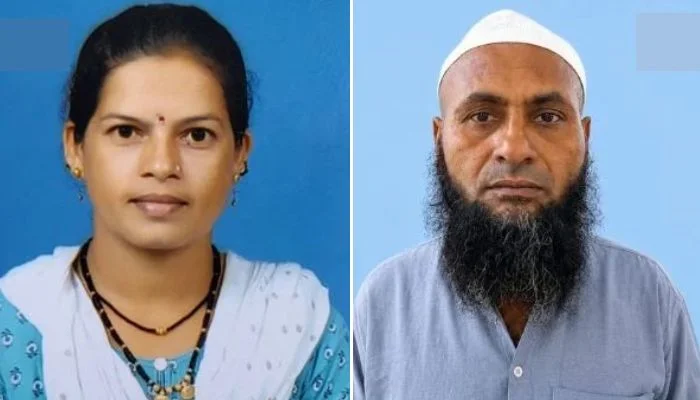
Case Summary
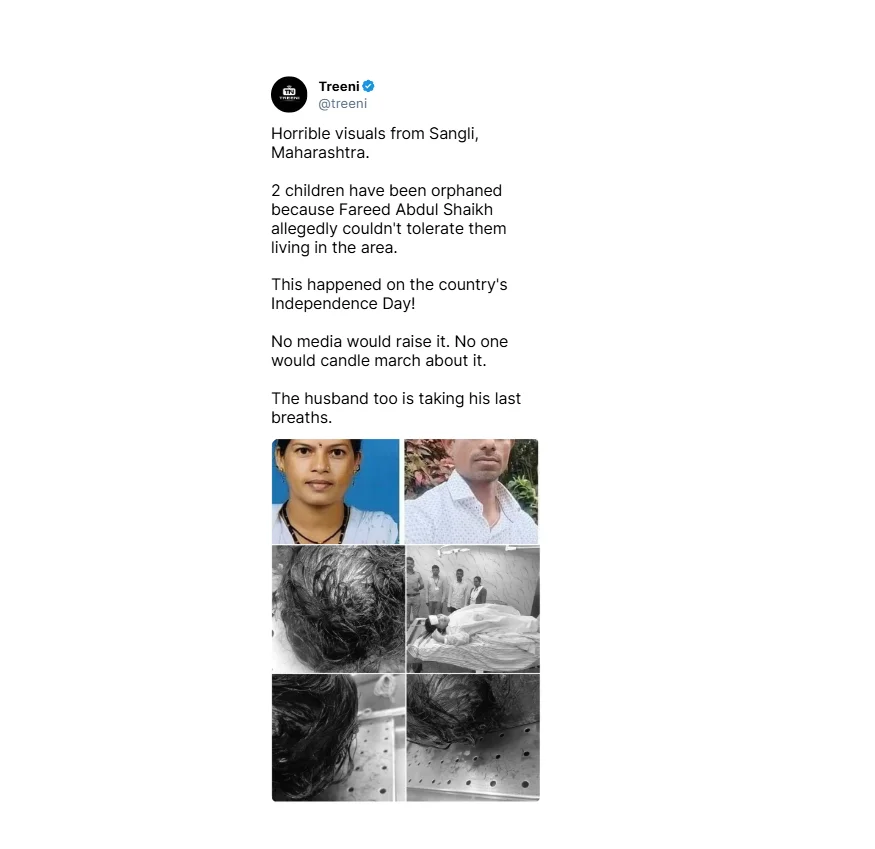
In Sangli, Maharashtra, a Hindu woman, Manisha Mohan Kesarekar, was stabbed several times and killed by a Muslim man, Farid Abdul Sheikh. Her husband, Mohan Nagappa Kesarekar, who was also brutally assaulted in the same attack, later succumbed to his injuries, resulting in the deaths of both Manisha and Mohan. Sheikh had repeatedly harassed the Hindu family over their presence in the area and demanded that they leave. He would regularly tell them, "You cannot live in our area (referring to the area where Muslims are in prominent numbers)". The incident occurred at around 6 am on 15 August 2026 in Vighnaharta Colony near Chanakya Chowk in Kupwad, Sangli district. As per reports, Manisha and Mohan lived in Vighnaharta Colony with their two children. Their daughter was studying in Class 11, while their son was in Class 7. The family originally belonged to Hebbal in Karnataka's Belagavi district and had constructed their house in Kupwad around nine to ten months before the crime occurred. Sheikh had been living alone in the same locality for a long time. He worked as a flooring mason, while Mohan worked as a mason and Manisha was a homemaker. On the day of the incident, Manisha was outside her house and lighting a wood-fired stove to heat water when Sheikh dumped garbage on the road behind the house. Manisha objected to this, following which an argument broke out between the two. When Manisha's husband Mohan intervened to settle the dispute, Sheikh assaulted him. Manisha then confronted Sheikh over the assault on her husband, following which the argument escalated into more brutal violence. Sheikh subsequently went inside his house and returned with a hammer and a knife. He attacked Mohan on the head with the hammer, critically injuring him, and then stabbed Manisha several times with the knife, including in the head and abdomen. She succumbed to her injuries, while Mohan was rushed to a government hospital in Miraj, where he was admitted to the Intensive Care Unit (ICU) for treatment. Mohan later succumbed to his injuries, meaning that both Manisha and Mohan died as a result of the attack. Sheikh fled the scene on a bicycle after the attack. Further details about Sheikh's repeated harassment of the family emerged through videos of the victims' relatives that went viral on social media following the incident. In a video, Manisha's daughter stated that Sheikh had been constantly harassing their family since they moved into their newly built house in the area. She stated that Sheikh repeatedly told them, "You cannot live in our area" (referring to an area where Muslims are in prominence), and demanded that they leave. She further stated that he regularly harassed the family by throwing batteries and stones at their house. She also revealed that whenever Sheikh saw Manisha, he would stare at her and spit on the ground in front of her. She said that on the day of the incident, Sheikh dumped garbage outside their house, following which a dispute arose between Manisha and Sheikh. He then assaulted Mohan and stabbed Manisha several times with a knife, killing her. She also stated that Mohan was critically injured in the assault. Another video featuring the victim's nephew, Nagesh Nagappa Katkal, also went viral on social media. Introducing himself as Mohan Kesarekar's nephew, Nagesh stated that Sheikh had repeatedly harassed the family since they moved into their new house in the area. He also testified that Sheikh would tell the family, "This is our area, you cannot live here" (referring to an area where Muslims are in prominence), and repeatedly demanded that they leave. Nagesh further stated that Sheikh regularly harassed the family by throwing garbage and stones at their house. He also stated that the accused had repeatedly harassed the victim's family and that, when Mohan and his family objected to the harassment, Sheikh attacked Mohan before taking out a knife and stabbing Manisha several times, killing her. Mohan subsequently died from the injuries sustained during the attack. Following the incident, Superintendent of Police Tushar Doshi, Additional Superintendent of Police Kalpana Baravkar, Local Crime Branch Inspector Sanjeev Zade and Kupwad Police Station Assistant Inspector Anandrao Ghadge reached the scene. The Sangli Local Crime Branch launched a search for Sheikh and traced him to Wanlesswadi. He was arrested within two hours of the incident. Police stated that he admitted to the crime during questioning before being handed over to Kupwad Police for further investigation. With both Manisha and Mohan having died, the attack resulted in two fatalities. At the time of writing this report, the police investigation was ongoing.
Case Images
Why it is Hate Crime ?
This case is being added to the Hinduphobia Tracker under the primary category: Attack resulting in death. The subcategory selected is: Attacked for crossing 'Muslim area'. One of the reasons that Hindus get attacked unprovoked specifically by Islamists is them crossing ‘Muslim areas’. Essentially, Muslim mobs often attack Hindus crossing or present in certain areas which have a majority Muslim population. It has often been cited as one of the reasons to blame Hindus for attacks against themselves, signaling that Hindus displaying religious symbols, taking out religious processions, or crossing any area that is dominated by Muslim residents is a provocation in and of itself. These areas are mostly ghettoized areas where mobs mobilize quickly to attack Hindus for a variety of reasons like playing music during a religious procession, crossing a mosque, wearing a tilak or any other religious symbol in a Muslim-dominated area, praying at a local temple in that area, etc. There have been cases where the few local Hindus of that area have been attacked on their way to the Temple for prayers as well, simply because the area is considered a Muslim-dominated area. Several times, it is entirely possible that the immediate trigger for the violence against Hindus was non-religious in nature, however, the violence became religiously motivated in nature because the area was Muslim dominated and the residents on the whole harboured animosity towards Hindus, evidenced from the actions of the mob, the slogans, and the nature of the attack. Such crimes are motivated by the religious identity of the victims and are therefore classified as hate crimes. Under this category, we would document cases where the attacks have led to the death of the Hindu victims. This incident was a clear example of a religiously driven hate crime, as Hindu woman Manisha Mohan Kesarekar was stabbed to death and her husband, Mohan Nagappa Kesarekar, was also brutally assaulted and later succumbed to his injuries, resulting in the deaths of both Hindu victims, by Muslim man Farid Abdul Sheikh. Sheikh had repeatedly harassed the family over their presence in the area, telling them, "You cannot live in our area", referring to an area where Muslims were in prominence, and demanding that they leave. The victim's daughter and nephew also stated that he repeatedly threw stones, batteries and garbage at their house. This sustained hostility, followed by the fatal attack that ultimately claimed the lives of both Manisha and Mohan, indicated that the family's Hindu identity and presence in an area the accused regarded as exclusively belonging to the Muslim community were central to the hostility, making the incident a clear case of religious animosity. It is crucial to note that the accused repeatedly referred to the area as "our area" while objecting to the Hindu family's presence there. His repeated demand that the family leave, along with his assertion that they cannot live in the area, showcased a sense of religious entitlement, with the accused treating a shared residential space as if it belonged exclusively to the Muslim community and viewing the Hindu family as unwelcome outsiders. Here, it is important to note that Muslims often consider areas near mosques, dargahs, areas where their community is in the majority, or areas where they have lived for a long period or where there is a prominent Muslim presence, as "Muslim areas". This reveals a disturbing sense of Islamic supremacy held by the attacker, who viewed the area as an exclusive zone where non-Muslims, particularly Hindus, were unwelcome to live. This sense of entitlement and superiority reflects deep-seated prejudice and an attempt to assert religious dominance over public spaces. The assault on the Hindu victims was motivated by this supremacist ideology, with the Muslim man looking down upon the Hindu family and believing that he and other Muslims had the right to control who could live freely in "their area". The fact that the attack ultimately resulted in the deaths of both Manisha and Mohan further demonstrated the lethal consequences of this exclusionary hostility. Such an act illustrates a dangerous mindset rooted in exclusion, intolerance and religious animosity, making this case an example of a crime motivated by religious animosity. The victim's daughter further stated that Sheikh would stare at Manisha and spit on the ground whenever he saw her, while both the daughter and nephew described his repeated harassment of the family through the throwing of batteries, stones and garbage at their house. The act of deliberately spitting on the ground whenever he saw Manisha further reflected the contempt and religious hatred directed towards the Hindu woman. The repeated harassment, including throwing stones, batteries and garbage at the family's house, further showcased a deep-seated hatred towards the family's Hindu presence in the area and an attempt to intimidate and humiliate them. This pattern of behaviour extended beyond an isolated dispute and indicated an attempt to exclude the Hindu family from the area. Such conduct reflected the sense of hatred and superiority underlying the accused's behaviour and his attempt to assert control over a shared residential space. The subsequent assault, in which Mohan was attacked with a hammer and later died from his injuries, while Manisha was stabbed multiple times and killed, demonstrated the extreme extent to which this exclusionary religious hostility escalated. Such conduct illustrates a dangerous mindset rooted in religious intolerance and animosity, making this case an example of a crime motivated by religious animosity. Such acts are carried out by Muslim perpetrators due to indoctrination by Islamic theology, which advocates that all non-Muslims, derogatorily referred to as kafirs, are inferior and subject to subjugation unless they convert to Islam or live under Islamic rule (dhimmitude). These ideas are not mere abstractions; they manifest in actions where non-Muslims, especially Hindus in India, are seen as targets for religious domination, coercion or humiliation. This theological framework fosters an "us versus them" mindset, in which any presence or assertion of Hindu identity or religious freedom is seen not only as undesirable but as a threat to Islamic supremacy. As a result, the perpetrator who was shaped by such teachings felt justified, even morally obligated, to harass, suppress or violently attack the Hindu couple, particularly when Hindus assert their religious identity or resist fleeing the area. Such acts, therefore, are not isolated but driven by a broader ideological hostility towards Hindus as non-believers and reflect an attempt to impose religious dominance. Since this case was not a random or isolated incident but a sustained pattern of harassment culminating in a fatal attack that resulted in the deaths of both Hindu spouses, motivated by bias and hostility towards the Hindu family, which is a defining feature of hate crimes, this case has been added to the Hate Crime database of the Hinduphobia Tracker.
Victim Details
Total Victim
2
Deceased
2
Gender
- Male 1
- Female 1
- Third Gender 0
- Unknown 0
Caste
- SC/ST 0
- OBC 0
- General 2
- Unknown 0
Age Group
- Minor 0
- Adult 2
- Senior Citizen 0
- Unknown 0


Case Status
Arrested


Perpetrators Details
Perpetrators
Muslim Extremists
Perpetrators Range
One Person
Perpetrators Gender
male
 Sources




