Hindu pilgrimage site defiled; Islamic flag displayed atop Raghunath temple in Sialkot, Pakistan
 Sialkot, Punjab, Pakistan
  14 August, 2025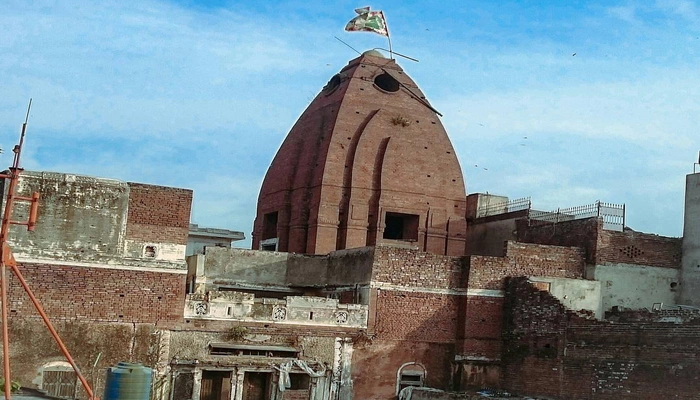
Case Summary
A historic Hindu temple in Pakistan was defiled with an Islamic religious flag displayed on its roof. The incident took place at the historic Raghunath Mandir in Gurr Mandi Bazaar, Sialkot, a pre-Partition Hindu temple. According to a statement circulated among members of the Hindu community, the Islamic religious flag had been displayed on the temple roof for approximately one year. The issue came to wider attention after a video showing the flag was shared on 10 August 2026. Following the video's circulation, Sialkot Deputy Commissioner Owais Mushtaq took notice of the matter and ordered the removal of the flag from the temple roof. Members of the Hindu community welcomed the administrative intervention. Raghunath Mandir is among the surviving Hindu religious sites in Sialkot. The temple is located in Gurr Mandi Bazaar and is listed among the city's historic Hindu temples, alongside other sites such as the Puran Bhagat Temple, Jagannath Temple, and Shivala Teja Singh Temple. The matter was subsequently discussed in the context of the preservation of Hindu religious sites in Sialkot. At the time of reporting, the administration ordered the removal of the flag from the temple roof.
Why it is Hate Crime ?
The primary category selected in this case is: Attack on Hindu religious representations. Within this, the sub-category selected is: Desecration of Hindu religious symbol. Icons and symbols, or a religious representation of a spiritual ideal, are widely revered in Hinduism. Iconography is of vital significance in the Hindu milieu. It helps connect people’s spiritual beliefs with the real world. Iconography within the Hindu faith takes several shapes and forms. Murtis are of great significance to Hindus, to which daily rituals, prayers and offerings are done. Besides the murtis, there are several other symbols which have deep significance in the Hindu faith – the Om and Swastika, for example. Since these Hindu religious symbols hold paramount importance in Hinduism, any desecration of symbols, icons, murtis, religious representations and manifestations is driven by animosity towards the faith itself, which manifests itself through these murtis, icons and symbols. Therefore, any desecration of these Hindu religious symbols and representations is considered religiously motivated hate crimes under this category. The other sub-category selected is: Breaking rules of place of worship. Sanatan Dharma is not a religion of one book, which is to say that while it has religious scriptures that form the central tenets of the faith, there are several traditions followed through thousands of years, mostly passed from generation to generation orally. One of these oral or written traditions is the rules of specific temples. Certain temples have rules which are traditional, dependent on the worship of the presiding deities. These rules and traditions have been followed for thousands of years, whether they find scriptural mention or not. Such traditions are based on the nature and rules of worship of the presiding deity of that temple. Any non-compliance with these traditions, owing to animosity towards the faith or to activism, stems not only from a lack of faith in the presiding deity but also from disregard for the faith of the devotees of that deity/temple and implicit bias against the faith, the tradition, and the deity itself. Since these traditions are central to the faith of devotees of that temple and its presiding deity, any noncompliance with these rules would be considered a religiously motivated hate crime. This case has been added to the hate crime database because a historic Hindu place of worship was targeted by the display of an Islamic religious flag on its roof. This action clearly desecrated the temple's sanctity and wounded the religious sentiments of the Hindu devotees, turning a place of worship and devotion into a site of deliberate provocation and fear. Hindu temples serve as sacred spaces where devotees feel the living presence of the divine, pouring their hearts into worship and spiritual solace. Raghunath Mandir is a historic Hindu religious site situated in Gurr Mandi Bazar in central Sialkot and forms part of the city's surviving Hindu heritage. It is part of Sialkot's pre-Partition Hindu heritage, alongside other surviving Hindu religious sites in the city. The display of an Islamic religious flag on the roof of Raghunath Mandir disregarded the temple's Hindu religious identity. This incident has clear religious dimensions as the Islamic flag was not displayed on an ordinary building or public structure but on a historic Hindu temple. A temple is not merely a physical structure but a sacred institution associated with Hindu worship, memory, and cultural heritage. The religious identity and sanctity of a temple are integral to its devotees' faith. By allowing the symbol of another religion to occupy the visible space of a Hindu place of worship, the act diminished the temple's distinct religious identity and conveyed disregard for the sanctity attached to it by Hindus. The conduct therefore went beyond an ordinary display of a flag and constituted a direct interference with a sacred Hindu institution. The incident must also be viewed against the broader vulnerability of the Hindu minority and its religious heritage in Pakistan. Hindu temples and other minority religious sites have repeatedly faced neglect, encroachment, damage, and interference, raising concerns about the protection afforded to Hindu places of worship. In this case, the Islamic flag reportedly remained displayed on the roof of the historic Raghunath Mandir for around a year before the matter received administrative attention and its removal was ordered. The prolonged presence of the flag, followed only later by administrative intervention, highlights concerns over the failure to adequately protect the religious character of Hindu places of worship. Seen against this broader backdrop, the defilement of Raghunath Mandir reflects the continuing vulnerability of Hindu religious sites in Pakistan and therefore warrants inclusion in the Hate Crime database. Disclaimer: The Hinduphobia Tracker records incident dates based on when the crimes occurred, not when the media reported them. However, in this case, the media report stated that the Islamic religious flag had been displayed on the roof of Raghunath Mandir for approximately one year, but did not specify the exact date when it was first put up. Therefore, for documentation purposes, we have selected 15 August 2025, one year before the media report published on 15 August 2026, as the indicative incident date.


Case Status
Unknown


Perpetrators Details
Perpetrators
Muslim Extremists
Perpetrators Range
Unknown
Perpetrators Gender
unknown
 Sources




