Hindu religious sentiments hurt by social media post targeting Kanwar Yatra and Sanatan Dharma
 Kanpur Dehat, Uttar Pradesh, India
  13 August, 2026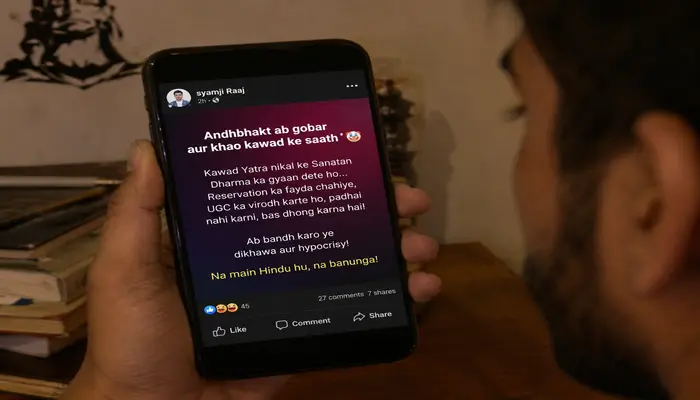
Case Summary
In Surasi village of Kanpur Dehat, Uttar Pradesh, Hindu sentiments were outraged after a youth made derogatory remarks against the sacred Kanwar Yatra and Sanatana Dharma on social media. According to reports, the accused youth used the social media account ‘syamji Raaj’, and posted remarks concerning Kanwariyas and the Kanwar Yatra. He wrote, “Andhbhakt ab gobar aur khao kawad ke saath” (Andhbhakt, now eat more cow dung along with the Kanwar). The post also stated that the accused did not consider himself a Hindu and included objectionable comments about promoting Sanatan Dharma, ending reservations, opposing the UGC, promoting education and ending hypocrisy. The post triggered anger among local Hindu organisations and villagers, who approached the police and demanded action against the youth. A confrontation subsequently took place between the two sides, during which an argument and scuffle broke out before the police intervened. A video of the confrontation later circulated on social media, showing the two sides arguing in the presence of police personnel and blaming each other over the dispute. Anticipating further escalation, the police summoned the youth to the police station for questioning. Station in-charge Anil Kumar stated that the youth subsequently deleted the social media post. The dispute was later resolved through mutual agreement between the two sides, following which the situation returned to normal.
Why it is Hate Crime ?
This case has been added to the tracker under the primary category- Hate Speech against Hindus. The subcategory selected is- Anti-Hindu slurs, mocking faith. Anti-Hindu slurs and the deliberate mocking of the Hindu faith owing to religious animosity involve the usage of derogatory terms, stereotypes, or offensive references to religious practices, symbols, or figures. One of the common anti-Hindu slurs used against Hindus is “cow-worshipper” and “cow piss drinker”. The intention of using this term is to demean and mock Hindus as a group and their religious beliefs since Hindus consider the cow holy. Additionally, some symbols and the slurs attached to them have a historical context that exacerbates the insult, hate, stereotyping, dehumanisation and oppression against Hindus. Cow worship has been used for centuries to denigrate Hindus, insult their faith and oppress Hindus specifically as a religious group. There has been overwhelming documentation about how cow slaughter has been used to persecute Hindus with cow meat being thrown in temples and places of worship. There has also been overwhelming documentation where cow meat (beef) has been force-fed to Hindus to either forcefully convert them to Islam or denigrate their faith. Apart from cow worship, the Swastika – which holds deep religious significance for the Hindus – has also been misinterpreted and distorted to use as a slur against Hindus. Similarly, the worship of the Shivling has been used by supremacist ideologies and religions to denigrate Hindus owing to religious animosity. Such slurs and denigration stem out of inherent animosity and hate towards Hindus and their faith, therefore, it is categorised as hate speech targeted at Hindus specifically owing to their religious identity. This incident constituted a religiously motivated hate crime because the offensive content was directed at the Kanwar Yatra, a Hindu religious observance, and the devotees participating in it. The Kanwar Yatra was not referenced merely as a general social or political issue; the post specifically mocked Kanwariyas and the act of carrying the Kanwar, thereby making Hindu religious practice the central subject of the derogatory expression. The targeting of participants while they were identified through their participation in a visible religious tradition demonstrated that the hostility was connected to their religious identity and practice. The use of the term “Andhbhakt” was significant in this context because it was directed at Hindu devotees in a manner intended to ridicule their religious devotion. Rather than criticising a particular individual for unrelated conduct, the expression characterised those participating in the religious observance as irrational or incapable of independent thought. Such language demeaned the devotees precisely in the context of their religious commitment and sought to portray their faith-based conduct as something contemptible. The insult therefore carried a clear religious dimension rather than constituting an ordinary personal disagreement. The reference to cow dung further intensified the religious insult. Cows occupy a particularly revered position within Hindu religious and cultural traditions, and the remark deliberately invoked a substance associated with the cow in a degrading manner while addressing people engaged in a Hindu pilgrimage. In this context, the expression functioned as a means of humiliation directed at the religious sensibilities of the devotees. The insult was therefore not incidental to the discussion of the Kanwar Yatra; it used a culturally and religiously significant element associated with Hinduism to demean those practising the faith. The broader wording of the post reinforced this connection by discussing Sanatan Dharma and the conduct of those associated with it. The statement that the poster did not identify himself as Hindu, when considered alongside the derogatory treatment of Hindu devotees and their religious observance, formed part of the surrounding context of the post. However, the principal evidence of religious hostility remained the direct mockery of the Kanwar Yatra and the degrading language used towards its practitioners. The incident therefore did not depend merely on the poster’s personal religious identity or on disagreement over social and political issues; it was the explicit targeting of a Hindu religious practice and its adherents that established the religious character of the offence. The public nature of the post also amplified the harm. By publishing the remarks through a social media account, the derogatory treatment was communicated beyond a private dispute and became capable of reaching a wider audience. This transformed the expression from a private insult into a public denigration of a Hindu religious observance, with the potential to stigmatise devotees and provoke hostility towards a community based on its religious practices. The subsequent outrage among local Hindu organisations and villagers demonstrated that the remarks were perceived as an attack on a religious practice rather than simply a disagreement between individuals. Taken together, the targeting of Kanwariyas, the mocking characterisation of their devotion, the degrading reference to cow dung and the explicit religious context of the post demonstrated that the conduct was directed at Hindus because of their religious practice and identity. The incident therefore reflected religiously motivated hostility towards Hindu devotees and a deliberate denigration of a recognised Hindu religious tradition. Disclaimer: The available sources did not specify the exact date on which the social media post was made or when police took action. The tracker records incident dates based on when the crime occurred rather than when it was reported or published. Since the date of the incident could not be determined from the available material, 14 August 2026, has been selected as the indicative incident date for documentation purposes.


Case Status
Complaint not filed


Perpetrators Details
Perpetrators
Unknown
Perpetrators Range
Unknown
Perpetrators Gender
male
 Sources




