Hindu woman abducted and held captive by Muslim man; pressured to convert to Islam, undergo nikah and eat meat
 Amethi, Uttar Pradesh, India
  11 June, 2026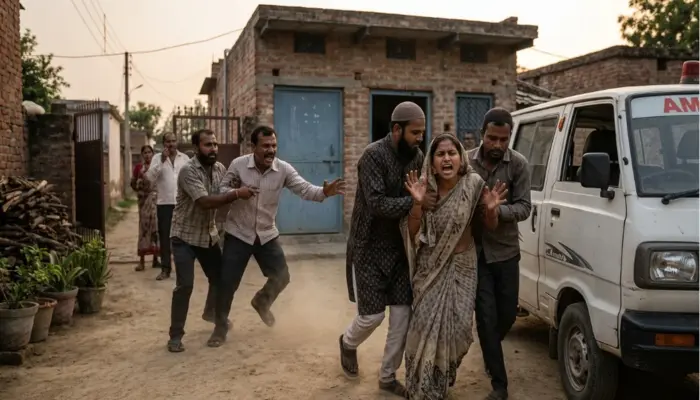
Case Summary
In the Bazar Shukul area of Amethi, Uttar Pradesh, a Dalit Hindu woman was lured and abducted by a Muslim man named Tabrez Ahmed. The accused took her captive, raped her and pressured her to convert to Islam for nikah. The accused, Tabrez Ahmed, a resident of Newaj Madargarh, lured and abducted the Hindu woman on 12 June 2026. According to the complaint submitted by the victim and her husband, she was taken to Lucknow in an ambulance, where she was held captive at different locations for nearly two months. During this period, Tabrez Ahmed repeatedly raped her and threatened her with death or with being sold to another person when she asked to return home or speak to her family. The woman further reported that she was subjected to pressure to convert to Islam during her confinement. She was pressured to undergo nikah, made to eat meat, read Urdu books and wear Islamic clothing. Furthermore, when she refused to eat meat, Tabrez left her. The complaint also stated that an attempt was made to alter her Aadhaar details by replacing her husband's name with Tabrez Ahmed's name and address. She eventually managed to escape and returned to her home, where she informed her husband about the incident. The woman and her husband subsequently approached the Bazar Shukul police station seeking legal action. They stated that their complaint was initially not registered and that the matter was treated as a love affair by the local police. Following the intervention of the Superintendent of Police, the police registered a case under relevant sections and began an investigation. As of the date of writing this report, the accused was arrested and sent to jail, while the investigation was ongoing.
Why it is Hate Crime ?
This case has been added to the tracker under the primary category of - Crimes against women in relationships and other sexual crimes. Within it, the sub-category selected here is - Forced conversion before marriage, with the tertiary category being - Forced to do nikah. In such cases, a non-Hindu man is in a relationship with a Hindu woman when the pressure to convert her religion begins to manifest. In such cases, typically, two patterns emerge. First, when the relationship is consensual, and the religious identity of the perpetrator is known to the Hindu woman in the relationship, however, at some point during the relationship, the non-Hindu man starts to force the victim to convert her religion and give up her Hindu religious identity. The second is when the woman gets into a marriage with the man pretending to share her faith. Later, when the truth is revealed, the man starts pressuring the woman to convert her religion and give up her religious identity. In both the situations, the methods used to force the victim to convert her religion often revolve around force-feeding beef, forcing her to wear hijab, forcing her to read the Kalma or even pressurizing the victim to do ‘Nikah’, which is marriage under Islamic law, with a prerequisite being conversion to Islam. Cases where a Hindu woman consensually converts to Islam in a relationship will be left out of the hate crime database, even though it could be argued in several cases that the conversion was a result of religious brainwashing. The other sub-category selected here is - Assault or threat upon refusal to convert. When Hindu women are in a relationship with non-Hindu men, there are cases where the woman faces threats or assault after she refuses to convert and change her religious identity owing to pressure/force by the non-Hindu man. Such relationships may be consensual with the religious identity of the non-Hindu man known to the victim. Somewhere along the relationship, the non-Hindu man starts pressurizing the Hindu woman to convert to Islam and upon her refusal, assaults or threatens the victim. Such cases are driven by specific religious motivations and against the religious identity of the victim and are therefore qualified as hate crimes. Cases where the Hindu woman converts to Islam and does not file a complaint about the force or threat, are not considered a part of the hate tracker, even though, it may be argued that the woman was brainwashed or threatened to convert to Islam. The religious dimension of this incident was demonstrated by the fact that the abduction, sexual violence and unlawful confinement were specifically aimed at altering the victim’s religious identity. The attempt to convert a married Hindu woman to Islam was not an incidental feature of the incident but formed part of the coercive treatment she experienced while being held away from her family. The pressure to undergo a Nikah, consume meat, read Urdu religious material and adopt forms of conduct associated with the other faith demonstrated that the accused sought to impose a different religious identity and set of religious practices upon her. The pressure to undergo Nikah alongside the demand for religious conversion demonstrated that the victim was being coerced to abandon her existing Hindu faith in order to conform to the religious requirements imposed upon her. Pressuring a Hindu individual to discard her religious faith and embrace another was a direct attack on her religious identity and dignity. It was not a matter of personal choice; it was coercion rooted in hostility towards the victim's Hindu identity. Such an attempt reflects religious animosity because the act was not simply about personal differences but about erasing the victim’s Hindu faith, making it a religiously motivated crime. Often in such cases, sexual violence or abduction serves a dual purpose: physical subjugation and religious humiliation. The intention was to break the victim down, emotionally, physically, and spiritually, so that she could be converted. This was not random violence; it was systematic, targeted, and rooted in religious animosity. The weaponisation of such extreme violence underscored the ideological motivation to force religious compliance through absolute terror. Furthermore, the attempt to alter the victim’s Aadhaar details by replacing her husband's name with the accused man's name and address further demonstrated the effort to sever or undermine her existing Hindu identity and establish her association with the accused. The conduct sought to reshape important aspects of the victim's personal and religious identity and place her within a different religious and social framework. The force-feeding of meat to the victim was not a neutral act or a cultural misunderstanding. For many Hindu women, the consumption of meat carries profound religious significance. It is not merely a dietary preference but a matter of faith, identity, and deeply held religious conviction. Forcing meat upon her against her will was an act of religious desecration, a deliberate assault on the most intimate expression of her Hindu identity. It was not done carelessly. It was done to humiliate, to violate, and to signal that her Hindu identity was no longer hers to protect. Similarly, the force applied upon her to wear Islamic clothing and reading Urdu, which she was compelled to do against her will. This coercion directly infringed upon her religious freedom, stripping her of the right to maintain her religious identity. The use of force to compel her to observe Islamic rituals, demonstrates an attempt to erase her Hindu identity and impose Islamic practices upon her. A further indicator of the religiously motivated nature of the incident was the use of threats and physical abuse when the victim resisted the demand to change her religion. Her refusal to comply with the pressure to convert was met with intimidation and violence, demonstrating that the religious demand was being enforced through coercion rather than presented as a voluntary choice. This is particularly significant as the mistreatment was triggered by her unwillingness to abandon her existing religious identity and adopt the religion being imposed upon her.. Taken together, the coercive conversion pressure, punishment for resistance, and threats and violence directed at the victim demonstrated that her religious identity was a direct factor in the abuse she experienced. The conduct therefore reflected not only criminal exploitation but also targeted hostility towards her refusal to abandon her existing faith.
Victim Details
Total Victim
1
Deceased
0
Gender
- Male 0
- Female 1
- Third Gender 0
- Unknown 0
Caste
- SC/ST 1
- OBC 0
- General 0
- Unknown 0
Age Group
- Minor 0
- Adult 1
- Senior Citizen 0
- Unknown 0


Case Status
Arrested


Perpetrators Details
Perpetrators
Muslim Extremists
Perpetrators Range
One Person
Perpetrators Gender
male
 Sources




