Hindu woman subjected to medieval barbaric torture by Muslim in-laws after voluntarily converting to Islam and marrying Muslim man in Debiganj, Bangladesh
 Panchagarh District, Bangladesh
  9 August, 2026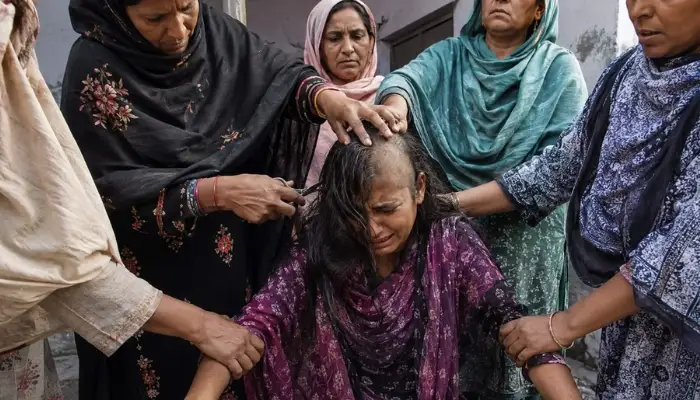
Case Summary
In Debiganj, Panchagarh, Bangladesh, a Hindu woman who converted to Islam and married a Muslim man was subjected to severe assault and torture in a barbaric manner. This was done by the Muslim members of her husband's family. The woman, identified as Konika Roy alias Mosa, later known as Kulsum Begum, voluntarily converted to Islam on 12 June 2026 and subsequently married Md. Dargali. On the night of 10 August 2026, members of her husband's Muslim family entered the couple's house and assaulted them. She was then taken to another house, separated from her husband and subjected to further physical torture, including having her hair cut and chilli powder applied to sensitive parts of her body. The woman stated in a video that seven women from her husband's family assaulted her, including her husband's first wife, his younger brother's wife, two of his maternal uncles' wives (mamis), and two of his paternal uncles' wives (kakas' wives). She also stated that her husband's two sons, Shamsher and Sherjana, assaulted her. She said that she and her husband were taken away and that she was placed in a separate room, while she had possession of the relevant documents before being separated. The assault was accompanied by the looting of the Hindu woman's property. She stated that her Android phone, 4,000 taka in cash and other belongings were taken. The house was in her name, and her relatives broke its lock and removed the belongings kept inside, including her clothes. The complaint-based account further recorded the removal of approximately 85,000 taka in cash, household goods worth around 1.5 lakh taka and 11 maunds of almonds. The attackers also forced the victims to sign three blank non-judicial stamps under threat. The Hindu woman was subsequently rescued in a seriously injured condition and admitted to Debiganj Upazila Health Complex for treatment. A complaint was filed at Debiganj Police Station naming six persons in connection with the assault, torture and looting, and the police investigation was underway. This incident occurred amidst the escalation of violence against Hindus in Bangladesh. It had unfolded in three distinct phases: first, following the ouster of Sheikh Hasina’s government in August 2024; second, after the death of Sharif Osman Bin Hadi in December 2025; and third, in the immediate aftermath of the 13th National Parliamentary Election 2026. Following the ouster of Sheikh Hasina, multiple reports documented attacks on Hindu homes, temples, and religious institutions, alongside intimidation campaigns, arson, and mob assaults targeting minority neighbourhoods. The Hinduphobia tracker has recorded 336 such incidents against the Hindu minority, underscoring the scale and persistence of anti-Hindu violence during this period. A further escalation occurred following the death of Sharif Osman Bin Hadi, a Muslim political activist and student leader known for his anti-Hindu and anti-India rhetoric. Hadi had been involved in political unrest after the fall of the Hasina government and was killed in Dhaka on 18 December 2025 during clashes. In the aftermath of his death, Hindu communities were blamed and subsequently targeted in retaliatory violence. Hindu homes were selectively set ablaze in multiple localities, forcing families to flee and leaving many displaced. The attacks appeared patterned rather than sporadic, with Muslim mobs focusing on Hindu neighbourhoods, properties, and religious symbols. Among the victims was Dipu Chandra Das, who was lynched to death and his body was set ablaze by a Muslim mob over false blasphemy allegations. The Hinduphobia tracker documented 51 incidents of anti-Hindu violence in the period following Hadi’s death alone. Such incidents underscore the vulnerability of the Hindu minority amid rising communal hostility and the weaponisation of religious accusations. Reports further indicated that posters and written materials calling for the extermination of Hindus were displayed in public spaces, signalling an alarming normalisation of genocidal rhetoric. When combined with acts of arson, vandalism, assault, and targeted intimidation, these developments suggest a coordinated environment of hostility aimed at terrorising the Hindu community and reinforcing majoritarian dominance. The third phase of violence was unleashed after the 13th National Parliamentary Election 2026. Within days of the announcement of results, Hindu families in districts such as Noakhali, Rangpur, Nilphamari, Sylhet, Thakurgaon, and Dinajpur reported coordinated attacks involving arson, looting, assault, and vandalism of temples and homes. In several instances, Hindu homes were selectively targeted, looted, and families were threatened with displacement.
Why it is Hate Crime ?
The primary category for this case is: Attack not resulting in death. The subcategory for this case is: Attacked for Hindu identity. In several cases, Hindus are attacked merely for their Hindu identity without any perceived provocation. A classic example of this category of religiously motivated hate crime is a murder in 2016. 7 ISIS terrorists were convicted for shooting a school principal in Kanpur because they got ‘triggered’ seeing the Kalava on his wrist and tilak that he had put. In this, the Hindu victim had offered no provocation except for his Hindu religious identity. The motivation for the murder was purely religious, driven by religious supremacy. Such cases where Hindus are targeted merely for their religious identity would be documented as a hate crime under this category. This case involved a Hindu woman who had voluntarily converted to Islam and married a Muslim man, but was subsequently subjected to severe assault and torture by members of her husband's family. The violence was directed at a Hindu woman who had entered the marriage and changed her religion, yet she was subjected to brutal treatment within the family she had married into. The treatment of the Hindu woman reflected a barbaric and deeply degrading form of violence. She had converted to Islam and married into a Muslim family, yet she was subjected to collective physical assault, confinement, forced cutting of her hair, chilli-powder torture, threats and the seizure of her property and personal belongings. The involvement of multiple members of her husband’s family transformed the abuse into a sustained act of humiliation and domination against a Hindu woman, stripping her of her dignity, security and control over her own home and possessions. The prolonged and collective nature of the abuse demonstrated the extent of the hostility directed towards the victim. The incident was particularly significant because the victim had already converted from Hinduism to Islam and married into a Muslim family, yet the change in her religious identity did not protect her from the violence. Her treatment demonstrated how a Hindu woman could remain vulnerable to severe physical abuse even after entering a Muslim household and changing her faith. The assault therefore cannot be viewed merely through the lens of an isolated domestic dispute; the victim's background as a Hindu woman remained an important part of the circumstances surrounding her persecution. These actions are driven by indoctrination in Islamic theology, which views non-believers (kafirs) as fundamentally inferior and warranting subjugation. These ideas are not mere abstractions; they manifest in actions where non-Muslims, especially Hindus in India, are seen as targets for religious domination, coercion, or humiliation. Within this framework, the conversion of a Hindu woman is often treated not as genuine integration, but as a mechanism for exerting dominance and control over her identity. This rigid 'us versus them' dichotomy prevents any true acceptance of the other, leading adherents to believe that hostility, harassment, or violence against non-Muslims is not only justified, but ideologically mandated. Even if it is argued that the abuse suffered by the victim stemmed solely from domestic discord rather than a religious motive, the broader context of anti-Hindu hostility, persecution, and insecurity in Bangladesh remains relevant for classification. During periods marked by sustained violence, intimidation, and targeting of Hindus based on their religious identity, the Hinduphobia Tracker applies a contextual presumption that attacks on Hindu victims may be faith-targeted, even when immediate reports attribute the violence to personal, criminal, or local disputes and do not record an explicit religious motive. In such circumstances, the vulnerability of Hindu communities and the normalisation of hostility towards religious minorities can contribute to attacks occurring without perpetrators openly expressing religious intent. For the purpose of documenting the 2024 to 2026 ethnic cleansing of Hindus in Bangladesh and the subsequent persecution after the political exile of Sheikh Hasina, the death of Sharif Osman Hadi, and the 13th National Parliamentary Election 2026, the Hinduphobia Tracker records such incidents as likely religiously motivated at the point of entry. If any case is later established through credible investigation or court findings to stem from motivations other than religious hostility, it will be revised or removed from the hate crime database. The incident must accordingly be viewed not only through the immediate circumstances of the assault but also against the broader insecurity experienced by Bangladesh's Hindu minority. Hindu victims may face violence, intimidation, property-related disputes, social pressure and other forms of coercion in circumstances where perpetrators do not openly articulate a religious motive. The absence of an explicit religious statement therefore does not, by itself, resolve the question of whether religious hostility formed part of the wider context of the attack. Such attacks contribute to a wider environment in which Hindu women remain vulnerable to violence, intimidation and coercion in circumstances involving interfaith relationships and conversion. The victim's Hindu identity and her subsequent treatment after converting and marrying a Muslim man therefore formed an important part of the religious context of the incident. The case was consequently documented under Attack not resulting in death, Attacked for Hindu identity.
Victim Details
Total Victim
1
Deceased
0
Gender
- Male 0
- Female 1
- Third Gender 0
- Unknown 0
Caste
- SC/ST 0
- OBC 0
- General 0
- Unknown 1
Age Group
- Minor 0
- Adult 1
- Senior Citizen 0
- Unknown 0


Case Status
Unknown


Perpetrators Details
Perpetrators
Muslim Extremists
Perpetrators Range
From 5 to 10
Perpetrators Gender
both
 Sources




