Hindu students prohibited from wearing religious threads in Tamil Nadu schools
 Tamil Nadu, India
  11 June, 2026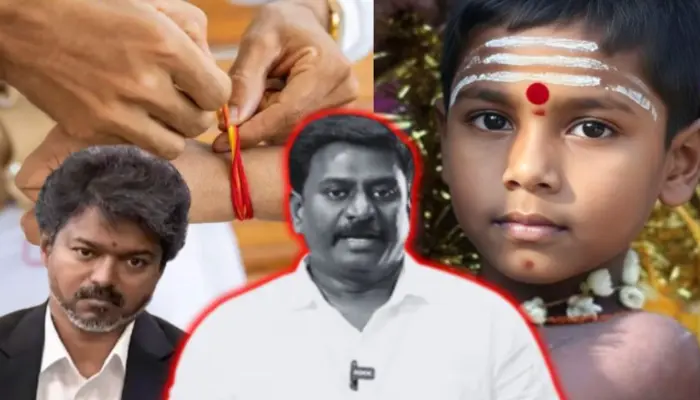
Case Summary
On 12 June 2026, Tamil Nadu Education Minister Rajmohan, of Joseph Vijay-led Tamilaga Vettri Kazhagam (TVK), stated that students would not be permitted to enter school premises displaying visible symbols associated with religion or caste, including religious threads worn on the body. During an interaction with journalists on measures to address caste discrimination and social divisions in educational institutions, he said schools should have no room for anything that promoted religious or caste identities and should focus on science and social justice. Rajmohan further said that awareness had already been created among teachers through official educational channels and that the government had issued instructions prohibiting the display of religious or caste symbols on school premises. He said that even a small religious thread (kalava) would not be permitted and gave the example that he removed such a thread before leaving home. He also said that the government intended to study the Justice Chandru report on caste discrimination in educational institutions through an expert panel and implement its recommendations after examining how they could be taken to the grassroots. Rajmohan further stated that teachers would need time to implement measures aimed at preventing caste-related tensions in educational institutions.
Why it is Hate Crime ?
This case was added to the “Undecided” database due to the lack of sufficient evidence confirming a religious motive behind the directive. The religious significance of the symbols covered by Education Minister Rajmohan's directive was important to consider. The kalava, or sacred thread, was widely worn by Hindus as an expression of religious devotion, faith and observance. It was not a marker of any particular caste, as Hindus belonging to different castes and social backgrounds wore it as a sacred protective thread and as an outward expression of their religious identity. Similarly, the tilak was a religious and devotional marker worn by Hindus irrespective of caste. It could signify devotion to a deity, participation in religious worship or adherence to a particular spiritual tradition. Neither the kalava nor the tilak inherently represented caste identity or promoted caste distinctions. The prohibition therefore affected more than a student's choice of clothing. Rajmohan had specifically stated that even a small religious thread would have to be removed before entering school premises. For Hindu students who wore the kalava as part of their religious practice, this meant removing a sacred religious marker in order to attend school. The same principle applied to other visible Hindu religious markers such as the tilak. Unlike an item that altered the prescribed school uniform or interfered with classroom activities, these symbols were worn on the body as expressions of faith and did not inherently disrupt the functioning of an educational institution. The stated justification of preventing caste divisions also required scrutiny because the religious symbols referred to by Rajmohan were not synonymous with caste identity. The kalava and tilak were worn across caste groups and could not reasonably be treated as inherently caste-identifying symbols. Prohibiting them on the ground that they promoted caste distinctions therefore had the effect of restricting practices that, for many Hindus, were primarily religious rather than caste-based. The broader ideological context of the TVK also provided grounds for examining whether the restriction could have been influenced by hostility towards Hindu religious traditions. In May 2026, TVK MLA V.M.S. Mustafa stated that his party had entered politics to eradicate Sanatana Dharma. The statement generated controversy and was subsequently followed by apology from Mustafa that the TVK respected all religions and opposed caste discrimination rather than any particular faith. While these clarifications needed to be taken into account, Mustafa's original statement remained relevant contextual evidence when assessing the ideological environment in which restrictions on visible Hindu religious practices were introduced. The issue could also be viewed against the 2022 Karnataka hijab controversy, which had become a matter of national debate. Supporters of restrictions on the hijab argued that schools had the authority to enforce uniform standards in order to maintain equality, discipline and harmony in educational institutions, and that regulating overt religious symbols as part of a generally applicable uniform policy did not necessarily constitute religious discrimination. A similar argument could be advanced in support of Rajmohan's directive. However, there was a distinction between regulating a prescribed school uniform and prohibiting a benign religious marker that neither replaced the uniform nor interfered with classroom activities. The fact that a religious symbol was visible did not, by itself, establish that it disrupted the educational environment. At the same time, the available material did not establish that Hinduism or Hindu students were specifically singled out by the directive. Rajmohan presented the restriction as applying generally to religious and caste symbols and linked it to preventing social divisions and caste tensions. Further, no detailed implementing government order setting out the precise scope of the prohibition, the categories of symbols covered, or the manner in which it would be enforced had been identified in the available material. It therefore remained unclear whether the restriction would ultimately be applied as a genuinely religion-neutral policy or whether Hindu religious practices would be specifically or disproportionately affected. Taken together, the religious nature of the symbols targeted, the impact of the prohibition on Hindu religious expression and the broader ideological statements associated with the TVK provided grounds for concern that the measure could have been influenced by hostility towards Hindu traditions. However, the available evidence did not establish that religious hostility was the motive behind this particular directive. The case therefore remained in the “Undecided” database. If subsequent rules, implementation practices or statements establish that Hindu religious identity or practices were specifically targeted, the case could be reconsidered for inclusion in the Hate Crime database of the Hinduphobia Tracker.


Case Status
Unknown


Perpetrators Details
Perpetrators
Others
Perpetrators Range
One Person
Perpetrators Gender
male
 Sources




