Ancient Hindu temple land illegally occupied by encroachers in Barhan, Uttar Pradesh
 Uttar Pradesh, India
  9 August, 2026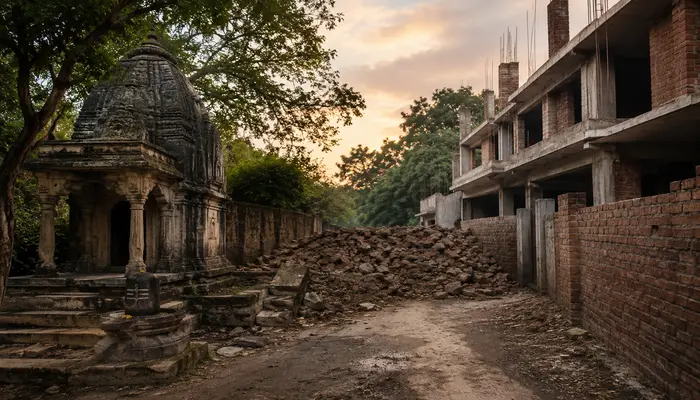
Case Summary
In Uttar Pradesh's Barhan district, an ancient Shiva temple was illegally encroached upon. In response, Hindu devotees launched an indefinite protest under the banner of the Shri Siddheshwaraya Siddha Gufa Mahadev Seva Trust. The demonstration began at the town's main square on 10 August 2026. The protesters demanded the removal of the encroachment from the temple premises and the restoration of a road that had been blocked. According to the report, the encroachment was carried out by a person associated with the BJP, while the Sub-Divisional Magistrate had also halted construction on land that had previously been donated to the temple. The protest was held at the ancient Siddha Gufa Mahadev Temple in Barhan, a site traditionally believed to be associated with the penance of Dronacharya. On the third day of the demonstration, Shiva devotees performed Rudrabhishek on the Shivalinga and offered prayers, seeking wisdom for the administration and those responsible for the encroachment. The religious observance was conducted before images of Lord Shiva, Goddess Parvati, and Adinath, the first Tirthankara of Jainism. According to the report, resentment among local residents had been mounting as the administration had failed to take any concrete steps to remove the encroachment or resolve the dispute. The protesters demanded immediate action and warned that public anger would intensify if the authorities remained inactive. Hundreds of Shiva devotees participated in the protest, including Shri Siddheshwaraya Siddha Gufa Mahadev Seva Trust president Anil Kumar Verma, advocates Raj Kumar Dixit, Dalbir Singh, and Amit Dixit, along with several other devotees from the locality. Addressing the gathering, advocate Dalbir Singh, who was leading the agitation, criticised organisations such as the Vishva Hindu Parishad (VHP), Bajrang Dal, and the Rashtriya Swayamsevak Sangh (RSS). He stated that although these organisations often claimed to work to protect Hindu temples, none had come forward to oppose the encroachment on the ancient Shiva temple. He further alleged that the encroachment was taking place under the patronage of individuals associated with the BJP.
Why it is Hate Crime ?
The primary category for this case is: Attack on Hindu religious representations. The subcategory for this case is: Encroachment or illicit takeover of temple land/ land near a temple. In Hinduism, a temple is the abode of the Deity. The Deity in the Temple is consecrated, thereby, making it a real, breathing entity. Hindus believe that not just the Deity but the temple premises itself are sacred to Hindus since Hindus hold the faith that the entire Temple space is an amalgamation of the divine energy of the deity. Not only the Temple but the Temple premises in its entirety are considered sacred by Hindus. In several cases, the premises of the Temple and/or religious centre are illicitly taken over by institutions belonging to other faiths – like the Waqf board or the Church. Other times, the temple property, land or the property of religious centres are illicitly encroached by non-Hindu groups. Any illicit take over or encroachment is a crime an initio, however, when non-Hindu groups illicitly take over or encroach the sacred land of Hindus, it is an affront to the Hindu community and is therefore classified as a religiously motivated hate crime under this category. The religious significance in this case arose from the land being attached to an ancient Shiva temple, making the premises part of a sacred Hindu religious space rather than ordinary property. In Hindu belief, a temple is regarded as the consecrated abode of the Deity, and the sanctity associated with the place of worship extends to its surrounding premises. The temple grounds therefore held religious significance for the devotees who worshipped there and formed part of the space in which Hindu rituals and religious gatherings were conducted. The encroachment upon the temple premises and the obstruction of the road affected the physical space and access associated with the Hindu place of worship. The temple premises were not merely a piece of land but part of a religious institution connected with the worship of Shiva. The occupation of such space therefore interfered with the integrity of the sacred environment and affected access to a place used by the Hindu community for religious purposes. The dispute also affected the functioning of the religious institution by interfering with the space required for worship and religious gatherings. The obstruction of access created practical difficulties for devotees seeking to use the temple premises and maintain the continuity of their religious activities. This demonstrated that the encroachment had implications beyond the material value of the land and affected the functioning of a Hindu place of worship. The religious importance of the site was reflected in the devotees’ response during the protest, when Rudrabhishek was performed on the Shivalinga and prayers were offered, demonstrating the continued significance of the temple and its premises as a Hindu place of worship. Any unauthorised occupation of such land diminished the sacred space associated with the temple and interfered with the functioning of the Hindu religious institution. In this case, the encroachment upon the temple premises and obstruction of access affected space traditionally associated with the worship of Shiva and treated land belonging to a sacred Hindu institution as ordinary property for unauthorised use. This disregarded the religious sanctity attached to the premises, undermined the integrity of the sacred site and affected the Hindu community’s access to its place of worship, thereby affecting its religious sentiments and interests. At the time of writing this report, although the identities of the perpetrators remain unknown, the act demonstrated hostility towards the Hindu community and its sacred places of worship. Therefore, the incident is being documented in the hate crime database of the Hinduphobia Tracker. Disclaimer: The Hinduphobia Tracker records incident dates based on when the crime occurs, rather than when the media reports it. In this case, the report did not specify when the encroachment began. Therefore, the media publication date, 10th August 2026, has been recorded as the indicative incident date for documentation purposes.


Case Status
Complaint filed


Perpetrators Details
Perpetrators
Unknown
Perpetrators Range
Unknown
Perpetrators Gender
unknown
 Sources




