Revered Hindu leader Veer Savarkar denigrated through "Bootlicker" slur and clemency jibe during unrelated political dispute
 Delhi, Delhi, India
  10 August, 2026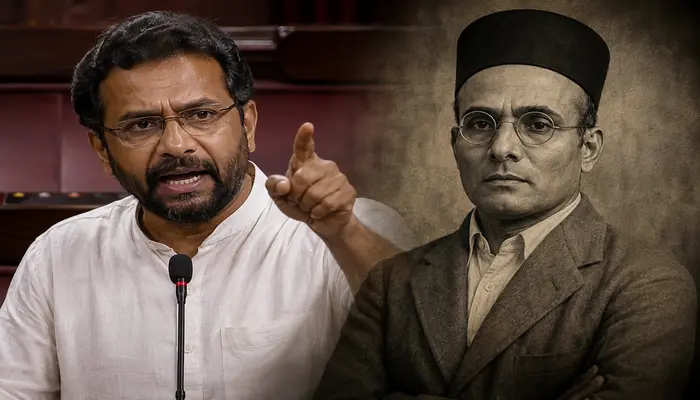
Case Summary
Following a heated exchange with Union Finance Minister Nirmala Sitharaman in the Rajya Sabha over the Taxation and Other Laws (Amendment) Bill, CPI(M) Rajya Sabha MP John Brittas chose to target revered Hindu leader Vinayak Damodar Savarkar while speaking to the media outside Parliament. Rather than confining his response to the parliamentary debate, Brittas invoked Savarkar to counter Sitharaman's criticism of the communists, accusing him and his followers of "licking the boots of the British" and derisively referring to the mercy petitions he submitted during his incarceration under British rule. Speaking to reporters, Brittas declared, "Communists went to the gallows shouting 'Inquilab'," before contrasting them with Savarkar, whom he accused of seeking clemency from the British. Taking a swipe at Sitharaman, he remarked that it was now an associate of Savarkar who was questioning the communists. Brittas also mocked Prime Minister Narendra Modi and Union Home Minister Amit Shah, claiming that the remarks had come from those associated with leaders who were "afraid to come to Parliament." Brittas' remarks came after Sitharaman described the communists as "total cowards" who "can't face facts" during the Rajya Sabha debate. The Finance Minister made the remarks after Brittas criticised the government's economic policies and left the House before her response. Instead of addressing Sitharaman's criticism directly, Brittas chose to invoke and denigrate Savarkar, dragging one of India's most prominent freedom fighters into an otherwise unrelated political dispute. This is not the first time John Brittas has displayed his hatred for the Hindu revered leader. On multiple occasions, the CPI(M) leader has made highly insensitive and false remarks against Veer Savarkar. One such instance was when, recently, Brittas, while denouncing RSS chief Mohan Bhagwat's demand for the Bharat Ratna for Veer Savarkar, said that "Veer Savarkar was the founder of hate and hatred". "It would be grossly unjust for the freedom fighters and the freedom movement if the Bharat Ratna is bestowed on Veer Savarkar; he is not known for fighting for freedom, but for writing apologies to the British. He was more interested in aligning with the British rather than supporting the freedom movement. And he is known as the father figure of Hindutva, which is actually the founder of hate and hatred. RSS wants divisive polarisation in this country, and even the very proposal for bestowing Bharat Ratna is targeted at that." Brittas said. Similarly, during Janashakti Utsav in Mangaluru on 21 August 2022, CPI(M) leader John Brittas made remarks critical of Savarkar and his ideology. He was stating that Savarkar’s ideology would “swallow the coming generations” and lead to the country’s destruction, while also arguing that Savarkar and the organisation he belonged to had not contributed to India’s freedom struggle. He was further accusing the BJP government of rewriting history to glorify particular figures and stated that comparing B.R. Ambedkar with Savarkar was an insult to genuine freedom fighters. This earlier instance showed a recurring pattern of Brittas publicly denigrating Savarkar and his ideological legacy.
Why it is Hate Crime ?
The selected primary category in this case is: Hate speech against Hindus, with the subcategory selected as: Mocking/denigrating Hindu leaders. Hate speech is defined as any speech, gesture, conduct, writing, or display that is prejudicial against a specific individual and/or group of people, which is leading to or may lead to violence, prejudicial action or hate against that individual and/or group. Religious leaders are often seen as representatives of the community, especially, the community’s religious faith and beliefs. Mocking or denigrating a religious leader specifically owing to his religious identity and/or the religious rituals he observes can be considered hate speech because the motivating factor of the speech is animosity and/or dislike for what he represents – the religious beliefs and faith of the community. It is important to note that mere insulting words against an individual do not constitute hate speech. It is entirely possible that insulting words are used for an individual, however, the specific speech is not the result of religious hate and/or animosity towards the professed faith of the religious leader, but the individual himself. For the speech to be considered hate speech, the speech itself or the motivating factor behind the speech has to be religious in nature. Such speech which denigrates Hindu religious leaders specifically owing to animosity towards the faith they profess and the community faith they represent will be treated as hate speech under this category. This incident has been included in the Hinduphobia Tracker because the remarks were directed against Vinayak Damodar Savarkar, a leader who occupies a place of immense reverence among the Hindu community. For Hindus, Savarkar is not merely a historical or political figure but a civilisational icon whose writings and ideas shaped the articulation of Hindu identity during a period marked by colonial rule, religious conversions, and communal politics. Consequently, repeated attempts to caricature or ridicule him are an attack on a personality deeply associated with Hindu self-assertion and cultural identity. What makes this incident significant is that Savarkar was dragged into an otherwise unrelated political dispute. Instead of responding to Union Finance Minister Nirmala Sitharaman's criticism of the communists, John Brittas invoked Savarkar solely to ridicule him, accusing him and his followers of "licking the boots of the British" and reducing his legacy to the mercy petitions he wrote during his imprisonment. The remarks ignored the well-documented conditions under which those petitions were written. Savarkar spent nearly eleven years in the Cellular Jail, where he endured prolonged solitary confinement, brutal hard labour, physical torture, and inhuman treatment that broke many political prisoners. Any discussion of the mercy petitions divorced from this historical context presents an incomplete picture of one of the most severe incarcerations suffered by an Indian freedom fighter. The present remarks also do not appear in isolation. On an earlier occasion, while opposing the proposal to confer the Bharat Ratna on Savarkar, Brittas stated that Savarkar was "not known for fighting for freedom, but for writing apologies to the British." He further described Savarkar as the "father figure of Hindutva" and characterised Hindutva as "the founder of hate". Here, it is important to mention how 'Hindutva' is often used as a euphemism to make the targeting of Hindus more palatable. Hindutva is essentially a unifying ideology for Hindus, which became imperative for Hindus to find and preserve their cultural identity, which was being eroded and attacked due to Islamic invasions, British colonisation, Christian theological impositions and conversions. Hindutva is not a destructive ideology, as some attempt to portray, but one that is used as a unifying edifice for Hindus. Hindutva is also often used as a euphemism to target Hindus on the whole and their religious identity and faith. It is essentially semantic jugglery to confuse Hindus into believing that their own persecution by supremacists is somehow 'justified' because the specific victims espoused an ideology (Hindutva) which deserves the onslaught. The fact that the use of 'Hindutva' is merely to mask animosity towards Hindus was evident from the "Dismantling Global Hindutva" conference held in the USA, where speakers unabashedly spoke about how Hindutva and Hinduism are indistinguishable and therefore, to "dismantle Hindutva" one would have to "dismantle Hinduism". The practices of targeting Hindus and their religious and cultural identity and justifying that victimisation and dehumanisation by using euphemisms like "Hindutva" stems out of inherent animosity and hostility towards Hindus. Further, the repetition of similar remarks on multiple occasions indicates that the present statement was not a spontaneous political retort but part of a continuing pattern of publicly denigrating Savarkar and the ideas with which he is associated, which is common with the left liberal cabal. Despite the well-documented atrocities and inhumane torture that Veer Savarkar endured in the Cellular Jail, the left-liberal gang has consistently demeaned and vilified him, disregarding historical facts that are readily available in the public domain. Their relentless attacks on Savarkar are not merely about political opposition but stem from a deeper animosity towards Hindus and their religious identity. Savarkar was not only a staunch nationalist but also a key figure in Hindutva, a philosophy that seeks to uphold and protect Hindu civilisational values. His contributions to India’s freedom struggle and his sacrifices are undeniable, yet he has been subjected to malicious propaganda and ridicule by the leftist ecosystem, which seeks to erase or distort the history of Hindu resistance against colonial and Islamist oppression. This sustained denigration of Savarkar is part of a larger pattern wherein Hindu icons and leaders are systematically targeted, while leaders of other communities are shielded from scrutiny. The leftist cabal selectively highlights aspects of history that fit their anti-Hindu narrative, ignoring the brutal oppression that Hindu leaders like Savarkar faced at the hands of colonial rulers. The refusal to acknowledge his suffering, his resilience, and his unwavering commitment to India's freedom struggle reflects a deliberate attempt to delegitimise Hindu voices in history. By dismissing the horrors of the Cellular Jail and mocking Savarkar’s struggle, the leftist-liberal ecosystem reveals its inherent bias against Hinduism and its historical figures, exposing its deep-rooted contempt for Hindu identity and heritage.
Victim Details
Total Victim
1
Deceased
0
Gender
- Male 1
- Female 0
- Third Gender 0
- Unknown 0
Caste
- SC/ST 0
- OBC 0
- General 0
- Unknown 1
Age Group
- Minor 0
- Adult 1
- Senior Citizen 0
- Unknown 0


Case Status
Unknown


Perpetrators Details
Perpetrators
State and Establishment
Perpetrators Range
One Person
Perpetrators Gender
male
 Sources




