Hindu sentiments outraged; Christian pastor makes derogatory remark against revered Hindu temple in New Jersey
 New Jersey, United States
  7 August, 2026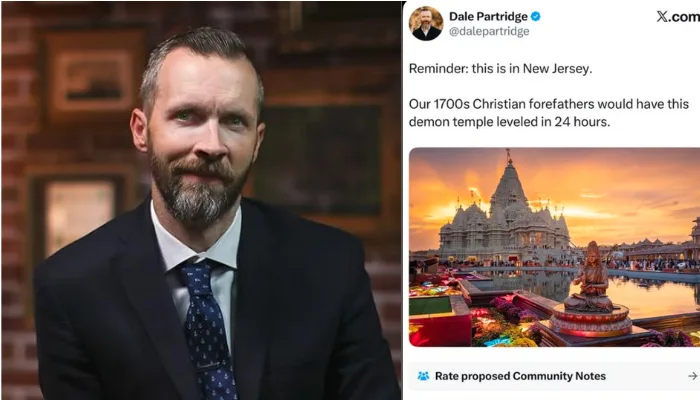
Case Summary
Hindu religious sentiments were outraged by a Christian pastor named Dale Partridge in the United States. The accused made derogatory remarks about the BAPS Swaminarayan Akshardham, a revered Hindu temple in Robbinsville, New Jersey. Hinduphobia Tracker's team examined the social media accounts of Dale Partridge and found that he identified himself as a Christian pastor and a conservative public personality. Partridge targeted the Swaminarayan temple by calling it a “demon temple” and expressing support for its destruction. In a post on X on 8 August 2026, he shared an image of the temple and wrote, “Reminder: this is in New Jersey....Our 1700s Christian forefathers would have this demon temple levelled in 24 hours.” The post was publicly circulated on X and, at the time of writing this report, had received several thousand views and more than 2,300 likes. The message reached a substantial audience while portraying a Hindu place of worship as an object deserving destruction. As the post went viral, the Coalition of Hindus of North America (CoHNA), a Hindu organisation based in the United States, condemned the incident on its official X handle. Sharing a screenshot of Partridge's post, the organisation wrote: “Yup, no Hinduphobia here. 🤔.....Just a white nationalist fantasising about destroying a Hindu temple, one that has welcomed millions of visitors of all faiths and backgrounds since opening in 2023 and has become a must-see destination for Americans and international visitors alike.” The organisation further wrote, “Yet groups like Hindus for Human Rights, activists like Pieter Friedrich, academics like Audrey Truschke, and the South Asia Scholar Activist Collective continue to dismiss concerns about Hinduphobia, and challenge the Hindu community’s right to raise them with lawmakers and law enforcement.....Hindus have every right to speak about threats, hatred, and bigotry directed at their community. We will not be denied, delegitimised, or silenced.” Notably, the BAPS Swaminarayan Akshardham in Robbinsville, New Jersey, was inaugurated in October 2023 and is recognised as the largest Hindu temple built outside India in the modern era. Constructed by the BAPS Swaminarayan Sanstha using intricately carved stone and traditional Hindu temple architecture, it has emerged as one of the most prominent Hindu religious and cultural landmarks in North America. Since its opening, the temple has welcomed millions of visitors from different faiths and backgrounds, serving as a centre for worship, cultural education, and interfaith engagement.
Why it is Hate Crime ?
The primary category for this case is: Hate speech against Hindus. The subcategory for this case is: Anti- Hindu slurs, mocking faith. Anti-Hindu slurs and the deliberate mocking of the Hindu faith owing to religious animosity involve the usage of derogatory terms, stereotypes, or offensive references to religious practices, symbols, or figures. One of the common anti-Hindu slurs used against Hindus is “cow-worshipper” and “cow piss drinker”. The intention of using these terms is to demean and mock Hindus as a group and their religious beliefs, since Hindus consider the cow holy. Additionally, some symbols and the slurs attached to them have a historical context that exacerbates the insult, hate, stereotyping, dehumanisation and oppression against Hindus. Cow worship has been used for centuries to denigrate Hindus, insult their faith and oppress Hindus specifically as a religious group. There has been overwhelming documentation about how cow slaughter has been used to persecute Hindus, with cow meat being thrown in temples and places of worship. There has also been overwhelming documentation that cow meat (beef) has been force-fed to Hindus to either forcefully convert them to Islam or denigrate their faith. Apart from cow worship, the Swastika – which holds deep religious significance for Hindus- has also been misinterpreted and distorted to be used as a slur against Hindus. Similarly, the worship of the Shivling has been used by supremacist ideologies and religions to denigrate Hindus owing to religious animosity. Such slurs and denigration stem from inherent animosity and hate towards Hindus and their faith; therefore, it is categorised as hate speech targeted at Hindus specifically owing to their religious identity. This case is a clear example of religiously motivated hate speech, as the perpetrator targeted a revered Hindu temple solely because of its religious identity, describing it as a "demon temple" and expressing approval for its destruction. By portraying the demolition of a Hindu place of worship as something that should have occurred, the perpetrator directed hostility towards a sacred Hindu institution and, by extension, the Hindu community that venerates it. To understand the severity of this case, it is important to first understand the religious significance of Hindu temples. In Hinduism, temples are not merely physical structures but sacred spaces where devotees believe the divine resides in the consecrated deity. They serve as centres of worship, spirituality, cultural continuity, and community life. Hindus regard temples with profound reverence because they symbolise the presence of the divine and constitute one of the strongest pillars of their faith. Any insult or attack directed at a Hindu temple is therefore an insult to the religion itself and to the devotees who worship there. The BAPS Swaminarayan Akshardham in Robbinsville, New Jersey, is among the most prominent Hindu temples outside India. Inaugurated in 2023, it is recognised as the largest Hindu temple built outside India in the modern era and has welcomed millions of visitors from different faiths and backgrounds. It serves not only as a place of worship for Hindus but also as a major centre of Hindu culture, education, and interfaith engagement. Its prominence makes it an important symbol of Hindu religious identity in the United States. Against this backdrop, referring to such a revered Hindu temple as a "demon temple" and expressing support for its destruction demonstrated deep-seated religious hostility towards Hinduism and its followers. The remarks were not directed at the activities of a particular institution but at the temple solely because it represented the Hindu faith. By branding a sacred Hindu place of worship as demonic, the perpetrator vilified one of the holiest symbols of Hinduism and portrayed a place that Hindus regard as the abode of the divine as something evil and deserving of contempt. This amounted to the denigration of Hinduism itself and reflected deep-rooted prejudice towards the religion and its adherents. The hostility was further reinforced by the statement that his Christian forefathers would have levelled the temple within twenty-four hours, which did not merely reference destruction but praised and endorsed it as a desirable act. By invoking his Christian forefathers in this context, the perpetrator glorified the hypothetical demolition of a Hindu place of worship and suggested that its elimination would have been justified because of its Hindu identity. Taken together, these remarks sought to denigrate a sacred symbol of the Hindu faith while portraying its destruction as commendable, thereby deeply hurting Hindu religious sentiments, fostering hostility towards the Hindu community, and constituting a clear example of religiously motivated hate speech. The act of describing a Hindu temple as a “demon temple” is not merely an isolated insult. Historically, Christian theology has characterised non-Christian religions and their deities as false, demonic, or spiritually inferior. Such beliefs have at various points been used to justify missionary activity, the suppression of polytheistic faith traditions such as Hinduism, and the destruction of non-Christian places of worship. In this context, referring to a Hindu temple as a “demon temple” while simultaneously expressing support for its destruction reflects doctrinal hostility towards Hinduism rather than a simple expression of personal dislike. The language reinforces a worldview in which a non-Christian place of worship is portrayed as inherently evil and, by virtue of its religious identity, as a legitimate target for destruction. Taken together, the perpetrator’s remarks demonstrated a clear disdain for Hindu places of worship, the Hindu faith, and the Hindu community. Therefore, the incident constitutes a clear example of a religiously motivated act and warrants inclusion in the Hinduphobia Tracker’s hate crime database.


Case Status
Unknown


Perpetrators Details
Perpetrators
Christian Extremists
Perpetrators Range
One Person
Perpetrators Gender
male
 Sources




