Hindus targeted for conversion by Christian missionaries on pretext of prayer gathering; Hindu faith vilified
 Pune, Maharashtra, India
  9 August, 2026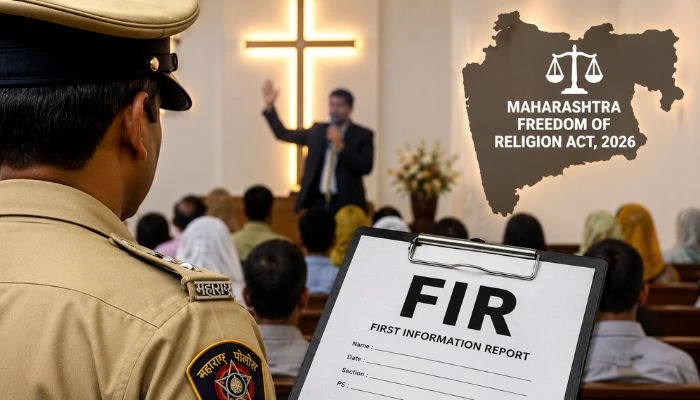
Case Summary
In Pune, Maharashtra, Hindus were lured and brainwashed to convert to Christianity by a UK-based Overseas Citizen of India (OCI) during a religious gathering. The accused, a resident of Manchester, claimed miraculous healing upon invoking the name of Jesus and abused Hindu deities in the gathering. On 10 August 2026, Pune Police registered a First Information Report against the man under relevant provisions of the Immigration and Foreigners Act, 2025, and the Maharashtra Freedom of Religion Act, 2026. The case was registered at Khadak police station after the accused attended a religious programme at a Marathi church in Guruwar Peth. During his address, he attempted to convert people to Christianity during an event without permission. He abused Hinduism and made derogatory remarks against temples and deities. He used terms associated with Hindu religious traditions, including “kirtan”, “Sant” and “Mauli”. The accused further lured Hindus by stating that illnesses could be cured and rainfall could occur by invoking the name of Jesus. As per the reports, the Police stated that such statements were made to attract Hindus towards Christianity and induce them to embrace the religion. A Khadak police station official stated that OCI cardholders were permitted to attend prayer meetings and participate in religious functions, but could not preach, conduct kirtans or deliver religious discourses without obtaining the requisite permission. Police subsequently registered the case against the accused and initiated an investigation into the religious activities conducted during the programme and the circumstances in which the attendees were encouraged to embrace Christianity. The Maharashtra Freedom of Religion Act, 2026, was notified on 31 July and came into force on 1 August 2026. The law prohibits unlawful conversion, attempted conversion, and aiding or abetting conversion through means including coercion, fraud, allurement, misrepresentation, force, threat and undue influence. It also prescribes enhanced punishment where unlawful conversion involves minors, women, members of Scheduled Castes or Scheduled Tribes, or persons of unsound mind. At the time of writing the report, police were investigating the religious discourse delivered by the accused and the circumstances in which the gathering was used to encourage people towards Christianity. Further investigation into the religious conversion activities and any other individuals involved was underway.
Why it is Hate Crime ?
The primary category for this case is: Predatory Proselytisation. The first subcategory selected for this case is: Conversion/ attempts to convert by inducement. Predatory Proselytisation is not just limited to threat, harassment, force and violence, but it also has contours of stealth. In several cases, the Hindu victim is exploited to convert, with non-Hindus taking advantage of their poverty. In such cases, the Hindu victim who is suffering financially is offered monetary benefits, including lucrative offers for jobs, health treatment, education, etc, to induce the victim into changing his/her religion. In such cases, the religious identity of the victim and the aim to disenfranchise him from his faith form the heart of the crime. Also, taking advantage of and exploiting an individual’s economic vulnerabilities is widely acknowledged as exploitation, forms of which are often penalised by law. Such cases therefore are considered religiously motivated hate crimes since the victim’s religious identity forms the very heart of the crime itself. The next subcategory selected is: Attempting to convert/ converting by denigrating Hinduism. In several cases, Hindus are converted, or an attempt is made to convert Hindus by denigrating their faith, Hinduism. In such cases, the Hindus associate with the non-Hindu perpetrators often by choice and then the attempt to convert them by insulting their faith, showing the faith down, etc begins. An example of this would be a non-Hindu gathering where the Hindus are attending the gathering of their own free will. However, once they attend the gathering, there is an explicit attempt to convert them by abusing their faith and hailing the faith of the perpetrator. The denigration of the Hindu faith is often based on misrepresentation of the Hindu faith, its doctrine and scriptures and insults to espoused traditions, if not blatant lies about Hindu beliefs and ways. Such conversions or attempts at conversions are driven by animosity towards the Hindu faith and are therefore documented as religiously motivated hate crimes. This case was included in the Hinduphobia Tracker because the religious conduct was directed at influencing Hindu attendees towards Christianity while undermining aspects of their own faith. The Christian evangelists were overtly trying to convert Hindus by abusing and disparaging Hinduism while glorifying their own faith, Christianity. In an effort to indoctrinate Hindus against their religion, which itself is a product of hostility towards the Hindu faith, they were making derogatory remarks about Hindu temples and deities. The Christian missionaries extolled their faith by promoting Jesus as the true deity and disparaging Hinduism. Further, the Christian evangelists attempted to exploit a specific vulnerability of the victims who were in all likelihood also economically backward. The missionaries exploited the poor victims by promising them miraculous cures for their ailments - cures that they either could not afford or for incurable diseases. They gave false assurance that illnesses could be cured and rainfall could occur by invoking the name of Jesus. These claims portrayed Christianity as possessing supernatural powers capable of providing healing and fulfilling worldly needs. By linking devotion to Jesus to relief from illness and rainfall, the religious message became more attractive and persuasive to those present. Such claims therefore served as a means of presenting the competing faith as spiritually superior while influencing Hindu attendees towards it. The statements concerning Hindu temples and deities placed Hindu beliefs in a negative and misleading context. This was not a neutral comparison of religious doctrines, as Hindu religious practices and objects of worship were undermined while devotion to Jesus was promoted as the alternative. Such conduct sought to weaken the confidence of Hindu attendees in their own faith and create receptiveness towards another religion. Religious grooming, brainwashing and subtle indoctrination often operate through psychological and emotional influence rather than direct threats or physical force. Such methods sought to create an impression that the perpetrator's faith possesses greater spiritual efficacy while gradually weakening attachment to the existing faith. The use of supernatural claims in such a context makes the religious message more persuasive by linking conversion to relief from illness and the fulfilment of worldly needs. The conduct here was significant because the objective was not merely to communicate or discuss Christian beliefs with members of the public. Hindus were brought into a setting where efforts were underway to persuade them to convert to Christianity. When organised religious activity is directed towards members of a particular faith with the objective of changing their religious affiliation, it directly engages with their religious identity. In this context, the Hindu faith of the intended targets was treated as something to be changed rather than simply a religious identity to be respected. Furthermore, rather than being limited to an isolated interaction with one individual, the prayer meeting brought several Hindus together and provided a setting in which they could be manipulated towards conversion to Christianity. The gathering therefore facilitated a concerted conversion effort targeting multiple members of the Hindu community and demonstrated that the conduct was directed against their religious identity rather than arising from an individual religious interaction. The use of religious persuasion in this manner also affected the religious autonomy of the targeted Hindus. Conversion becomes religiously significant when efforts are directed at persuading individuals to leave their existing faith and adopt another, particularly where the stated purpose of the gathering does not transparently disclose that conversion is part of the activity. The attempt to alter the religious affiliation of Hindu villagers therefore went beyond ordinary religious expression and constituted conduct specifically directed at changing the faith of members of the Hindu community. Such instances of forced proselytisation are manifestations of doctrinal hostility embedded within Abrahamic religions like Christianity that regard non-adherents as inferior and encourage their conversion. This leads to the dehumanisation of those who do not share the faith and creates an environment in which coercive conversion takes place. Therefore, this case was added to the Hinduphobia Tracker's hate crime database.


Case Status
Complaint filed


Perpetrators Details
Perpetrators
Christian Extremists
Perpetrators Range
One Person
Perpetrators Gender
male
 Sources




