Hindu temple land encroached upon, devotees denied access and obstructed from performing traditional worship in Thanjavur, Tamil Nadu
 Thanjavur, Tamil Nadu, India
  9 August, 2026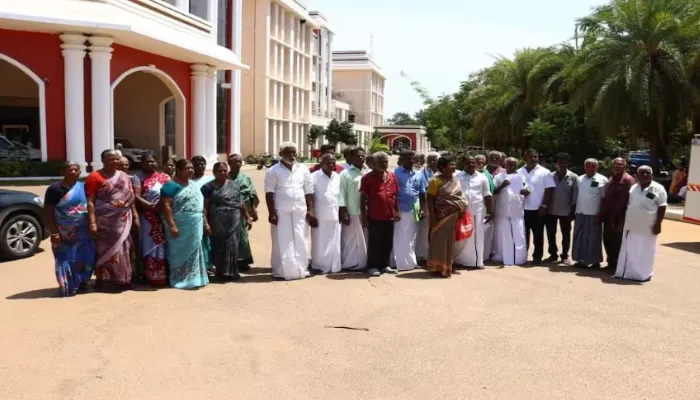
Case Summary
In Kulamangalam, Orathanadu taluk of Thanjavur district, Madurai Veeran Swamy Temple land was encroached upon, and Hindu families were prevented from freely accessing the temple and their family deity due to encroachments on the temple pathway and surrounding temple land. The Hindu devotees had worshipped Madurai Veeran Swamy as their family deity for many years and faced obstruction in reaching the temple and performing darshan. The Hindu families raised the matter at the Public Grievance Day meeting held at the Thanjavur Collectorate, chaired by Collector Revathi. They submitted a petition on 10th August, 2026, demanding the immediate removal of encroachments from the road leading to the temple, the temple premises and the surrounding areas so that devotees could reach the shrine and worship the deity without obstruction. The devotees stated that the encroachment had restricted access to the temple and that only selected persons were being permitted to enter, while those occupying the surrounding areas were preventing other Hindu devotees from entering the temple. This directly interfered with their ability to visit their family deity and perform regular worship. The Hindu families also raised the issue of temple and surrounding land pattas being transferred into the names of private individuals. They demanded an examination of the relevant land and temple documents and sought cancellation of the pattas that had been changed in this manner. They further demanded that the district administration take steps to protect the temple land and the traditional pathway used by devotees. The devotees specifically sought uninterrupted performance of their traditional worship practices, including Kidavettu Puja followed by food offerings at the Madurai Veeran Swamy Temple. They demanded that these established religious practices continue without interference and that devotees be allowed to participate in worship and have darshan of the deity. The Hindu families demanded a permanent resolution to the obstruction surrounding the temple, including removal of the encroachments, restoration of the temple pathway and protection of the temple land. They sought unrestricted access for devotees to visit the Madurai Veeran Swamy Temple and continue their customary worship and religious practices.
Why it is Hate Crime ?
The primary category for this case is: Attack on Hindu religious representations. The subcategory for this case: Encroachment or illicit takeover of temple land/land near temple. In Hinduism, a temple is the abode of the Deity. The Deity in the Temple is consecrated, thereby, making it a real, breathing entity. Hindus believe that not just the Deity but the temple premises itself are sacred to Hindus since Hindus hold the faith that the entire Temple space is an amalgamation of the divine energy of the deity. Not only the Temple but the Temple premises in its entirety are considered sacred by Hindus. In several cases, the premises of the Temple and/or religious centre are illicitly taken over by institutions belonging to other faiths – like the Waqf board or the Church. Other times, the temple property, land or the property of religious centres are illicitly encroached by non-Hindu groups. Any illicit take over or encroachment is a crime an initio, however, when non-Hindu groups illicitly take over or encroach the sacred land of Hindus, it is an affront to the Hindu community and is therefore classified as a religiously motivated hate crime under this category. In this case, the encroachment of the land surrounding the Madurai Veeran Swamy Temple had a direct impact on the ability of Hindu devotees to access and worship at their family deity. A Hindu temple is not merely a physical structure but a sacred space centred on the deity and sustained through generations of worship, ritual and religious tradition. The temple premises, its customary access pathways and the surrounding land used in connection with worship therefore hold significant religious importance for the devotees. The encroachment of such a sacred site is not an act of mere land dispute but a direct assault on the spiritual integrity of the Hindu faith. The deliberate attempt to occupy and enclose the temple site reveals deep-seated hostility towards Hindu religious traditions and reflects an attempt to desecrate what the community holds holy. Such unlawful interference and encroachment represent not only an attack on property but also a violation of the collective religious sentiment and cultural identity of Hindus in the region, making it a religiously motivated crime. The conduct constituted a hate crime because the encroachment directly interfered with the Hindu community's ability to access and worship at a sacred religious site and to practise traditions connected to their family deity. A temple and the land necessary for devotees to access and use it form an integral part of Hindu religious life; obstructing access to such a site therefore affects the community's ability to exercise and preserve its faith. By preventing Hindu devotees from freely reaching the deity and participating in established worship, the encroachment effectively imposed a restriction on the practice of their religion. The interference was particularly significant because it affected a customary form of worship preserved by the families over generations, thereby disrupting not only individual acts of devotion but also the transmission and continuation of a Hindu religious tradition. Such conduct goes beyond an ordinary dispute over land when the practical consequence is to prevent devotees from accessing their place of worship and carrying out religious practices associated with it. It therefore constituted religiously discriminatory interference with the Hindu community's exercise of its faith and undermined their ability to maintain an established religious tradition. Hindu religious customs are often preserved through continuous practice across generations, including family traditions, temple rituals and customary forms of worship. Such practices form an important part of the religious life of the communities that observe them. Preventing devotees from accessing their place of worship or interfering with the conditions necessary to perform such rituals can therefore disrupt the continuation of these established religious practices. Accordingly, the significance of this case lies in the manner in which the encroachment restricted Hindu devotees' access to a longstanding place of worship and interfered with their ability to perform customary religious practices. The obstruction therefore had consequences extending beyond a conventional land dispute, as it affected the devotees' access to their family deity and their continued practice of established Hindu religious traditions.


Case Status
Case sub-judice


Perpetrators Details
Perpetrators
Unknown
Perpetrators Range
Unknown
Perpetrators Gender
unknown
 Sources




