Anti-Hindu prejudice: Leftist media outlets selectively portray Kanwariyas as assailants in Hapur assault case, downplay role of Muslim accused
 Hapur, Uttar Pradesh, India
  6 August, 2026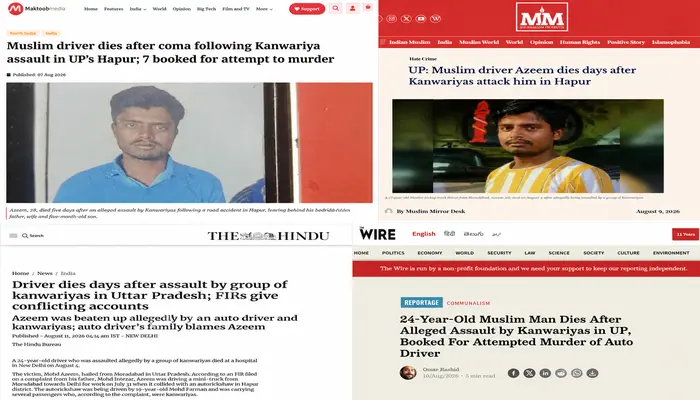
Case Summary
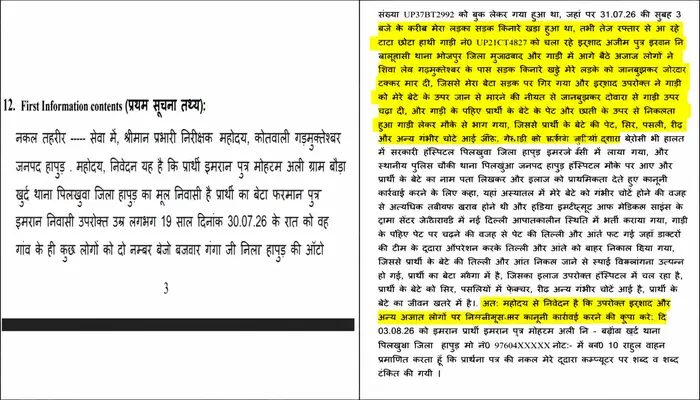
While reporting the Hapur assault case, several left-leaning and Islamist media outlets selectively pinned the blame for the death of 24-year-old Mohammad Azeem on Hindu Kanwariyas while conveniently downplaying or completely ignoring the role of Mohammad Farhan, a Muslim auto-rickshaw driver who was also named as an accused in the same case. The incident stemmed from a road collision that took place on 31 July 2026 near Shiva Dhaba under the Garhmukteshwar Police Station limits in Hapur, Uttar Pradesh, when Azeem's Tata mini-truck collided with a parked auto-rickshaw driven by Farhan, which was booked by four Kanwariyas. The collision escalated into a violent altercation in which Azeem sustained serious injuries, and Farhan was also critically injured. Azeem later succumbed to his injuries on 4 August 2026 while undergoing treatment at a hospital in Delhi. On 10 August 2026, The Wire published a report titled, "24-Year-Old Muslim Man Dies After Alleged Assault by Kanwariyas in UP, Booked For Attempted Murder of Auto Driver." The headline foregrounded only the Kanwariyas despite the police records naming Farhan as the primary accused alongside the four Kanwariyas. According to the complaint lodged by Intezar, the deceased's father, after Azeem's mini-truck collided with Farhan's parked auto-rickshaw, Mohammad Farhan, the four Kanwariyas travelling in the vehicle, and two unidentified persons dragged Azeem out of the vehicle and assaulted him. The FIR named Mohammad Farhan as the primary accused and Ankit, Lokesh, Manish, Shivam, and two unidentified persons as other accused. Thus, the complainant himself did not attribute the assault solely to the Kanwariyas but specifically named Farhan as one of the principal participants. The police investigation also recorded a counter-version of the incident. In a complaint filed by Imran, the father of Mohammad Farhan, it was alleged that Azeem deliberately drove his Tata mini-truck into Farhan, who was standing beside the road, knocking him down before driving over him a second time with the intention of killing him. The complaint stated that Farhan sustained grievous injuries to his head, ribs, spine, abdomen, spleen, and intestines, underwent multiple surgeries, and remained admitted in a coma at AIIMS Trauma Centre, New Delhi. Since Mohammad Azeem died during treatment, the Station House Officer of Garhmukteshwar Police Station stated that the FIR against him was being processed for closure in accordance with legal procedure. Despite the existence of these two FIRs, The Wire framed the incident entirely around the role of the Kanwariyas. While its report briefly mentioned Farhan within the body of the article, the headline made no reference to him, even though Azeem's own father had named him as an accused. Instead, the report created the impression that the incident was primarily an assault by Kanwariyas on a Muslim man. Several other media outlets adopted a similar editorial approach. The Hindu carried the headline, "Driver dies days after assault by group of Kanwariyas in Uttar Pradesh; FIRs give conflicting accounts." Muslim Mirror reported the incident under the headline, "UP: Muslim driver Azeem dies days after Kanwariyas attack him in Hapur," while Maktoob Media published, "Muslim driver dies after coma following Kanwariya assault in UP's Hapur; 7 booked for attempt to murder." Although the wording differed, all these reports placed the Kanwariyas at the centre of the incident while either omitting or substantially downplaying the role attributed to Farhan in the complainant's own FIR. The available police records indicate that the case arose from a road accident followed by a violent altercation between the parties involved. At the time of reporting, the investigation had not concluded, nor had the police indicated that the assault was motivated by the religious identities of those involved. Nevertheless, the selective emphasis placed by several media outlets on the Hindu identity of the Kanwariyas, while minimising the involvement of the Muslim co-accused named in the FIR, resulted in the incident being presented as a case of Hindu devotees attacking a Muslim man rather than as a criminal case involving allegations against individuals from both sides. The reporting also attracted criticism because the selective framing reinforced a broader narrative portraying Kanwariyas as inherently violent while overlooking material facts contained in the police records. By foregrounding only the Hindu identity of one set of accused and sidelining the involvement of the Muslim co-accused named in the same complaint, the reports gave the incident a communal character that was not reflected in the FIRs or in the information released by the investigating authorities.
Case Images
Why it is Hate Crime ?
The primary category selected in this case is: Hate speech against Hindus, with the subcategory selected as: Anti-Hindu subversion and prejudice. The tertiary category selected is: Anti-Hindu fake news or downplaying Hate speech is defined as any speech, gesture, conduct, writing, or display that is prejudicial against a specific individual and/or group of people, which is leading to or may lead to violence, prejudicial action or hate against that individual and/or group. Media plays a specific and overarching reach in perpetuating prejudicial attitudes towards a community owing to unfair, untrue coverage and/or misrepresentation/misinterpretation, selective coverage and/or omission of facts of/pertaining to issues affecting a specific religious group. This type of bias can dehumanise the victim group, making it easier for others to justify harmful actions against them, which aligns with the objectives of hate speech laws aimed at preventing such harm. It is often observed that the media takes a prejudicial stand against the Hindu community driven by their need to shield the aggressor community which happens to be a numeric minority, however, is the one perpetrating violence against Hindus. For example, the media is often quick to contextualise religiously motivated crimes against Hindus, omit or misrepresent facts that point towards religiously motivated hate crimes, justify and/or downplay religiously motivated hate crimes or simply present fake news to stereotype Hindus. Such media bias leads to the denial of persecution and is often used to dehumanise Hindus, leading to justification for violence against them. For example, the media covered several fake allegations of Hindus targeting Muslims and forcing them to chant Jai Shree Ram. Most of these cases were proved false and fabricated after police investigation. These fake news reports were subsequently never retracted or clarified. Such fake news led to the justification of violence and dehumanisation of Hindus based on the argument that since Hindus targeted Muslims and forced them to chant Jai Shree Ram, the dehumanisation of Hindus and violence against them was par for the course and merely a retaliation. Such media bias leads to prejudicial portrayal of Hindus and offers a justification for violence against them and therefore is considered hate speech under this category. The incident has been included in the tracker because several media outlets selectively highlighted the involvement of Hindu Kanwariyas while downplaying or omitting the role of Mohammad Farhan, a Muslim co-accused who was also named in the FIR lodged by the deceased's father. Despite the case arising out of a road collision followed by a violent altercation involving allegations and counter-allegations, the reporting largely reduced it to a narrative of "Kanwariyas assaulting a Muslim man." The issue is not that the Kanwariyas were named in the reports, but that the facts were presented selectively. By foregrounding the Hindu identity of one set of accused while minimising the role of the Muslim co-accused named in the same complaint, the reports transformed a criminal investigation into a communal narrative. Instead of allowing the investigation to establish individual culpability, the emphasis shifted towards portraying a Hindu religious group as collectively responsible. Such selective framing has consequences beyond a single news report. Kanwariyas undertake one of the largest annual Hindu pilgrimages in the country, and repeatedly associating them with violence through incomplete or one-sided reporting reinforces negative stereotypes about Hindu devotees as a whole. When the religious identity of Hindus is repeatedly highlighted while comparable facts concerning others involved are sidelined, it shapes public perception in a manner that stigmatises an entire community rather than the individuals accused of a crime. The deliberate tendency to paint Hindus as perpetrators whenever Muslims are victims, while suppressing or downplaying facts that complicate that narrative, reflects a broader pattern of bias. Since this systematic distortion is indicative of an underlying prejudice that perpetuates discrimination against Hindus and exemplifies how the denial or downplaying of material facts is rooted in hostility towards Hindus and their faith, this case has been added to the Hinduphobia Tracker. Disclaimer: The Hinduphobia Tracker records incident dates based on when the anti-Hindu act, crime, discriminatory conduct, or victim’s ordeal occurred, rather than when it was reported by the media or brought to public attention. However, in the present case, the incident concerns the dissemination of a misleading media narrative and not a standalone physical crime with a clearly identifiable date of occurrence. Among the media outlets discussed, the earliest identified report advancing this narrative was published by Maktoob Media on 7 August 2026, while Muslim Mirror, The Wire, and The Hindu published similar reports between 9 August and 11 August 2026. Accordingly, 7th August, 2026 has been recorded as the incident date for documentation purposes.


Case Status
Unknown


Perpetrators Details
Perpetrators
Others
Perpetrators Range
Unknown
Perpetrators Gender
unknown
 Sources




