Hindu school teacher suspended over quiz question on revered Hindu leader Veer Savarkar in Kerala
 Kasaragod District, Kerala, India
  5 August, 2026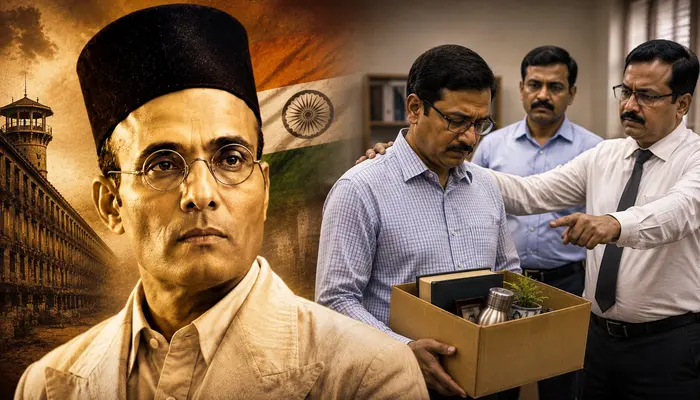
Case Summary
In Kerala, a Hindu school teacher named Guru Prasad Master was suspended after he included a question about revered Hindu leader Veer Vinayak Damodar Savarkar in a school quiz competition. The question prompted protests from Left-affiliated and Muslim student organisations, following which the Kerala General Education Department suspended the teacher and initiated departmental disciplinary proceedings against him. The incident arose from the Social Science Club Freedom Quiz 2026, a school-level quiz competition conducted on 6 August 2026 for Lower Primary, Upper Primary, and High School students in schools under the Kasaragod, Kumbla, and Manjeshwaram educational sub-districts of Kasaragod district, Kerala. The Lower Primary question paper contained 15 questions and five tie-breaker questions. The fifth question asked, “Who is the freedom fighter who received the maximum punishment at the hands of the British?” with the answer key identifying Veer Savarkar as the correct answer. The questionnaire was subsequently used in schools across the concerned educational sub-districts. The question paper became public around 8 August 2026, following which the Democratic Youth Federation of India (DYFI), the youth wing of the Communist Party of India (Marxist) [CPI(M)], the Students' Federation of India (SFI), and the Muslim Students Federation (MSF), the student wing of the Indian Union Muslim League (IUML), protested against the inclusion of Veer Savarkar in the questionnaire. These organisations questioned how the question paper had been prepared, approved, and circulated. The issue also drew criticism from the CPI(M), whose leaders accused the state government of allowing the "Sangh Parivar agenda" to enter the education sector, while senior CPI(M) leader Pinarayi Vijayan stated that attempts were being made to glorify Savarkar through the education system. Following the protests, Kerala General Education Minister N. Shamsudheen sought an explanation from the District Education Officer (DEO), Kasaragod, and directed the Director of General Education (DGE) to investigate the matter, claiming that the question was "historically inaccurate" and could create a misleading historical impression. Education authorities also stated that the quiz questionnaire had not been prepared or authorised by the department. A preliminary inquiry conducted by the Deputy Director of Education (DDE), Kasaragod, examined the preparation of the question paper, including its authorship, approval process, and compliance with departmental procedures. The inquiry identified Guru Prasad, a teacher at Aided Upper Primary School (AUPS) Pallathadukka in the Kumbla educational sub-district, as the teacher who had led the team responsible for preparing the questionnaire. The inquiry further concluded that framing the question in a manner capable of creating a misleading historical impression was a serious matter. Based on the inquiry report, Director of General Education Snehil Kumar Singh ordered Guru Prasad's suspension. The DGE also directed the Deputy Director of Education, Kasaragod, to conduct a detailed investigation, instructed the manager of AUPS Pallathadukka to initiate departmental disciplinary proceedings against Guru Prasad under the Kerala Education Rules (KER), and sought an action-taken report after completion of the inquiry. The Bharatiya Janata Party (BJP) opposed the suspension, with BJP leader K. Surendran describing the action as a "witch-hunt". He stated that Veer V.D. Savarkar had received one of the harshest punishments imposed by the British during the freedom struggle and that the teacher had committed no wrongdoing. Surendran asserted that Guru Prasad could successfully challenge the suspension before a court and announced that the BJP would extend full legal and political support to him. The party subsequently organised protests in Kasaragod district, including demonstrations near Kumbla Government Higher Secondary School. Following the suspension, Guru Prasad stated that he had not personally drafted the question-answer key and maintained that other teachers had prepared the material, while he had only forwarded the document to the Deputy Director of Education.
Why it is Hate Crime ?
The selected primary category in this case is: Hate speech against Hindus, with the subcategory selected as: Anti-Hindu subversion and prejudice. Hate speech is defined as any speech, gesture, conduct, writing, or display that is prejudicial against a specific individual and/or group of people, which is leading to or may lead to violence, prejudicial action or hate against that individual and/or group. Media plays a specific and overarching reach in perpetuating prejudicial attitudes towards a community owing to unfair, untrue coverage and/or misrepresentation/misinterpretation, selective coverage and/or omission of facts of/pertaining to issues affecting a specific religious group. This type of bias can dehumanise the victim group, making it easier for others to justify harmful actions against them, which aligns with the objectives of hate speech laws aimed at preventing such harm. It is often observed that the media takes a prejudicial stand against the Hindu community driven by their need to shield the aggressor community which happens to be a numeric minority, however, is the one perpetrating violence against Hindus. For example, the media is often quick to contextualise religiously motivated crimes against Hindus, omit or misrepresent facts that point towards religiously motivated hate crimes, justify and/or downplay religiously motivated hate crimes or simply present fake news to stereotype Hindus. Such media bias leads to the denial of persecution and is often used to dehumanise Hindus, leading to justification for violence against them. For example, the media covered several fake allegations of Hindus targeting Muslims and forcing them to chant Jai Shree Ram. Most of these cases were proved false and fabricated after police investigation. These fake news reports were subsequently never retracted or clarified. Such fake news led to the justification of violence and dehumanisation of Hindus based on the argument that since Hindus targeted Muslims and forced them to chant Jai Shree Ram, the dehumanisation of Hindus and violence against them was par for the course and merely a retaliation. Such media bias leads to prejudicial portrayal of Hindus and offers a justification for violence against them and, therefore, is considered hate speech under this category. This case is a clear example of anti-Hindu prejudice in plain sight, where a Hindu school teacher, Guru Prasad Master, was suspended simply for including a question on Veer Savarkar, a revered Hindu leader. The incident reveals the deep-seated hostility the perpetrators harboured towards Veer Savarkar. The question itself was factual and entirely neutral; it asked who was the freedom fighter who received the maximum punishment from the British, with Veer Savarkar marked as the correct answer. There was nothing communal or provocative about it. Despite this, Left-affiliated and Muslim student organisations treated the mere mention of his name as an offence. They maligned him by branding the information false and misleading and spoke about him in a derogatory manner. Trying to label a historical fact about a sacred Hindu leader as inaccurate, and then punishing the teacher who included it, is a direct attack on a figure who is sacred to the Hindu community. It makes this a clear case of a religiously driven hate crime. Veer Vinayak Damodar Savarkar was one of the foremost faces of the Hindutva movement and one of the most revered and respected Hindu leaders and cultural icons of the Hindu community. Hindutva is a cultural and civilisational pro-Hindu movement that seeks to unite Hindus irrespective of caste, class or gender, and to bring them together to protect their dharma and identity against foreign anti-Hindu forces such as Muslim extremists, Khalistani terrorists, Christian missionary groups, and anti-Hindu leftist academia. That is what Hindutva stands for: the preservation, assertion and strengthening of Hindu civilisation. Savarkar was the intellectual force who articulated this framework, and his contribution played a foundational role in shaping modern Hindu political thought and collective identity. He was also a revolutionary freedom fighter who was sentenced by the British to two transportation-for-life terms totalling 50 years and imprisoned in the Cellular Jail in the Andaman Islands. The fact that a Hindu teacher was targeted for asking a factual question that simply acknowledged that Savarkar endured one of the harshest punishments in the freedom struggle shows anti-Hindu prejudice and hatred towards a sacred Hindu figure. The reaction was completely disproportionate because the outrage and the suspension did not stem from any genuine factual dispute, but from Savarkar's association with Hindutva. Opposition to Savarkar is driven by opposition to Hindutva, and by extension to the Hindu community itself, rather than by any neutral historical inquiry. Leftist and Muslim organisations despise Savarkar precisely because he spoke about uniting Hindus and securing their Hindu identity, which directly challenges their own politics that thrives on dividing Hindus and eroding Hindu collective consciousness. That is why Savarkar is treated differently from other freedom fighters by the Left. While questions on other national leaders would never invite such hostility, a straightforward question on Savarkar was immediately branded as an attempt to bring the "Sangh Parivar agenda" into education. This proves the issue was never the wording of the question, but the ideological hatred for what Savarkar represents: unapologetic Hindu assertiveness and consciousness. Kerala's political culture has long been dominated by Left-leaning parties, particularly the Communist Party of India (Marxist), and by parties such as the Indian Union Muslim League [IUML], which have often opposed pro-Hindu ideological positions. Kerala has become a hotbed of leftist politics where there is a deep-seated disdain for Hinduism and the Hindu community, especially in the public sphere and in academia. When Savarkar's name appeared in a school quiz, the protests by the DYFI, SFI and MSF were clear evidence that pro-Hindu figures are viewed with suspicion and hostility even inside educational institutions in Leftist-dominated states like Kerala. The fact that student wings could dictate what can and cannot be taught, and that the state machinery immediately complied with their demands, points to a prevailing, institutionalised anti-Hindu ecosystem. This case amounts to anti-Hindu subversion because a teacher was suspended for including a question about a Hindu leader and freedom fighter, while questions about other national figures would not have provoked the same outrage. The protests by Left-affiliated and other political organisations, the government's description of the question as "misleading," and the disciplinary proceedings under the Kerala Education Rules show that Hindu figures are subjected to selective scrutiny in educational institutions. This is not a dispute over historical phrasing, but a deliberate attempt to marginalise Hindu civilisational narratives and to delegitimise Savarkar's legacy as a revered Hindu leader. The action against Guru Prasad Master sends a chilling message that even mentioning a sacred Hindu figure in a school can invite punishment, something that would never happen in the case of other leaders. As this case meets several parameters of a religiously driven hate crime, it is being added to the hate crime database of the Hinduphobia Tracker. Disclaimer: The Hinduphobia Tracker records the incident date based on when a crime or act of targeted discrimination occurs rather than when it is reported by the media. In this case, however, the exact date on which the teacher was suspended has not been specified. The only confirmed date available is 6 August 2026, when the quiz competition was organised. Accordingly, 6 August 2026 has been selected as the indicative incident date for documentation purposes. Although multiple Left-wing organisations protested against the inclusion of Veer Vinayak Damodar Savarkar's name in the quiz question paper, it was the state establishment that acted on those demands by suspending the Hindu teacher. Accordingly, for documentation purposes, the "State and Establishment" have been selected as the perpetrator in this case. In this case, the suspension order was issued by Snehil Kumar Singh, Director of General Education, Kerala, who ordered the suspension of teacher Guru Prasad. Accordingly, for documentation purposes, the perpetrator count has been recorded as "1".
Victim Details
Total Victim
1
Deceased
0
Gender
- Male 1
- Female 0
- Third Gender 0
- Unknown 0
Caste
- SC/ST 0
- OBC 0
- General 0
- Unknown 1
Age Group
- Minor 0
- Adult 1
- Senior Citizen 0
- Unknown 0


Case Status
Unknown


Perpetrators Details
Perpetrators
State and Establishment
Perpetrators Range
One Person
Perpetrators Gender
male
 Sources




