Hindu-owned vehicles bearing religious symbols targeted for theft by Muslim racket in Indore, Madhya Pradesh
 Indore, Madhya Pradesh, India
  9 August, 2016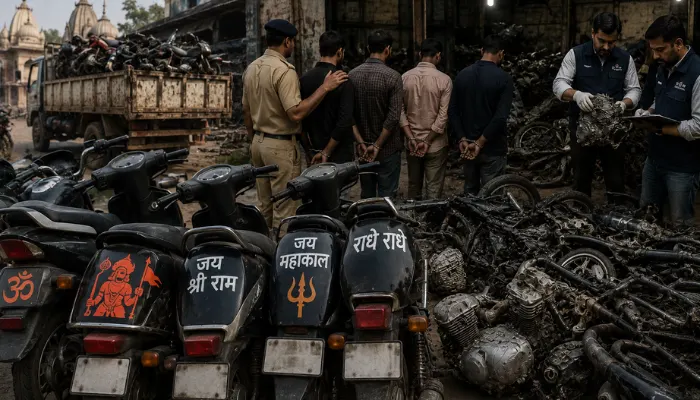
Case Summary
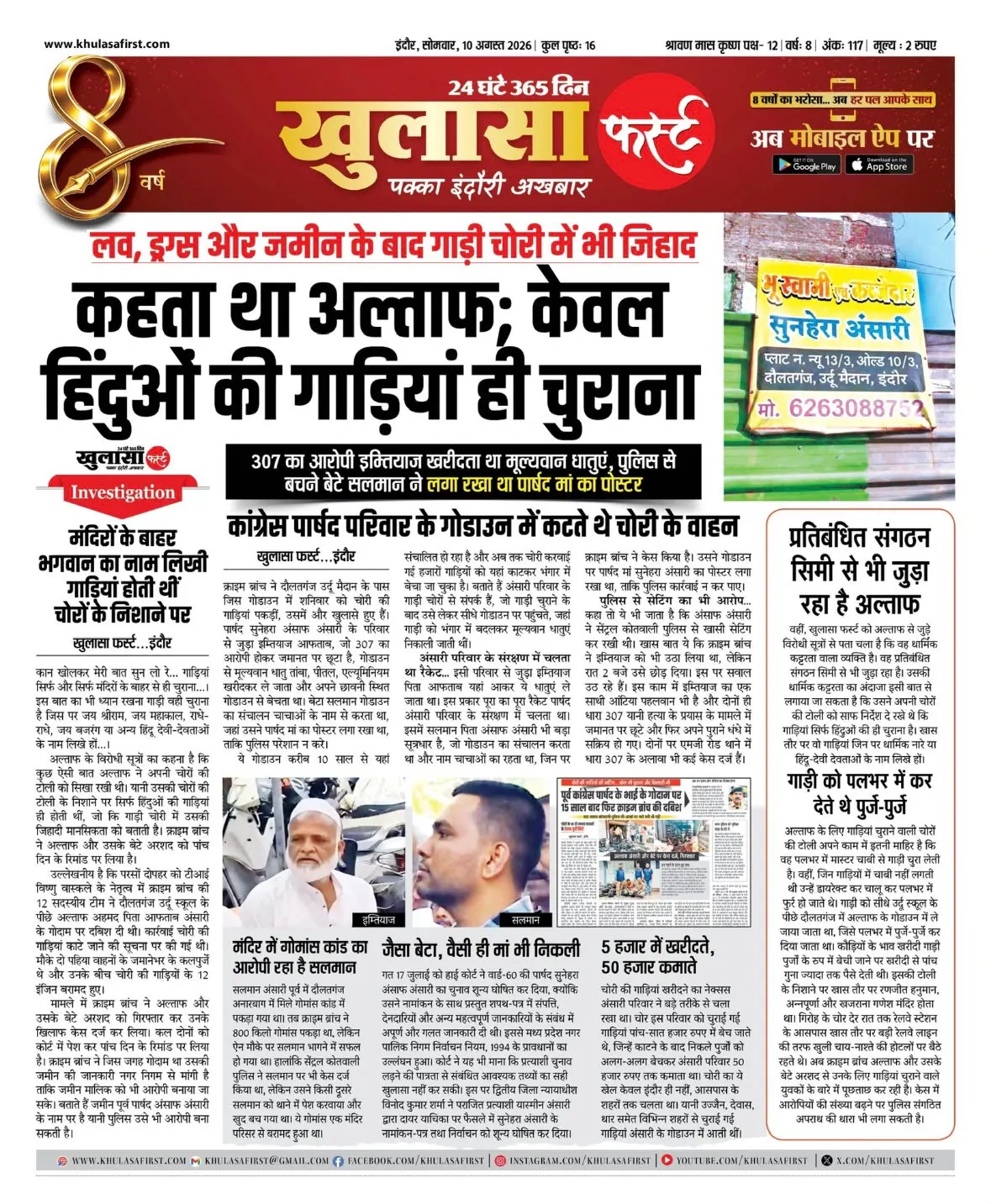
In Indore, Madhya Pradesh, Hindu-owned vehicles were targeted for theft by a racket of Muslim individuals. The gang specifically targeted vehicles carrying Hindu religious stickers, symbols and names, including “Jai Shri Ram”, “Jai Mahakal”, “Radhe Radhe”, “Jai Bajrangbali". Vehicles parked outside temples were particularly targeted on the instructions of the gang's head, Altaf Ansari. The racket was headed by 49-year-old Altaf Ansari, a resident of Indore. According to the newspaper account, Altaf instructed members of the gang to steal only vehicles belonging to Hindus. The racket had been operating for approximately 10 years, during which thousands of stolen vehicles were brought to a godown behind Urdu School in the Daulatganj area and dismantled for scrap. The stolen vehicles were not limited to Indore. Vehicles were brought from Ujjain, Dewas, Dhar and other surrounding areas. The thieves sold the stolen vehicles to the Ansari family for approximately ₹5,000–₹7,000 per vehicle. The vehicles were then dismantled, with their engines, other parts and valuable metals separated and sold. The dismantled material could generate up to approximately ₹50,000 per vehicle. The Crime Branch received information that large numbers of two-wheelers were being stolen and rapidly dismantled. A police team was formed to verify the information before conducting a raid at the scrap premises near Urdu Maidan in Ranipura. During the raid, police found large quantities of motorcycle parts, damaged vehicle components and tools used to dismantle vehicles and remove or erase identification numbers. No records or registers were being maintained for the vehicles or their parts. During the raid, police recovered 12 engines, including three engines whose identification numbers had been erased, along with other vehicle parts. The total value of the seized material was approximately ₹3 lakh. The operation involved several members of the Ansari family and their associates. Altaf's 25-year-old son, Arshad Ansari, was involved in the operation, while Salman Ansari, the son of former Congress corporator Sunehra Ansari, operated the godown. A poster of Sunehra Ansari had been placed at the premises. According to the newspaper account, the poster was used to keep police away from the godown. Another associate, Imtiyaz, purchased valuable metals recovered from the dismantled vehicles, including copper, brass and aluminium. He subsequently sold these materials from another godown in the Cantonment area. The newspaper account further identified Altaf Ansari as being associated with the banned Islamic terror organisation Students' Islamic Movement of India (SIMI). SIMI was founded in 1977 in Aligarh as a youth wing of Jamaat-e-Islami Hind. It rejected Indian democracy and advocated for an Islamic state. The organisation was banned in 2001 under the Unlawful Activities (Prevention) Act and was linked to various terrorist acts and underground militant offshoots, including the Indian Mujahideen. The Crime Branch arrested Altaf Ansari, Arshad Ansari, Imtiyaz and Salman Ansari in connection with the racket. Police registered a case under relevant provisions of the Bharatiya Nyaya Sanhita (BNS) at the Crime Branch police station. Altaf and Arshad were subsequently taken on five days' police remand. Police also sought details of FIRs concerning stolen vehicles registered at other police stations and investigated the possible involvement of additional members of the family and the wider network. Further arrests were expected as the investigation continued.
Case Images
Why it is Hate Crime ?
The primary category for this case is: Attack not resulting in death. The subcategory for this case is: Attacked for Hindu identity. In several cases, Hindus are attacked merely for their Hindu identity without any perceived provocation. A classic example of this category of religiously motivated hate crime is a murder in 2016. 7 ISIS terrorists were convicted for shooting a school principal in Kanpur because they got ‘triggered’ seeing the Kalava on his wrist and the tilak that he had put. In this, the Hindu victim had offered no provocation except for his Hindu religious identity. The motivation for the murder was purely religious, driven by religious supremacy. Such cases where Hindus are targeted merely for their religious identity would be documented as hate crimes under this category. This case is a clear example of a religiously driven hate crime, as the Muslim perpetrators selectively targeted only Hindu-owned vehicles for theft. The vehicles were identified as belonging to Hindus through visible religious markers, including stickers, names and slogans such as “Jai Shri Ram”, “Jai Mahakal”, “Radhe Radhe”, “Jai Bajrangbali". Vehicles parked outside temples were also specifically targeted for theft. The selection process therefore went beyond ordinary vehicle theft: the perpetrators used visible expressions of Hindu religious identity to identify which vehicles to target, demonstrating that Hindu identity was a direct factor in the selection of the victims and their property. This was not a case of random theft or indiscriminate financial crime. The perpetrators were not targeting vehicles because of a personal dispute, business rivalry, the value of a particular vehicle or any other individual conduct. Instead, Hindu ownership itself became the basis for victimisation, with Altaf Ansari specifically directing members of the gang to steal vehicles belonging to Hindus. By distinguishing Hindu-owned vehicles from others through religious symbols and markers, the perpetrators treated Hindu religious identity as a criterion for criminal targeting. Such selective targeting demonstrated hostility towards Hindus as a religious community and created a deliberate risk of economic harm to Hindu victims because of their faith. The deliberate targeting of vehicles displaying Hindu devotional symbols also gave the offence a distinctly religious character. “Jai Shri Ram”, “Jai Mahakal”, “Radhe Radhe”, “Jai Bajrangbali” and similar expressions were visible manifestations of Hindu faith rather than merely decorative markings. By using these expressions to identify vehicles for theft, the perpetrators effectively turned ordinary public expressions of Hindu identity into markers of vulnerability. The conduct therefore conveyed hostility towards Hindu religious expression and treated visible Hindu identity as a reason to single out and exploit the victims' property. The targeting also had a broader impact on the Hindu community because it made open expressions of Hindu faith a basis for victimisation. Hindu devotees displaying religious names and symbols on their vehicles could be identified and singled out precisely because of those expressions of faith, while vehicles parked outside temples were also targeted. The conduct therefore extended beyond the immediate financial loss suffered by individual victims and affected the ability of Hindus to express their religious identity openly without becoming targets. The selective targeting of Hindu-owned property, the deliberate use of Hindu religious identifiers to identify victims, and the resulting economic harm to Hindu victims demonstrated religious hostility and made the incident a religiously motivated hate crime. The religious hostility underlying the racket was further underscored by the newspaper account's identification of its mastermind, Altaf Ansari, as being associated with the banned Students' Islamic Movement of India (SIMI), an Islamic terror organisation that advocated the establishment of an Islamic state in India and had been linked to terrorist activities and attacks targeting the Indian state and Hindu civilians. This background did not by itself establish the motive for every act committed by the gang, but it provided important context for assessing the ideological environment surrounding the racket. The fact that the person directing the operation was identified as having an association with such an organisation, while simultaneously instructing the gang to selectively steal Hindu-owned vehicles identified through Hindu religious symbols and to target vehicles parked outside temples, reinforced the seriousness of the religious hostility reflected in the crime. The combination of this ideological association and the deliberate selection of Hindu property demonstrated that the racket was not merely causing financial losses through indiscriminate theft, but was specifically inflicting economic harm on Hindus while treating their religious identity as a basis for victimisation. Overall, since this case meets the parameters of a hate-driven offence, it is being added to the hate crime database of the Hinduphobia Tracker. Disclaimer: Although the vehicle theft racket had been operating for approximately 10 years, the incident came to light on 10 August 2026, when media reports brought the matter to public attention. Therefore, 10 August 2026 has been selected as the indicative incident date for documentation purposes only. The identified perpetrators in this case were Altaf Ansari, Arshad Ansari, Imtiyaz and Salman Ansari. However, the account indicated that the racket involved several other members of the Ansari family and their associates, without specifying their names or the total number of individuals involved. Therefore, for documentation purposes, a conservative estimate of 4 perpetrators has been recorded based on the four individuals who were specifically identified and arrested.


Case Status
Arrested


Perpetrators Details
Perpetrators
Muslim Extremists
Perpetrators Range
From 2 To 5
Perpetrators Gender
male
 Sources




