Historic Hindu temple's land targeted for illegal occupation by encroachers in Banda, Uttar Pradesh
 Banda, Uttar Pradesh, India
  9 August, 2026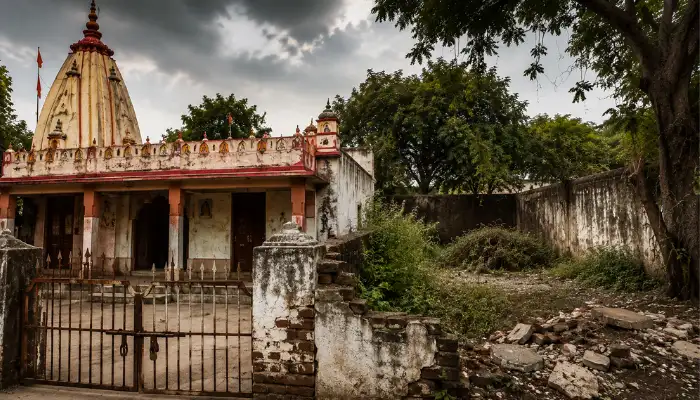
Case Summary
In Bisanda, Banda, Uttar Pradesh, the land of a historic Hindu temple was targeted for illegal encroachment with the help of a fake trust. The temple's hereditary priest family stated that a group of encroachers attempted to gain control of around 10 bighas of the temple's land through the fraudulent trust, prompting the district administration to order an inquiry. The temple was identified as the historic Narmadeshwar Mahadev Temple, a Hindu temple dedicated to Lord Shiva. The dispute concerned Gata No. 2348, measuring approximately 2.829 hectares, of which around 10 bighas were sought to be brought under the control of the fake trust. According to the hereditary priest family, the trust was created without their knowledge despite the family having maintained the temple and its property for generations and continuously performing its daily religious rituals and responsibilities. Pushpa Devi, the eldest daughter of the temple's hereditary priest family, submitted a written complaint to the District Magistrate. She stated that her late mother had served the temple throughout her life and that, after her mother's death, she and her father had continued managing the temple and performing its daily religious duties. She stated that some local land dealers had conspired with residents of Chitrakoot district to create the fake trust in an attempt to usurp the temple land. The complaint named Neelam, Ashish, Anusuya and Pappu, residents of Chitrakoot district, along with several unidentified associates. According to the complainant, they had acted in collusion with local land dealers to establish control over the temple property despite having no connection to the land. She further stated that the temple property was being targeted for illegal occupation and possible sale. The complaint also raised questions regarding the role of Lekhpal Vinod Rawat in processing the relevant land and trust-related documents. Pushpa Devi requested an investigation into the revenue records, trust registration documents and ownership status of the disputed land. She also sought protection of the temple property from further encroachment or unauthorised transfer and demanded legal action against those responsible for creating the fake trust. Following the complaint, the Additional District Magistrate directed the Sub-Divisional Magistrate of Atarra to conduct an inquiry into the matter. The administration was instructed to examine the original revenue records and trust documents, determine the legal status of the temple land and take further action based on its findings.
Why it is Hate Crime ?
The primary category for this case is: Attack on Hindu religious representations. The subcategory for this case is: Encroachment or illicit takeover of temple land/ land near a temple. In Hinduism, a temple is the abode of the Deity. The Deity in the Temple is consecrated, thereby making it a real, breathing entity. Hindus believe that not just the Deity but the temple premises themselves are sacred to Hindus since Hindus hold the faith that the entire Temple space is an amalgamation of the divine energy of the deity. Not only the Temple but the Temple premises in their entirety are considered sacred by Hindus. In several cases, the premises of the Temple and/or religious centre are illicitly taken over by institutions belonging to other faiths – like the Waqf board or the Church. Other times, the temple property, land or the property of religious centres are illicitly encroached by non-Hindu groups. Any illicit takeover or encroachment is a crime an initio; however, when non-Hindu groups illicitly take over or encroach the sacred land of Hindus, it is an affront to the Hindu community and is therefore classified as a religiously motivated hate crime under this category. In this case, the attempted takeover of land belonging to the historic Narmadeshwar Mahadev Temple in Banda directly targeted a Hindu place of worship and its sacred property. Hindu temples hold profound religious significance as spaces dedicated to the worship and veneration of Hindu Deities and serve as centres of religious practice, spiritual life and community traditions. They are not merely physical structures but sacred institutions that preserve and facilitate the continuity of Hindu beliefs, rituals and traditions. An attack on a Hindu temple or an attempt to undermine its functioning therefore directly interferes with a religious institution of significance to the Hindu community. Temple land is similarly not merely ordinary property or a commercial asset; it is inseparable from the temple ecosystem itself. Land attached to a temple holds religious sanctity, supports the functioning and preservation of the temple, and remains intrinsically connected to the Deity and the religious institution. Any attempt to usurp or unlawfully seize such land therefore goes beyond an ordinary property dispute and constitutes an affront to a sacred Hindu institution. By seeking to encroach upon land belonging to the Narmadeshwar Mahadev Temple, the perpetrators interfered with property dedicated to a Hindu place of worship, undermined Hindu religious beliefs, hurt the religious sentiments of Hindus and attacked their ability to preserve and protect a sacred religious institution. The attempted encroachment therefore constituted a religiously motivated hate crime. The manner in which the offence was carried out further demonstrated its deliberate and malicious nature. According to the complaint, the perpetrators sought to establish control over the temple land by creating and registering a fake trust without the knowledge of the hereditary priest family that had managed the temple and performed its religious rituals for generations. The use of a fraudulent trust was not an isolated administrative irregularity but a premeditated mechanism to bypass the lawful custodians of the temple, alter control over its sacred property and facilitate its illegal occupation. Such calculated actions reflected a conscious attempt to undermine the traditional management of a Hindu religious institution through deception. More broadly, illicit attempts to take over temple land threaten the security and continuity of Hindu religious institutions. Hindu temples are not confined to the physical structure where worship is performed; the surrounding land and associated property form an integral and inseparable part of the temple's religious and cultural identity. Repeated attempts to encroach upon such land weaken Hindu institutions, disrupt their traditional administration and place sacred spaces at risk of being permanently alienated from the Hindu community. Such acts therefore constitute an affront to Hindu religious identity and undermine the collective right of Hindus to preserve, protect and manage their temples and sacred spaces. This act showcased the mindset of the perpetrators, who demonstrated a blatant disregard for the sanctity of a Hindu place of worship and the religious sentiments of Hindus. Their willingness to interfere with property intrinsically connected to a sacred Hindu institution showed that they were prepared to trample upon Hindu religious rights without regard for the significance of the temple or the faith it represented. Such conduct reflected a broader disdain for Hinduism and an unwillingness to respect the beliefs, traditions and institutions of the Hindu community. Their readiness to undermine the sanctity and security of a Hindu temple in pursuit of control over its sacred property revealed a deeply hostile attitude towards Hindu religious interests. Overall, since this case meets the parameters of a religiously driven crime, it is being added to the hate crime database of the Hinduphobia Tracker. Disclaimer: The Hinduphobia Tracker records incident dates based on when a crime occurs rather than when it is reported by the media. In this case, the reports did not state the exact date when the crime first occurred. Hence, the date on which the incident was reported by the media, 10 August 2026, has been selected as the indicative incident date for documentation purposes.


Case Status
Complaint filed


Perpetrators Details
Perpetrators
Others
Perpetrators Range
From 2 To 5
Perpetrators Gender
both
 Sources




