Anti-Hindu hate on display; woman desecrates revered Hindu king’s statue and hurls abusive remarks against him
 Pune, Maharashtra, India
  10 August, 2026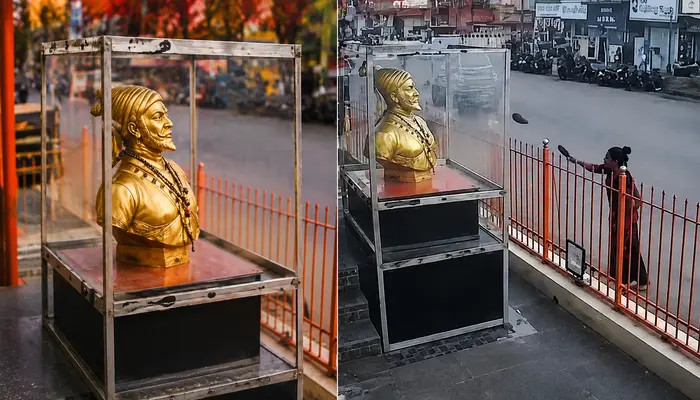
Case Summary
In the Sasane Nagar area of Hadapsar, Pune, Maharashtra, Hindu religious sentiments were hurt after a statue of Chhatrapati Shivaji Maharaj was desecrated by a woman. According to media reports, the woman was caught on video hurling abusive remarks at the revered Hindu king and throwing slippers and stones at his statue. The statue was protected by a glass cover, preventing it from sustaining any damage. The video of the incident subsequently went viral on social media, sparking outrage among local Hindu residents. Following the incident, angry locals traced the woman and confronted her. Some women blackened her face with purple ink, while another woman slapped her. The woman was subsequently handed over to the Pune City Police. Police said that appropriate legal action would be taken against the woman and began investigating the circumstances surrounding the incident, including whether she had acted under pressure from her friends. Security was also increased in the area amid concerns over further unrest. As the video went viral, several Hindu social media users condemned the incident and called for legal action against the woman.
Why it is Hate Crime ?
The primary category selected in this case is: Attack on Hindu religious representations. The subcategory selected is: Desecration of Hindu religious symbol. Icons and symbols or a religious representation of a spiritual ideal are widely revered in Hinduism. Iconography is of vital significance in the Hindu milieu. It helps connect people’s spiritual beliefs with the real world. Iconography within the Hindu faith takes several shapes and forms. Murtis are of most significance to Hindus, to which daily rituals, prayers and offerings are done. Besides the murtis, there are several other symbols which have deep significance in the Hindu faith – the Om and Swastika for example. Since these Hindu religious symbols hold paramount importance in Hinduism, any desecration of symbols, icons, murtis, religious representations and manifestations, is driven by animosity towards the faith itself which manifests itself through these murtis, icons and symbols. Therefore, any desecration of these Hindu religious symbols and representations is considered religiously motivated hate crimes under this category. The other primary category selected is: Hate speech against Hindus. The subcategory selected is: Mocking/denigrating Hindu leaders Hate speech is defined as any speech, gesture, conduct, writing, or display that is prejudicial against a specific individual and/or group of people, which is leading to or may lead to violence, prejudicial action or hate against that individual and/or group. Religious leaders are often seen as representatives of the community, especially, the community’s religious faith and beliefs. Mocking or denigrating a religious leader specifically owing to his religious identity and/or the religious rituals he observes can be considered hate speech because the motivating factor of the speech is animosity and/or dislike for what he represents – the religious beliefs and faith of the community. It is important to note that mere insulting words against an individual do not constitute hate speech. It is entirely possible that insulting words are used for an individual, however, the specific speech is not the result of religious hate and/or animosity towards the professed faith of the religious leader, but the individual himself. For the speech to be considered hate speech, the speech itself or the motivating factor behind the speech has to be religious in nature. Such speech which denigrates Hindu religious leaders specifically owing to animosity towards the faith they profess and the community faith they represent will be treated as hate speech under this category. This case is a clear example of a religiously driven hate crime, as the perpetrator desecrated the statue of Chhatrapati Shivaji Maharaj and also hurled abusive remarks at him. This resulted in the denigration of a revered Hindu king and cultural icon. The combination of verbal abuse and the deliberate targeting of his statue goes beyond ordinary vandalism or damage to public property. The conduct directly targeted a figure who holds profound religious, historical and cultural significance for Hindus, thereby having the effect of insulting and hurting the religious sentiments of the community that revered him. To understand the severity of the incident, it is important to understand the religious and cultural significance of Chhatrapati Shivaji Maharaj. Shivaji Maharaj is revered in Hindu society as a Hindu ruler who established Hindavi Swaraj and became a symbol of resistance against the political and military domination of Islamic invaders during the medieval period. He is remembered for defending his people, protecting Hindu places of worship, supporting Hindu religious traditions and establishing a system of governance associated with Hindu self-rule. His legacy represents courage, resistance, justice, the protection of dharma and the preservation of Hindu civilisational identity. For Hindus, therefore, Shivaji Maharaj is not merely a historical monarch but a deeply revered Hindu icon and a leader whose memory is closely intertwined with their religious and cultural consciousness. His statues consequently carry significance beyond that of an ordinary public monument. Statues of Shivaji Maharaj serve as visible representations of his legacy, his ideals and the historical memory associated with Hindu self-rule and resistance. They are installed and revered as symbols of pride, remembrance and Hindu cultural identity. Targeting such a representation therefore carries a meaning that extends beyond an attack on a physical object. The desecration of the statue constitutes an attack on a symbol through which members of the Hindu community express reverence for a figure of immense historical, religious and cultural importance. The act of throwing slippers and stones at the statue constituted a grave act of disrespect towards this revered Hindu icon. In Hindu cultural and religious understanding, footwear is associated with impurity and disrespect when directed towards a person, sacred representation or object of reverence. Throwing slippers at the statue therefore carried an unmistakably humiliating and degrading symbolism. The use of stones further demonstrated a deliberate act of hostility towards the Hindu religious representation. Taken together, these actions transform the incident from ordinary vandalism into a deliberate public act of desecration directed at a figure revered by millions of Hindus. The circumstances were particularly significant because the desecration was accompanied by abusive remarks directed at Shivaji Maharaj. Verbal abuse against an ordinary public object could not be equated with publicly insulting a figure who occupies a position of profound reverence within a religious community. By combining degrading language with a symbolic act of humiliation, the perpetrator denigrated the identity and legacy of a revered Hindu icon and leader. The conduct therefore amounted not merely to the physical mistreatment of a statue but to an expression of contempt towards a figure whose memory is closely connected with Hindu religious and cultural identity. This overall makes this incident a clear example of a religiously driven hate speech. Given that this case meets the parameters of a religiously motivated crime, it is being added to the hate crime database of the Hinduphobia Tracker. Disclaimer: The Hinduphobia Tracker records incident dates based on when the crime occurs rather than when it is reported by the media. However, in this case, the media reports did not specify the exact date on which the crime occurred. Therefore, 11 August 2026, the date on which the incident was reported in the media, is being selected as the indicative incident date for documentation purposes only.


Case Status
Arrested


Perpetrators Details
Perpetrators
Unknown
Perpetrators Range
One Person
Perpetrators Gender
female
 Sources




