Hindu man brutally killed near a mosque by Muslim mob for wearing tilak in Ahilyanagar, Maharashtra
 Ahmednagar, Maharashtra, India
  6 August, 2026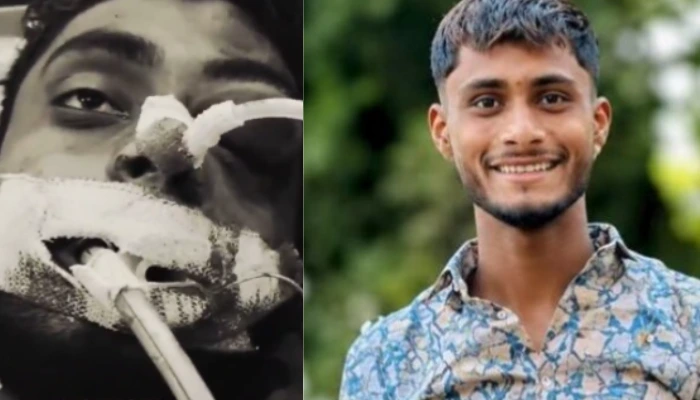
Case Summary
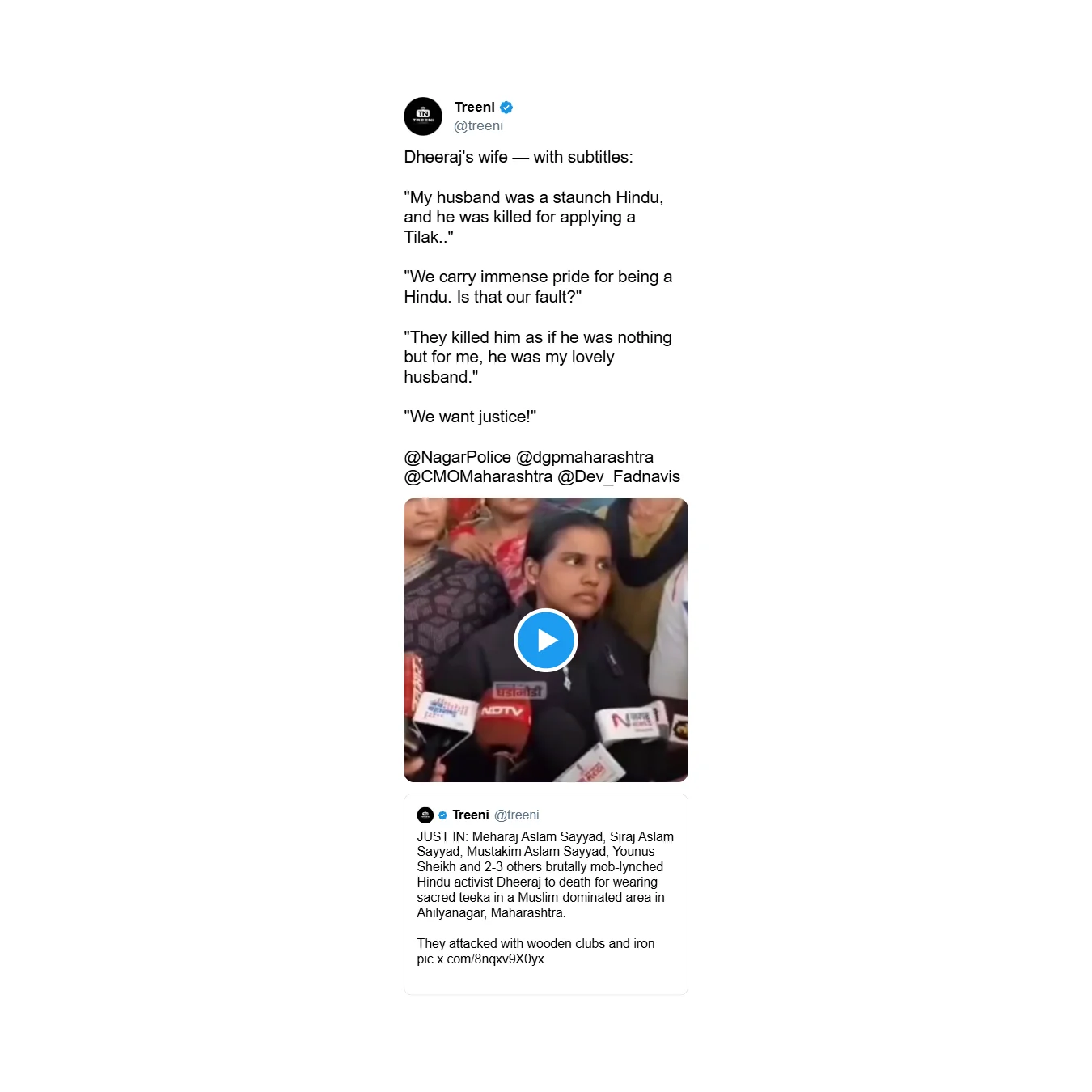
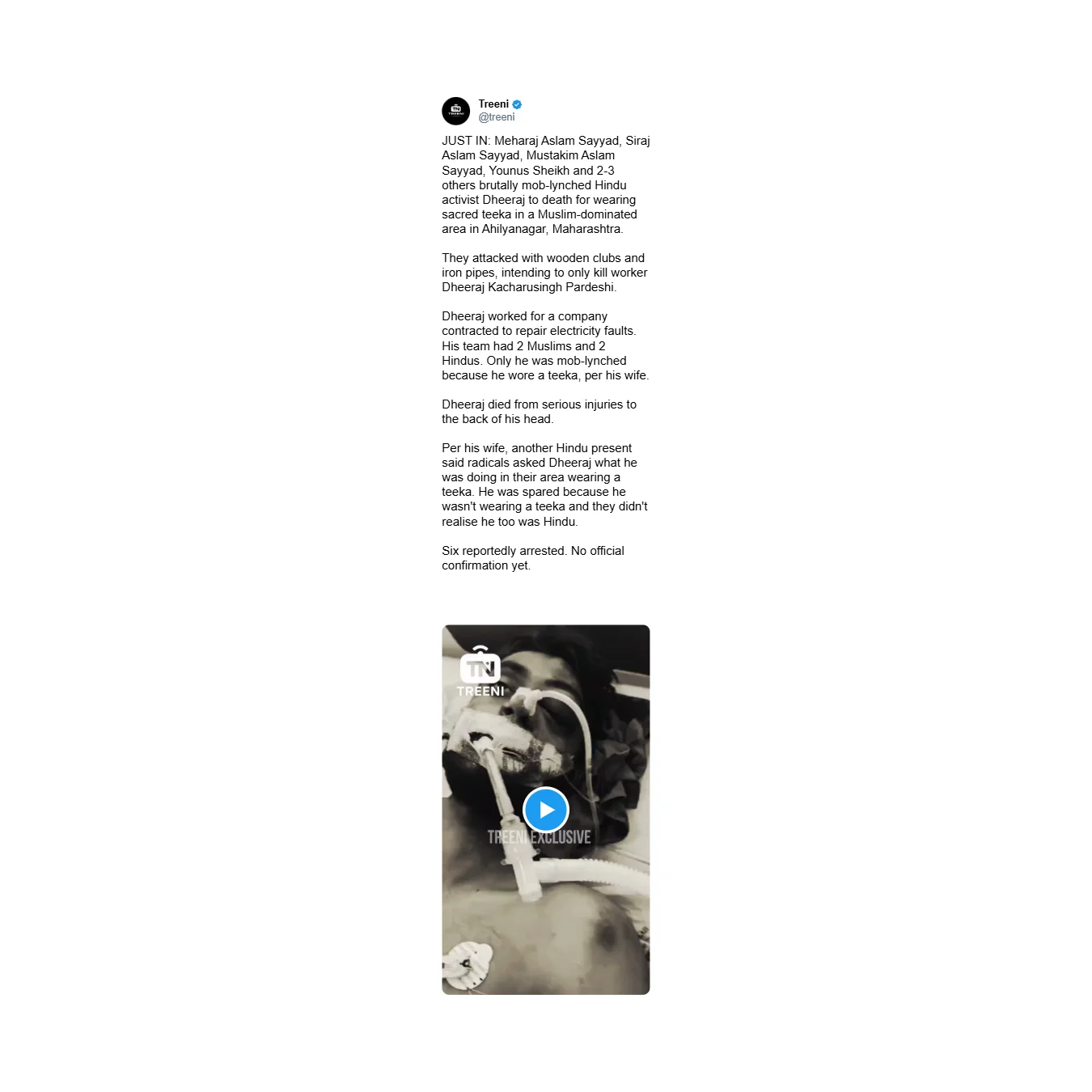
In Ahilyanagar, Maharashtra, a Hindu man, Dheeraj Pardeshi, was killed after being attacked by a mob of Muslim men for wearing a Tilak on his forehead and for his support for the Hindutva movement. The attack took place on 7th August 2026 near the Dargadaira graveyard, an Islamic cemetery, adjacent to the historic Dargah Daira Mehdavia Masjid and the shrine of the Sufi saint Hazrat Shah Sharif. According to media reports, Pardeshi was working as a wireman for a contractor associated with the Ahilyanagar Municipal Corporation’s Electricity Department. He had gone with his colleagues Akshay and Kavya to the Dargadaira graveyard at around 4 pm on 7th August 2026 to carry out electrical repair and streetlight installation work. While Akshay was on top of a bungalow checking the streetlight wiring and Kavya was operating the main electrical panel, Pardeshi was carrying out work near the graveyard. At around 4:10 pm, Akshay heard loud screams from downstairs and looked down to see Pardeshi being attacked by a mob of 10 to 15 Muslim men. The attackers brutally beat him with wooden bats, sticks and iron pipes, causing severe injuries to his head and other parts of his body. Pardeshi called out to Akshay for help, saying, “Akshay, save me.” Akshay attempted to intervene and threw the streetlight he was carrying at the attackers, while Kavya also urged them to release Pardeshi. The three accused then fled the spot on an Aviator motorcycle, while the other attackers fled on foot. After the attackers fled, Akshay came downstairs and found Pardeshi unconscious and bleeding profusely, with a serious head injury. He contacted his colleague Gaurav Borude, who asked him to bring the police to the scene, and also informed supervisor Akshay Borude about the attack. Akshay and Kavya placed Pardeshi in the company’s tempo and took him to the Civil Hospital. Due to the seriousness of his condition, doctors advised that he be shifted to another hospital. He was subsequently taken by ambulance to Makerere Hospital, where he remained under treatment for three days. He died during treatment on the afternoon of 9th August 2026 at around 2 pm. The First Information Report named four accused, Mehraj Aslam Syed, Siraj Aslam Syed, Mustaqeem Aslam Syed and Yunus Shaikh, and also mentioned two to three unidentified individuals. According to the First Information Report, the attackers were armed with wooden bats and iron pipes and repeatedly struck Pardeshi, including on his head, while shouting, “Kill him.” Pardeshi’s family and local Hindu leaders said that he was targeted because he was a Hindu, was wearing a Tilak and supported Hindutva. Initial media reports and social media posts also stated that he was wearing a Tilak and a sacred thread when he was attacked. Pardeshi’s wife demanded that his last rites be performed at the same Dargadaira graveyard where he was attacked. A video of her statement also went viral on social media, in which she said that Muslims had called her husband to the graveyard and that Muslims had killed him. She stated that the mob had shouted, “Kill him, kill him” while carrying out the attack. She also asserted that her husband had been killed for being a Hindu, for wearing a saffron Tilak on his forehead and for supporting the Hindu cause. She said that her family was proud of being Hindu and questioned whether openly identifying as Hindus was their fault, stating that this was why her husband had been killed. Member of the Legislative Assembly Sangram Jagtap questioned the police explanation that the incident had arisen from an old dispute. He said that Pardeshi and his colleagues had gone to Mukundnagar only for official work and that there was a discrepancy between the actual sequence of events and the information being given by the police. Jagtap demanded that the investigation establish the main conspirators and determine whether a larger conspiracy was behind the killing. Following the attack, Bhingar Camp Police registered a case and arrested four accused, Yunus Shaikh, Mehraj Aslam Syed, Siraj Aslam Syed and Mustaqeem Aslam Syed. Yunus Shaikh was arrested first, while Mehraj, Siraj and Mustaqeem fled the area after the attack. The three travelled from Sambhajinagar to Hyderabad by train and were subsequently arrested there by a local crime branch team. Police continued searching for the two to three unidentified individuals mentioned in the First Information Report, as well as others involved in the attack. Police Inspector Tejashree Vitthal Thorat was named as the investigating officer in the First Information Report. Pardeshi’s killing triggered tension and protests across Ahilyanagar. Members of the Sakal Hindu Samaj and other Hindu organisations gathered outside the hospital and called for a citywide bandh. There was widespread anger among local residents and Hindu organisations following his death. Members of the Legislative Assembly Sangram Jagtap and Akshay Kardile joined the protesters and later blocked a road near the statue of Chhatrapati Shivaji Maharaj at the old bus stand. Jagtap demanded strict action against those responsible and called for the investigation to identify the mastermind behind the attack. Protesters demanded strict punishment, including the death penalty, and also called for the houses of the accused to be demolished. The Municipal Employees’ Association, led by Jitendra Sarsar and Babasaheb Mudgal, announced an indefinite strike from Monday, 10th August 2026. The association stated that civic employees would not resume normal operations until all those responsible were arrested and adequate security was provided to municipal workers operating in the Mukundnagar area. General Secretary Anandrao Waikar questioned how municipal employees could continue providing essential services if they were not safe at their workplaces. The association paid tribute to Pardeshi and demanded action against everyone responsible for his death. Following Pardeshi’s death, a Gram Panchayat issued encroachment notices concerning the houses of three of the accused, Mustaqeem Khwajamia Syed, Mehraj Ibrahim Syed and Siraj Ibrahim Syed, in Nagardevala. The notices described the constructions as unauthorised and directed the occupants to submit documents establishing that the constructions had received the necessary permissions. The notices invoked Sections 52 and 53 of the Maharashtra Gram Panchayat Act, 1959, and referred to Gram Panchayat property numbers 2374 and 2517. The occupants were given an opportunity to present documents and objections, after which further action was to be taken. The notices came after Members of the Legislative Assembly and protesters demanded strict action against the accused, including the use of bulldozers against their houses. Following his death, Pardeshi’s body was sent to Ghati Hospital in Chhatrapati Sambhajinagar for a post-mortem examination. Police personnel were deployed across different parts of Ahilyanagar as authorities worked to contain the tension following the killing. Ahilyanagar Superintendent of Police Mummaka Sudarshan appealed to citizens to maintain peace and warned against spreading rumours or taking the law into their own hands. Police stated that the situation was under control and that the case was being thoroughly investigated. The police said that the facts and motive behind the incident would be established through the investigation.
Case Images
Why it is Hate Crime ?
This case is being added to the primary category: Attack resulting in death. The subcategory selected is: Attacked for Hindu identity. In several cases, Hindus are attacked merely for their Hindu identity without any perceived provocation. A classic example of this category of religiously motivated hate crime is a murder in 2016. 7 ISIS terrorists were convicted for shooting a school principal in Kanpur because they got ‘triggered’ seeing the Kalava on his wrist and tilak that he had put. In this, the Hindu victim had offered no provocation except for his Hindu religious identity. The motivation for the murder was purely religious, driven by religious supremacy. Such cases where Hindus are targeted merely for their religious identity would be documented as a hate crime. Under this category, cases where the attack led to the death of the Hindu victim/s would be documented. This case is a clear example of a hate crime because a Hindu man was brutally killed by a Muslim mob for wearing a Tilak near a mosque in Ahilyanagar, Maharashtra. Dheeraj Pardeshi was attacked and murdered solely because of the visible assertion of his Hindu identity and his support for Hindutva. Hindutva is a civilisational and political movement that focuses on protecting the rights of the Hindu community. The deliberate targeting of an individual for his religious identity and for his ideological commitment to the Hindu cause establishes that this is an unambiguous case of a hate crime. The religious marker in this case is evident from the fact that the victim was targeted, attacked and killed for wearing a Tilak. The Tilak holds profound religious significance in Hinduism. It is applied on the forehead and represents devotion, auspiciousness and adherence to Hindu Dharma. It is not a mere cultural accessory but a sacred declaration of faith. The fact that a Hindu man was profiled and attacked for wearing this symbol showcases deep-seated religious hostility. When an individual is singled out in a public space not for any personal dispute or provocation but solely because he is visibly identifiable as a Hindu through his religious symbols, it demonstrates selective targeting. This form of profiling, where a religious marker is used as a trigger for violence, proves that the attack was motivated by hostility towards the victim's religion itself. When religious markers are used to profile and target people for violence, it showcases deep- rooted hatred towards the Hindu community and the members of the Hindu faith. The fact that he was also targeted for his support for Hindutva further establishes this killing as a hate crime. Hindutva is a civilisational and political movement that stands for the rights of Hindus and for the recognition of India as a Hindu civilisational state rooted in its ancient heritage and ethos. Contrary to the deliberate misrepresentation by anti-Hindu elements who seek to portray it as an extremist ideology, Hindutva is not an extremist or radical movement in any sense. Its core objective is to secure the legitimate cultural, religious and civilisational interests of the Hindu community. The fact that the victim was killed for supporting such a pro-Hindu movement shows that the Muslim perpetrators were intolerant of his association with any cause that affirms Hindu identity. It reflects a clear hostility towards even the ideological assertion of being Hindu. When a person is murdered for aligning himself with a movement that defends Hindu interests, it constitutes a clear case of a religiously driven hate crime. The fact that this crime occurred near a mosque and an Islamic cemetery adjacent to the historic Dargah Daira Mehdavia Masjid further underscores its religious motivation. A recurring and well-established pattern in numerous such cases is that Muslim perpetrators treat areas surrounding mosques, dargahs, Islamic cemeteries, or localities where Muslims form a majority as exclusive Muslim spaces where Hindus and other non-Muslims are unwelcome. The attack and killing of a Hindu man who openly took pride in his Hindu identity in such a location exemplifies this mindset in practice. It reflects an Islamic supremacist ideology in which the perpetrators regarded the area around the mosque as an exclusive zone under their control and believed they had the authority to determine who could be present there. Within this worldview, the mere presence of a Hindu, or the visible expression of Hindu identity, is treated as a provocation warranting violence. This assertion of territorial control, combined with the deliberate targeting of the victim because of his Hindu identity, reflects a mindset rooted in religious exclusion, intolerance and the desire to assert religious dominance over public spaces, making this a clear case of a religiously motivated hate crime. The fact that the immediate family of the victim, particularly his wife, and local Hindu organisations were clearly asserting that he was killed for being a Hindu further corroborates the hate crime motive. His wife had stated on record that Muslims called her husband to the graveyard and that Muslims killed him while shouting 'kill him' repeatedly during the attack. She explicitly stated that her husband was killed for being a Hindu, for wearing a saffron Tilak on his forehead and for supporting the Hindu cause. This establishes that this was not a random incident but a calculated act of murder of a Hindu youth for openly displaying a Hindu religious symbol and for supporting a Hindu civilisational movement. Furthermore, the fact that a Muslim mob armed with wooden bats, sticks and iron pipes assembled so quickly and launched such a brutal attack shows that this was not a murder committed in a fit of rage. The speed of mobilisation, the number of attackers and the nature of the weapons prove that this was a well-coordinated and premeditated murder of a Hindu man for his Hindu identity. The attackers came prepared to inflict fatal injuries and acted in unison while shouting 'kill him', which demonstrates prior intent and collective religious hostility rather than sudden provocation. Another point to highlight is that the police initially tried to downplay the murder by linking it to a supposed old rivalry. Here, it is important to state that in many such cases where the religious motive behind the crime is obvious but not explicitly mentioned, the police deny that the crime was motivated by religious bias or state that there was no communal angle to the crime. Several factors are generally at play here. Many times the police downplay incidents of low-level communal crime because it is their jurisdiction that comes under question. The police also often say that there was no communal angle to a crime when there was one because they wish to ensure that, owing to the crime already committed, there is no further flare-up in the area. However, only a police statement cannot be enough to determine whether there is a communal angle present in the crime that has been committed. In fact, to determine whether the crime is communal in nature or not, we need to give emphasis to the ground realities. For example, in the case of Rinku Sharma, the Bajrang Dal activist who was mercilessly stabbed in his house in front of his family members in Delhi's Mangolpuri area in the year 2021, the leftist media and the leftist ecosystem tried to peddle that there was no communal angle to the crime. Even the police denied that the crime was communal in nature. However, OpIndia, a news portal, spoke to several people on the ground who were with the family of Rinku Sharma, and it was found that the communal tension in the area was palpable. The family of Rinku Sharma said that the Muslims of the area held a grudge against Rinku ever since he celebrated the Ram Mandir verdict. Like the case of Rinku Sharma, those cases where even if the police have attempted to deny the communal angle, but the ground reality, such as the victim's family or relatives' testimonies, makes it clear that there was an obvious religious bias that led to the crime, will be documented in this tracker. Going by the same logic, since the victim's immediate family and local Hindu organisations testified that the attack on the victim was deliberate and was carried out due to the fact that he was a Hindu, this case has also been included in the hate crime database of the Hinduphobia Tracker.
Victim Details
Total Victim
1
Deceased
1
Gender
- Male 1
- Female 0
- Third Gender 0
- Unknown 0
Caste
- SC/ST 0
- OBC 0
- General 0
- Unknown 1
Age Group
- Minor 0
- Adult 1
- Senior Citizen 0
- Unknown 0


Case Status
Case sub-judice


Perpetrators Details
Perpetrators
Muslim Extremists
Perpetrators Range
From 10 to 100
Perpetrators Gender
male
 Sources




