Hindu Kanwar pilgrims abused, insulted in offensive social media comment by Muslim man
 Amroha, Uttar Pradesh, India
  7 August, 2026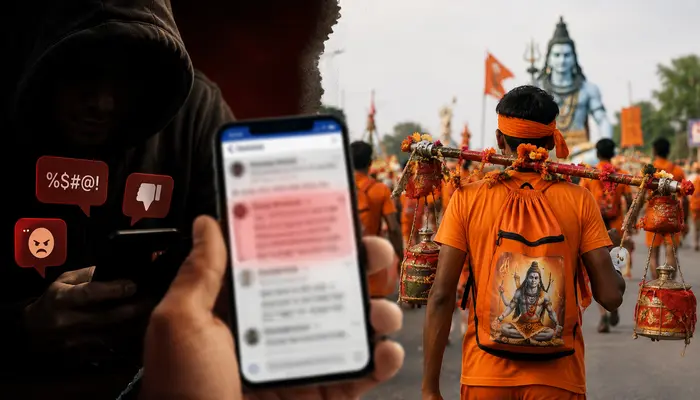
Case Summary
Hindu Kanwar pilgrims were abused through derogatory and objectionable comments by a Muslim man, identified as Tanzeem Chaudhary. The social media post containing abusive and derogatory remarks against Kanwariyas sparked outrage among members of the Hindu community, who demanded strict legal action against the accused for insulting Hindu devotees participating in one of Hinduism's most sacred annual pilgrimages. According to reports, on 8 August 2026, a Facebook post regarding a road accident involving a vehicle carrying Kanwar pilgrims in the Hapur area went viral. While commenting on the post, a youth from a village under the Saidnagli Police Station limits used abusive, obscene, and inflammatory language against the Kanwariyas, prompting widespread anger among Hindus. A complaint was subsequently submitted to the Rahra Police Station, seeking a detailed investigation into the viral comment and the registration of an FIR against the accused. Members of the Hindu community stated that the derogatory remarks were not merely offensive to individual devotees but amounted to an insult to a religious pilgrimage that holds immense significance for millions of Hindus. They warned that such inflammatory language against Hindu devotees had the potential to disturb communal harmony and demanded prompt legal action. They further stated that if no FIR was registered, they would be compelled to stage a protest. Circle Officer Pankaj Kumar Tyagi stated that the matter was under investigation and that appropriate action would be taken based on the findings.
Why it is Hate Crime ?
The primary category selected in this case is: Hate speech against Hindus. The subcategory selected is: Anti-Hindu slurs, mocking faith. Anti-Hindu slurs and the deliberate mocking of the Hindu faith owing to religious animosity involve the usage of derogatory terms, stereotypes, or offensive references to religious practices, symbols, or figures. One of the common anti-Hindu slurs used against Hindus is “cow-worshipper” and “cow piss drinker”. The intention of using this term is to demean and mock Hindus as a group and their religious beliefs since Hindus consider the cow holy. Additionally, some symbols and the slurs attached to them have a historical context that exacerbates the insult, hate, stereotyping, dehumanisation and oppression against Hindus. Cow worship has been used for centuries to denigrate Hindus, insult their faith and oppress Hindus specifically as a religious group. There has been overwhelming documentation about how cow slaughter has been used to persecute Hindus, with cow meat being thrown in temples and places of worship. There has also been overwhelming documentation where cow meat (beef) has been force-fed to Hindus to either forcefully convert them to Islam or denigrate their faith. Apart from cow worship, the Swastika – which holds deep religious significance for the Hindus – has also been misinterpreted and distorted to use as a slur against Hindus. Similarly, the worship of the Shivling has been used by supremacist ideologies and religions to denigrate Hindus owing to religious animosity. Such slurs and denigration stem from inherent animosity and hate towards Hindus and their faith; therefore, it is categorised as hate speech targeted at Hindus specifically owing to their religious identity. This incident has been included in the Hate Crime database because the accused's remarks were directed not at specific individuals involved in the road accident but at Kanwariyas as a whole, thereby targeting an entire community of Hindu devotees participating in a sacred religious pilgrimage. The viral post concerned a particular incident involving a Kanwar vehicle in Hapur. If the accused's grievance had genuinely been with the conduct of those involved in that specific incident, his criticism would naturally have been confined to the individuals concerned. Instead, he used the incident as a pretext to hurl abusive and derogatory remarks at all Kanwar pilgrims, demonstrating that his hostility extended beyond the isolated event and was directed at the broader Hindu religious community. The Kanwar Yatra is one of the largest annual Hindu pilgrimages dedicated to Lord Shiva. During the yatra, millions of devotees, known as Kanwariyas, travel to collect holy water from sacred rivers and carry it in decorated Kanwars to offer it at Shiva temples. For Hindus, the pilgrimage is an act of deep faith, devotion, penance, and spiritual commitment, and Kanwariyas are devotees performing a sacred religious observance. By using a single incident to vilify the entire body of Kanwar pilgrims, the accused transformed what could have been criticism of an individual event into an attack on a recognised symbol of Hindu faith. Such generalisation is a hallmark of prejudice, where the actions of a few are invoked to denigrate an entire religious community. The remarks also targeted the pilgrimage itself. Kanwar Yatra is not merely a public gathering but an act of devotion and penance that holds profound religious significance for millions of Hindus. Abusing Kanwariyas in sweeping terms because they were participating in this pilgrimage amounted to ridiculing and vilifying a sacred Hindu religious practice. The comments therefore went beyond offensive language and reflected hostility towards a religious community and one of its most visible expressions of faith.


Case Status
Arrested


Perpetrators Details
Perpetrators
Muslim Extremists
Perpetrators Range
One Person
Perpetrators Gender
male
 Sources




