Hindu villagers targeted for religious conversion at prayer meeting in Lucknow
 Lucknow, Uttar Pradesh, India
  8 August, 2026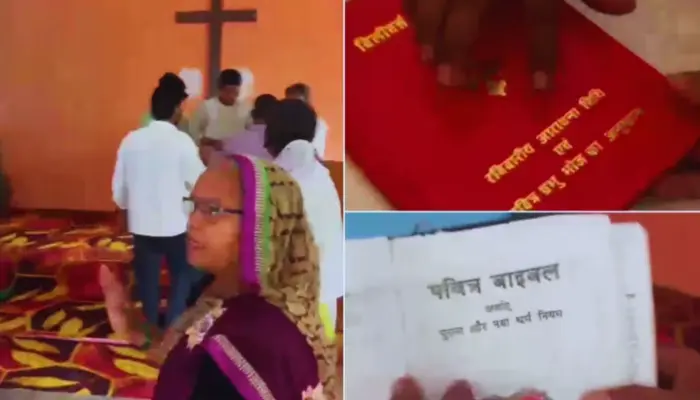
Case Summary
In Lucknow's Mohanlalganj area, Hindu villagers were targeted for religious conversion under the guise of a Changai Sabha (healing prayer meeting) inside a church operating from a residential house. Hindu organisations stated that villagers were being encouraged to convert to Christianity through religious gatherings and inducements. The incident happened on Sunday, August 9, 2026, in Raipur Bhadeshwa Nayakheda village under the Sisendi Police Station limits. According to the Hindu organisations, the church was using prayer meetings as a cover to lure Hindus with inducements and encourage them to convert to Christianity. Acting on the information, the police reached the spot, detained two individuals, including a woman, for questioning, removed several posters displayed at the premises, and initiated an investigation. According to media reports, a prayer meeting began at around 11:30 a.m. on Sunday, August 9, 2026, at the St. Stephen Believers Eastern Church, with approximately 30 to 35 people in attendance. During the gathering, members of Bajrang Dal received information that the premises were being used to conduct religious conversion activities. Members of Bajrang Dal and the Shri Ram Sanatan Seva Samiti reached the location, following which several people present at the premises reportedly fled. A pastor present at the church was identified as Chandrika Prasad, a resident of Daudhan Kheda, Barauli Khalilabad, Lucknow. The activists questioned the pastor about his Hindu name, stating that he had adopted it to conceal his religious identity. According to the report, he was unable to provide a satisfactory explanation. During the search of the premises, they recovered a diary and several Christian religious books. According to the organisations, the diary contained details of inducements allegedly offered to prospective converts, including promises of two goats, construction of a water tank at their residence, and other material benefits in exchange for embracing Christianity. The organisations stated that these entries pointed to a systematic effort to attract economically vulnerable villagers through financial and material incentives. Tension escalated during the protest, after which the police were informed, and a team from the Sisendi outpost reached the spot and brought the situation under control. Police recovered Christian religious books, Christian literature, a diary and other material from the premises. The diary contained entries concerning inducements, including promises of two goats and construction of a water tank. Police examined the names and other details recorded in the diary as part of the investigation. Two individuals, including a woman, were taken into custody for questioning. Police also removed posters displayed on the church premises and seized certain materials from the site before bringing those present to the Mohanlalganj Police Station. During initial questioning, some villagers claimed that they converted on their own free will. The accused Chandrika Prasad and Ramadevi denied converting people to Christianity. During questioning, they claimed that they were Christians while also maintaining that they had not formally converted to Christianity and described themselves as Hindus. The police subsequently began investigating the organisation of the prayer meeting, the identity of those present, and the complaints regarding religious conversion. Inspector Rambabu Singh, Station House Officer of Mohanlalganj Police Station, stated that a special police team had been constituted to investigate the matter and that further legal action would be taken based on the inquiry's findings. According to reports, the church had been operating at the location since 2009–10, with another report stating that Christian religious activities had been taking place there for around 15 years. The premises were described as a church operating inside a house or building, with a large cross erected on its roof. Jeet Yadav, the village head's representative, stated that the building had been constructed on government grazing land and that villagers had previously complained about it. The reports also stated that activities at the site were being conducted under the guidance or supervision of a larger church in Ganiyar village.
Why it is Hate Crime ?
The primary category selected in this case is- Predatory Proselytisation. The subcategory selected is- Conversion/attempts to convert by inducement. Predatory Proselytisation is not just limited to threat, harassment, force and violence, but it also has contours of stealth. In several cases, the Hindu victim is exploited to convert, with non-Hindus taking advantage of their poverty. In such cases, the Hindu victim who is suffering financially is offered monetary benefits, including lucrative offers for jobs, health treatment, education, etc, to induce the victim into changing his/her religion. In such cases, the religious identity of the victim and the aim to disenfranchise him from his faith form the heart of the crime. Also, taking advantage of and exploiting an individual’s economic vulnerabilities is widely acknowledged as exploitation, forms of which are often penalised by law. Such cases therefore are considered religiously motivated hate crimes since the victim’s religious identity forms the very heart of the crime itself. This incident has been categorised under Predatory Proselytisation because it demonstrates a systematic attempt to expand the Christian faith by exploiting the economic vulnerability of poor Hindu families. The objective was not merely to preach Christianity but to induce Hindus to abandon their religion by offering material benefits that many economically disadvantaged families would otherwise struggle to access. The diary recovered from the premises contained entries referring to inducements such as two goats, construction of a household water tank, and other forms of assistance. These are not incidental gifts but incentives directed at economically vulnerable individuals to influence a deeply personal decision regarding religion. When access to basic necessities and livelihood support is made contingent upon embracing another faith, the conversion cannot be viewed as the product of free and informed religious choice. Equally significant is the fact that the conversion efforts were directed specifically at poor Hindus. The accused did not randomly offer welfare or charitable assistance to all sections of society irrespective of religion. Instead, the material inducements were used as a tool to identify, approach, and persuade vulnerable Hindu families to embrace Christianity. The victims were targeted not because of their economic condition alone but because they were economically vulnerable Hindus, making their religious identity central to the entire exercise. The selective targeting of one religious community through financial incentives transforms what might otherwise appear to be charitable activity into a mechanism for religious conversion. The incident also highlights a growing pattern in organised conversion networks, where individuals who have embraced Christianity continue to retain their Hindu names while practising Christianity. This allows these crypto Christians to seamlessly integrate into Hindu communities, gain the confidence of unsuspecting families, and carry out conversion activities without immediately revealing their religious identity. In this case too, the pastor operated under the Hindu name Chandrika Prasad, illustrating how the continued use of a Hindu identity can facilitate access to communities that might otherwise be wary of conversion efforts. This incident reveals an organised pattern of predatory proselytisation in which economic inducements and targeted outreach towards vulnerable Hindus were employed together to facilitate conversion. Such actions stem from inherent hostility towards the victim's professed faith since Abrahamic faiths believe that any non-adherent to the faith is subject to being dehumanised till they convert. This mindset does not merely tolerate the existence of another faith but seeks its erasure or assimilation. As a result, Hindus are often targeted not because of who they are as individuals, but because of their religious identity. The violence, deception, or humiliation inflicted in such cases is therefore not random, but part of a broader ideological hostility toward Hinduism and its symbols, practices, and adherents. Here, too, the predatory actions stemmed from doctrinal animosity towards the Hindu faith, which is why this case is being documented as a religiously motivated hate crime.


Case Status
Complaint registered


Perpetrators Details
Perpetrators
Christian Extremists
Perpetrators Range
From 2 To 5
Perpetrators Gender
both
 Sources




