Hindu journalist threatened for reporting on murder of Hindu priest by Muslim man amid rising anti-Hindu hostility in Bangladesh
 Cox's Bazar District, Bangladesh
  8 August, 2026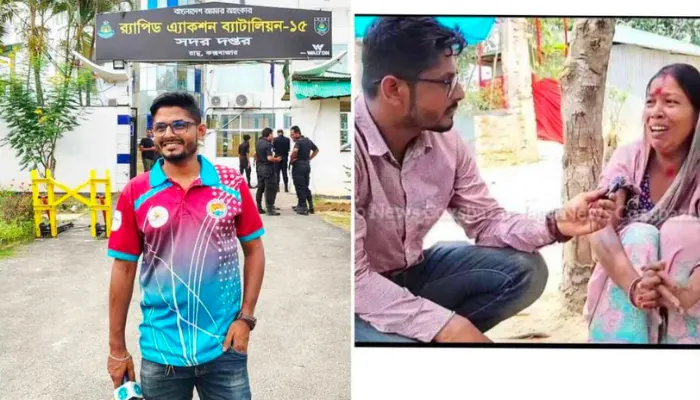
Case Summary
In Cox's Bazar, Bangladesh, a Hindu journalist, Antar De Vishal, faced threats of legal action and physical attack after publishing investigative reports and follow-up coverage on the murder of Hindu priest Nayan Das. Antar De Vishal, a journalist with Cox's Bazar Jago News, stated that the CJN team, led by Editor M.R. Mahabub, had continuously covered Nayan Das's murder from the day after his disappearance and continued publishing investigative and follow-up reports on the case. Nearly three months after the murder, police arrested Abdur Rahim in connection with the case. Following the arrest, Antar De Vishal went live on CJN's official Facebook page to report the development. Shortly afterwards, he began receiving threatening phone calls from different numbers in response to his continued reporting on the murder. Notably, the Hinduphobia Tracker previously wrote a report covering the murder of Nayan Das. He was a 35-year-old Hindu priest at the Sri Sri Sarvajanin Shiv Kali Temple in Khurushkul, Sadar Upazila, Cox's Bazar, and was abducted from the temple premises at around 9:00 pm on 19 April 2026. His family stated that unidentified individuals lured him away from the temple that night, after which he did not return. Following an extensive search, the family filed a police complaint on 20 April 2026. On 22 April 2026, while residents were searching the mountainous area behind the temple, they found Nayan Das's body hanging from a tree in the remote East Hamzar Deil area of Khurushkul. His body was partially burnt, and a scarf was wrapped around his neck. Police arrived at the location, recovered the body and began investigating his disappearance and death. During the investigation, police identified a Muslim man, Abdur Rahim, as the accused and arrested him in a special operation in the Hamzar Deil area on 7 August 2026. Police interrogated him before producing him before the Cox's Bazar District Court on 8 August 2026, where the court ordered that he be remanded to judicial custody. Following Abdur Rahim's arrest, Antar De Vishal continued reporting on the case. Thereafter, he began receiving threats demanding that he delete previously published news reports and stop publishing any further news or statements regarding Nayan Das's murder. The callers introduced themselves as being associated with a force or the administration and threatened him, including with legal action and physical attack, if he continued his reporting. Antar De Vishal subsequently disclosed the threats through a video circulated on social media and through a Facebook post. He stated that the threats would not stop him or the CJN team from reporting on criminal activities and that a journalist's responsibility was to present information and facts to the public without yielding to fear or pressure. He further stated that evidence relating to the threats had been preserved and that legal action would be initiated before the appropriate authorities. Antar De Vishal further stated that he faced difficulty in filing a General Diary at the police station because of concerns for his safety. He questioned how journalists could work freely when they faced threats of lawsuits and physical attacks for publishing news. He also stated that if reporting on criminals was treated as an offence, he and his colleagues would continue doing so. He further requested the cooperation of the relevant authorities and members of the public to ensure that the truth could be established without obstruction. Meanwhile, the threats against the journalist prompted concern among members of the local community and social media users, who called for an impartial investigation, the journalist's protection, the identification of those responsible for the threats, and appropriate legal action against them. No official statement from the concerned administration or law enforcement agencies had been issued regarding the identity of the individuals making the threats, and the matter remained under investigation. At the time of writing this report, it remained unclear whether the callers were actually connected to government or law enforcement agencies or had falsely invoked such identities to intimidate the journalist. The escalation of violence against Hindus and their places of worship in Bangladesh has unfolded in three distinct phases: first, following the ouster of Sheikh Hasina’s government in August 2024; second, after the death of Sharif Osman Bin Hadi in December 2025; and third, in the immediate aftermath of the 13th National Parliamentary Election 2026. Following the ouster of Sheikh Hasina, multiple reports documented attacks on Hindu homes, temples, and religious institutions, alongside intimidation campaigns, arson, and mob assaults targeting minority neighbourhoods. The Hinduphobia tracker has recorded 336 such incidents against the Hindu minority, underscoring the scale and persistence of anti-Hindu violence during this period. A further escalation occurred following the death of Sharif Osman Bin Hadi, a Muslim political activist and student leader known for his anti-Hindu and anti-India rhetoric. Hadi had been involved in political unrest after the fall of the Hasina government and was killed in Dhaka on 18 December 2025 during clashes. In the aftermath of his death, Hindu communities were blamed and subsequently targeted in retaliatory violence. Hindu homes were selectively set ablaze in multiple localities, forcing families to flee and leaving many displaced. The attacks appeared patterned rather than sporadic, with Muslim mobs focusing on Hindu neighbourhoods, properties, and religious symbols. Among the victims was Dipu Chandra Das, who was lynched to death and his body was set ablaze by a Muslim mob over false blasphemy allegations. The Hinduphobia tracker documented 51 incidents of anti-Hindu violence in the period following Hadi’s death alone. Such incidents underscore the vulnerability of the Hindu minority amid rising communal hostility and the weaponisation of religious accusations. Reports further indicated that posters and written materials calling for the extermination of Hindus were displayed in public spaces, signalling an alarming normalisation of genocidal rhetoric. When combined with acts of arson, vandalism, assault, and targeted intimidation, these developments suggest a coordinated environment of hostility aimed at terrorising the Hindu community and reinforcing majoritarian dominance. The third phase of violence was unleashed after the 13th National Parliamentary Election 2026. Within days of the announcement of results, Hindu families in districts such as Noakhali, Rangpur, Nilphamari, Sylhet, Thakurgaon, and Dinajpur reported coordinated attacks involving arson, looting, assault, and vandalism of temples and homes. In several instances, Hindu homes were selectively targeted, looted, and families were threatened with displacement.
Why it is Hate Crime ?
The primary category for this case is: Attack not resulting in death. The subcategory for this case is: Attacked for opposing radicals or trying to save the victim. In several cases, Hindus are attacked for opposing religiously motivated crimes being committed against a fellow Hindu or simply for voicing an opinion opposing radical elements, who either have in the past or continue to persecute Hindus. In such cases, the initial attack against the victim, against which the Hindu was trying to defend the victim, would also need to be classified as a religiously motivated hate crime. Since the initial crime itself was religiously motivated and the subsequent crime of attempting to save the victim or speaking against the radical elements ends up inviting a violent attack, it would also be classified as a religiously motivated hate crime under this category. In this case, the threats against Hindu journalist Antar De Vishal arose directly from his continued reporting on the murder of Hindu priest Nayan Das, in which Muslim man Abdur Rahim was arrested. The intimidation targeted a Hindu journalist who persistently documented the killing of a Hindu religious figure and continued exposing developments in the investigation despite pressure to remain silent. The demands that he delete previously published reports and cease further coverage demonstrated a clear attempt to suppress scrutiny of a crime committed against a member of the Hindu community and prevent further public attention to the case. The fact that this incident occurred amid the continuing persecution of Hindus in Bangladesh further reinforced its religious dimension. During periods of sustained and widespread violence targeting Hindus on the basis of their religious identity, the Hinduphobia Tracker applies a contextual presumption that attacks against Hindu victims are likely to be faith-based, even where the immediate report does not explicitly record a religious motive. In such circumstances, the normalisation of anti-Hindu hostility and the systematic dehumanisation of the Hindu minority create an environment in which religiously motivated crimes are committed without perpetrators expressly articulating their motives. For the purpose of documenting the 2024–2026 ethnic cleansing of Hindus in Bangladesh and the continuing persecution of the Hindu community following the political exile of Sheikh Hasina, the death of Sharif Osman Hadi, and the 2026 Thirteenth National Parliamentary Election, the Hinduphobia Tracker records such incidents as likely religiously motivated at the time of documentation. Should any case subsequently be established through a credible investigation or judicial finding to have arisen from motives unrelated to religious hostility, its classification will be reviewed and revised or removed from the hate crime database as appropriate. The religious dimension of the present incident extended beyond the identity of the murdered Hindu priest. Antar De Vishal himself was Hindu and was threatened while documenting violence committed against another Hindu. The intimidation was therefore directed not merely at a journalist performing his professional duties, but at a Hindu voice that persistently drew public attention to the killing of a Hindu religious leader. By attempting to silence his reporting, the perpetrators sought to discourage the continued documentation of anti-Hindu violence and limit public awareness of the crime. The perpetrators did not seek to prevent journalism in general; rather, they specifically targeted reporting on the murder of a Hindu priest. Their demands were confined to deleting previously published reports on Nayan Das's murder and preventing any further publication concerning the case. This established a direct connection between the threats and the exposure of violence against a Hindu victim. The intimidation therefore reflected hostility towards efforts to investigate, document and publicise violence committed against the Hindu community. The incident also formed part of the broader pattern of anti-Hindu persecution in Bangladesh, where Hindus have repeatedly faced targeted killings, attacks on places of worship, intimidation, discrimination and other forms of religiously motivated violence. Within this context, the murder of Nayan Das and the subsequent threats against the Hindu journalist who continued reporting on the case constituted successive manifestations of the same pattern of hostility directed at the Hindu community. The intimidation of Antar De Vishal extended the impact of the original crime by targeting the individual who refused to abandon efforts to expose and document the killing of a Hindu priest. The murder of Nayan Das has already been documented by the Hinduphobia Tracker as a separate incident. The present case arose directly from Antar De Vishal's continued reporting on that murder and should therefore be treated as a related incident. The threats were intended not only to intimidate a Hindu journalist but also to obstruct continued public scrutiny of the killing of a Hindu priest, thereby extending the impact of the original anti-Hindu crime beyond the murder itself and discouraging further reporting on violence against the Hindu community. Overall, since this incident satisfies the parameters for a religiously motivated hate crime, it is being included in the Hinduphobia Tracker's hate crime database. Disclaimer: The Hinduphobia Tracker records an incident date based on when a victim's ordeal begins or when the crime occurs, rather than when the incident is reported by the media. However, in the present case, the available media reports did not specify the exact date on which the Hindu journalist's ordeal and the threats against him began. Hence, 9 August 2026, the date on which the case was reported by the media, has been selected as the indicative incident date for documentation purposes only.
Victim Details
Total Victim
1
Deceased
0
Gender
- Male 1
- Female 0
- Third Gender 0
- Unknown 0
Caste
- SC/ST 0
- OBC 0
- General 0
- Unknown 1
Age Group
- Minor 0
- Adult 1
- Senior Citizen 0
- Unknown 0


Case Status
Unknown


Perpetrators Details
Perpetrators
Unknown
Perpetrators Range
Unknown
Perpetrators Gender
unknown
 Sources




