Hindu woman subjected to prolonged blackmail, sexual violence and intimidation by Muslim man amidst ongoing persecution of Hindus in Bangladesh
 Satkhira District, Bangladesh
  5 August, 2026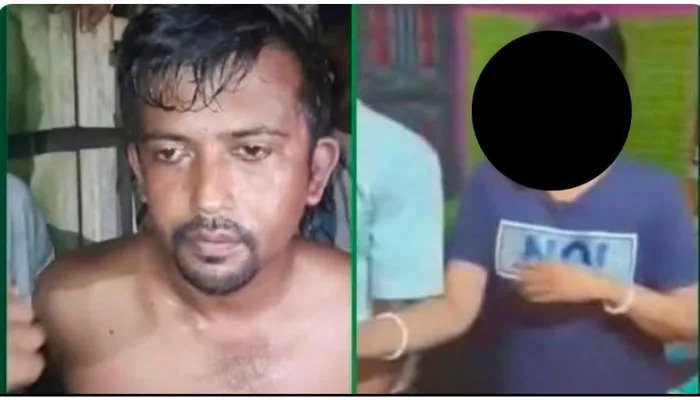
Case Summary
In the Chandipur area of Shyamnagar upazila, Satkhira, Bangladesh, a Hindu woman was subjected to prolonged blackmail and sexual exploitation by a Muslim man named Abdul Mannan (Rana). The incident came to light when residents found the accused with the Hindu woman inside her bedroom and surrounded the house. They broke open the locked door and detained the accused. A video subsequently circulated on social media showing the accused being detained from the woman’s bedroom, with the video showing him without clothes. The incident created widespread commotion in the area. The Hindu woman revealed that Abdul had been blackmailing her in various ways and making indecent proposals to her for a prolonged period. On the day of the incident, the accused forcibly entered her house on the pretext of giving her a lift to the market and attempted to sexually exploit her. Residents, who had previously noticed his frequent late-night visits to the victim's house, came to know about the accused's whereabouts and intervened. Following the discovery, residents surrounded the house and brought the accused out of the room. Local BNP leaders Abul Kashem and Abu Hamza stated that residents broke open the door on the night of 6 August 2026, after which the accused was taken outside and humiliated for his actions. They also stated that the woman and Mannan had known each other previously. The matter was brought to the attention of Fariduzzaman Babu, acting convener of the Shyamnagar Pourashava Jubo Dal, who stated that organisational action would be taken against Mannan. Local political sources also stated that Mannan had previously faced organisational action from the Pourashava Jubo Dal on July 7, 2025, after entering another person's business establishment and demanding extortion. Shyamnagar Police Station subsequently took up the Hindu woman’s case. The Officer-in-Charge stated that the incident had circulated on social media, but no written complaint had yet been received at the station. Before police arrived, members of both families attempted to settle the matter and moved the individuals away from the location. Police later reached the scene, brought the situation under control and took the relevant individuals to the police station for legal procedures and further investigation. Attempts to obtain Mannan’s statement were unsuccessful as his mobile phone was switched off. The escalation of violence against Hindus and their places of worship in Bangladesh has unfolded in three distinct phases: first, following the ouster of Sheikh Hasina’s government in August 2024; second, after the death of Sharif Osman Bin Hadi in December 2025; and third, in the immediate aftermath of the 13th National Parliamentary Election 2026. Following the ouster of Sheikh Hasina, multiple reports documented attacks on Hindu homes, temples, and religious institutions, alongside intimidation campaigns, arson, and mob assaults targeting minority neighbourhoods. The Hinduphobia tracker has recorded 336 such incidents against the Hindu minority, underscoring the scale and persistence of anti-Hindu violence during this period. A further escalation occurred following the death of Sharif Osman Bin Hadi, a Muslim political activist and student leader known for his anti-Hindu and anti-India rhetoric. Hadi had been involved in political unrest after the fall of the Hasina government and was killed in Dhaka on 18 December 2025 during clashes. In the aftermath of his death, Hindu communities were blamed and subsequently targeted in retaliatory violence. Hindu homes were selectively set ablaze in multiple localities, forcing families to flee and leaving many displaced. The attacks appeared patterned rather than sporadic, with Muslim mobs focusing on Hindu neighbourhoods, properties, and religious symbols. Among the victims was Dipu Chandra Das, who was lynched to death and his body was set ablaze by a Muslim mob over false blasphemy allegations. The Hinduphobia tracker documented 51 incidents of anti-Hindu violence in the period following Hadi’s death alone. Such incidents underscore the vulnerability of the Hindu minority amid rising communal hostility and the weaponisation of religious accusations. Reports further indicated that posters and written materials calling for the extermination of Hindus were displayed in public spaces, signalling an alarming normalisation of genocidal rhetoric. When combined with acts of arson, vandalism, assault, and targeted intimidation, these developments suggest a coordinated environment of hostility aimed at terrorising the Hindu community and reinforcing majoritarian dominance. The third phase of violence was unleashed after the 13th National Parliamentary Election 2026. Within days of the announcement of results, Hindu families in districts such as Noakhali, Rangpur, Nilphamari, Sylhet, Thakurgaon, and Dinajpur reported coordinated attacks involving arson, looting, assault, and vandalism of temples and homes. In several instances, Hindu homes were selectively targeted, looted, and families were threatened with displacement.
Why it is Hate Crime ?
The primary category for this case is: Attack not resulting in death. The subcategory for this case is: Attacked for Hindu identity. In several cases, Hindus are attacked merely for their Hindu identity without any perceived provocation. A classic example of this category of religiously motivated hate crime is a murder in 2016. 7 ISIS terrorists were convicted for shooting a school principal in Kanpur because they got ‘triggered’ seeing the Kalava on his wrist and the tilak that he had put. In this, the Hindu victim had offered no provocation except for his Hindu religious identity. The motivation for the murder was purely religious, driven by religious supremacy. Such cases where Hindus are targeted merely for their religious identity would be documented as a hate crime under this category. This case involved a Hindu woman in Chandipur, Shyamnagar upazila, Satkhira, Bangladesh, who was subjected to prolonged blackmail, indecent proposals and an attempted sexual assault by a Muslim man identified as Abdul Mannan (Rana). The accused had been blackmailing and harassing her for a prolonged period. On 6 August 2026, he \entered her home on the pretext of giving her a lift to the market and attempted to sexually exploit her. Residents subsequently discovered the accused inside the woman’s bedroom and intervened. While some may argue that the case details do not explicitly state a religious motive, the broader context of anti‑Hindu persecution in Bangladesh remains relevant for classification. During periods of sustained violence against Hindus based on religious identity, the Hinduphobia Tracker applies a contextual presumption that attacks on Hindu victims are likely faith‑targeted, even when the immediate report does not record a specific religious marker. In such periods, the normalisation of religious hostility and the dehumanisation of minorities can contribute to crimes against them without perpetrators openly stating a motive. For the purpose of documenting the 2024 to 2026 ethnic cleansing of Hindus in Bangladesh and the subsequent persecution after the political exile of Sheikh Hasina, the death of Sharif Osman Hadi, and the 13th National Parliamentary Election 2026, the Hinduphobia Tracker records such incidents as likely religiously motivated at the point of entry. If any case is later established through credible investigation or court findings to stem from motivations other than religious hostility, it will be revised or removed from the hate crime database. The nature of the incident further demonstrated the vulnerability of the Hindu woman. She was \subjected to prolonged blackmail and indecent advances before the accused entered her home and attempted to sexually exploit her. The fact that the conduct took place inside the victim’s residence, together with the repeated visits by the accused, reflected a sustained pattern of intimidation and harassment rather than an isolated encounter. Such conduct can create fear and insecurity among Hindu women and families, particularly within a minority community already facing heightened concerns regarding their safety and social protection. It is further relevant that the victim was subjected to blackmail before the attempted sexual assault. The use of intimidation and repeated unwanted approaches to exert control over a Hindu woman represented an abuse of her vulnerability. Although the immediate report did not establish that the accused's actions were explicitly motivated by religious hostility, the incident nevertheless occurred against the backdrop of continuing insecurity experienced by Hindus in Bangladesh, where Hindu women and girls have repeatedly been documented as particularly vulnerable to sexual violence, intimidation and coercion. For the purpose of documenting the wider pattern of persecution and insecurity affecting Hindus in Bangladesh during the 2024–2026 period, the Hinduphobia Tracker records cases such as this where the available circumstances indicate probable religious targeting in the context of the broader anti-Hindu environment. This classification remains subject to revision if subsequent police investigation, court proceedings or other credible evidence establishes that the incident was motivated solely by factors unrelated to the victim’s Hindu identity. The blackmail, harassment and attempted sexual exploitation of the Hindu woman therefore warranted documentation within the Tracker as a probable instance of religiously motivated targeting. The classification was based not on the mere religious identity of the parties in isolation, but on the combination of the victim's Hindu minority status, the nature and prolonged character of the alleged abuse, her vulnerability as a Hindu woman, and the wider pattern of insecurity and hostility faced by Hindus in Bangladesh. Any subsequent evidence establishing a non-religious motive should be taken into account and the classification revised accordingly.
Victim Details
Total Victim
1
Deceased
0
Gender
- Male 0
- Female 1
- Third Gender 0
- Unknown 0
Caste
- SC/ST 0
- OBC 0
- General 0
- Unknown 1
Age Group
- Minor 0
- Adult 1
- Senior Citizen 0
- Unknown 0


Case Status
Unknown


Perpetrators Details
Perpetrators
Muslim Extremists
Perpetrators Range
One Person
Perpetrators Gender
male
 Sources




