Hindu family, including minor girl, targeted in Christian conversion attempt; accused conducted Bible sessions and denigrated Hindu deities
 Bhayandar, Maharashtra, India
  3 August, 2026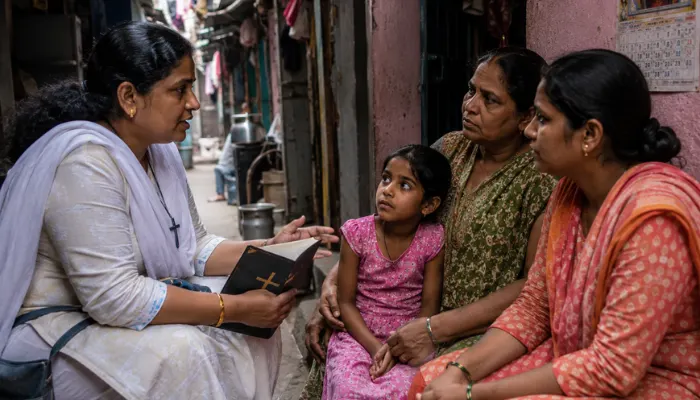
Case Summary
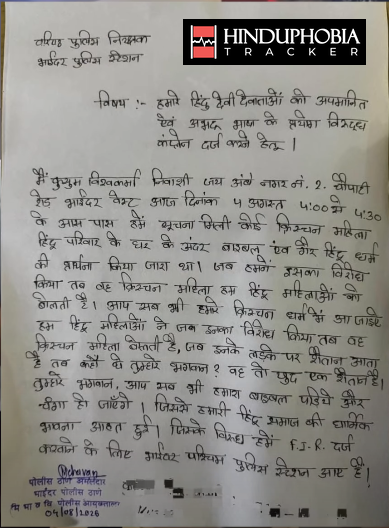
In Mira Bhayandar, Maharashtra, a Hindu family, including a minor girl, was targeted for religious conversion by a Christian missionary woman. The accused conducted Bible studies in the name of curing the minor, while simultaneously, performing supposed black magic (or some chemicals or drugs) to sicken a minor Hindu girl. According to the complaint, a Christian missionary woman repeatedly visited the Hindu family's home, conducted Bible study sessions, and attempted to persuade the family to embrace Christianity. She performed supposed black magic on the minor Hindu girl, causing her health to deteriorate, and told the family that if they read the Bible every day, she would recover and become healthy ("Agar tum humara Bible padhoge toh chaange ho jaoge"). The family stated that these repeated visits and conversations were aimed at influencing and brainwashing them into abandoning their Hindu faith. The incident was captured on video. The complaint further stated that the Christian missionary woman denigrated Hinduism and Hindu deities while attempting to influence the family. She referred to Hindu deities as "monsters" and made objectionable remarks about Hindu beliefs. It also emerged that Christian missionaries had been visiting the homes of several Hindu families in Bhayandar West and conducting Bible study sessions. After members of the Hindu community objected to these activities, the accused repeated objectionable remarks about Hindu deities. A written complaint was submitted to the Bhayandar West Police Station seeking registration of an FIR against the accused woman. The complainant requested legal action for attempting to convert a Hindu family, performing black magic on a minor Hindu girl, conducting repeated Bible study sessions to influence the family, denigrating Hindu deities, and making objectionable remarks against Hinduism. The Sakal Hindu Samaj stated that if the Bhayandar West Police failed to register an FIR, it would launch a protest against the Christian missionaries. Hinduphobia Tracker obtained a copy of the written complaint submitted to the Bhayandar West Police Station, and the video of the incident has also gone viral on social media. At the time of documenting this case, the Hinduphobia Tracker team attempted to contact the Bhayandar West Police Station for an official response but was unable to establish contact. The investigation into the matter was ongoing.
Case Images
Why it is Hate Crime ?
The primary category for this case is: Predatory Proselytisation. The first subcategory for this case is: Proselytisation by grooming, brainwashing, manipulation or subtle indoctrination, with the tertiary category being - Conversion of minor. Religious brainwashing essentially means the often subtle and forcible indoctrination to induce someone to give up their religious beliefs to accept contrasting regimented ideas. Religious grooming or brainwashing also involves propaganda and manipulation. It involves the systematic effort, driven by religious malice and indoctrination, to persuade “non-believers’ to accept allegiance, command, or doctrine to and of a contrasting faith. Cases of such grooming or brainwashing are far more nuanced than direct threats, coercion, inducement and violence. In such cases, it is often seen that there is repeated, subtle and continual manipulation of the victim to induce disaffection towards their own faith and acceptance of the contrasting faith of the perpetrator. While subtle indoctrination is widely acknowledged as predatory, an element which is often understated in such conversions or the attempts of such conversion is the role of loyalty and trust which might develop between the perpetrator and the victim. Fiduciary relationships are often abused to affect such religious conversion. For example, an educator transmitting religious doctrine of a competing faith to a Hindu student. The Hindu student is likely to accept what the teacher is transmitting owing to the existence of the fiduciary relationship. The exploitation of the fiduciary relationship to religiously indoctrinate victims would also be included in this category. Since the underlying animosity towards the victim’s faith forms the basis of predatory proselytisation, such cases are considered religiously motivated hate crimes. The next subcategory for this case is: Attempting to convert/ converting by denigrating Hinduism. In several cases, Hindus are converted, or an attempt is made to convert Hindus by denigrating their faith, Hinduism. In such cases, the Hindus associate with the non-Hindu perpetrators often by choice and then the attempt to convert them by insulting their faith, showing the faith down, etc begins. An example of this would be a non-Hindu gathering where the Hindus are attending the gathering of their own free will. However, once they attend the gathering, there is an explicit attempt to convert them by abusing their faith and hailing the faith of the perpetrator. The denigration of the Hindu faith is often based on misrepresentation of the Hindu faith, its doctrine and scriptures and insults to espoused traditions, if not blatant lies about Hindu beliefs and ways. Such conversions or attempts at conversions are driven by animosity towards the Hindu faith and are therefore documented as religiously motivated hate crimes. This case involved a Christian missionary woman repeatedly approaching a Hindu family and attempting to persuade them to convert to Christianity while targeting their minor Hindu daughter. The accused caused her health to deteriorate, and then told the family that if they read the Bible every day, they would recover and become healthy. Along with this, she insulted Hindu deities during her interactions with the family. These actions formed one continuous attempt to move the Hindu family away from its faith and towards Christianity. The alleged use of black magic or other means to make the minor Hindu girl sick, followed by presenting Bible reading as the means to cure her, formed a manipulative grooming tactic aimed at influencing the girl and her family towards Christianity. By creating or worsening the child's vulnerability and then portraying Christian religious practices as the solution to her illness, the accused sought to establish dependence and trust before encouraging the family to embrace Christianity. This pattern of allegedly causing distress and then presenting herself and her religious beliefs as the means of relief constituted a form of psychological and religious manipulation designed to make the Hindu family more receptive to conversion. It involves a systematic effort, driven by religious malice and sustained indoctrination, to persuade followers of another faith to abandon their existing religious beliefs and embrace a different religion. Such attempts are often carried out through repeated emotional influence, psychological manipulation, and the gradual weakening of a person's faith rather than through direct threats or physical force. Instead of relying on overt coercion, these methods seek to create trust, exploit vulnerability, undermine confidence in the victim's own religion, and gradually encourage acceptance of the perpetrator's religious beliefs. This pattern of sustained manipulation reflects a deliberate attempt to replace one religious identity with another through continuous influence rather than informed and independent choice. It is further important to note here that girl was a minor, which means the element of consent and genuine change of conscience was missing ab initio. Minors, due to their young age and lack of maturity, are particularly vulnerable to manipulation and coercion. They may not have the ability to fully understand the implications of converting to another religion, and the Christian perpetrator purposely targeted and exploited this vulnerability of the victim. Since this case exemplifies the use of coercion and manipulation to achieve religious conversion, it is a blatant act of religious hate. Proselytisation is not limited to threats or financial inducements. It also includes exploiting fear, emotional distress, and personal vulnerability to influence religious beliefs. In this case, the illness of a minor Hindu girl became the centre of the conversion attempt. Instead of respecting the family's Hindu faith, the accused presented Christianity as the solution to their suffering and encouraged them to rely on the Bible for healing. Using the hardship of a Hindu family to persuade them to adopt another religion reflected a deliberate effort to influence their religious identity through manipulation. The conversion attempt was accompanied by the denigration of Hinduism. The Christian missionary woman referred to Hindu deities as "monsters" and made objectionable remarks about Hindu beliefs. This goes beyond religious debate or proselytisation; it constitutes an act of incitement and insult directed at the core beliefs of the Hindu community. Such remarks are designed to demean and undermine the faith of Hindus and intend to create an inferiority complex in the minds of the victims against their own faith. This fosters an environment of hostility and disrespect towards the Hindu community and Hindu deities. These acts of insulting Hinduism stem from Christian theology, which harbours disdain and hatred for polytheistic faiths, and which categorises Hindus as ‘polytheists’, thereby fostering hatred against them. Such actions make the religiously motivated nature of the crime even more evident. The Christian faith places a strong emphasis on proselytisation. In pursuit of religious conversion, Christian missionaries may employ methods such as psychological influence, sustained religious indoctrination, and the denigration of other faiths to persuade individuals to embrace Christianity. Such efforts are directed at weakening a person's attachment to their existing religion and encouraging acceptance of Christian beliefs. These are not isolated acts of religious expression but deliberate attempts to replace one religious identity with another through sustained influence. The repeated visits to the family's home, the Bible study sessions, the promise that reading the Bible would cure illness, the use of black magic on the minor Hindu girl, and the insulting remarks about Hindu deities together formed a sustained pattern of religious influence. These actions worked towards a single objective: brainwashing the Hindu family to abandon Hinduism and embrace Christianity through continuous psychological and religious pressure. Therefore, this case qualifies for inclusion under the categories of predatory proselytisation through grooming and manipulation and attempting conversion by denigrating Hinduism.


Case Status
Complaint filed


Perpetrators Details
Perpetrators
Christian Extremists
Perpetrators Range
One Person
Perpetrators Gender
female
 Sources




